Disclosure: Some of the links you’ll encounter are unique links. Click and buy something and I’ll earn some money, at zero expense to you. Thank you!
Solid ruthenium metal is safe and non-toxic for humans, making it suitable for jewelry and bullion creation.
However, certain ruthenium compounds are highly dangerous. Ruthenium tetroxide is extremely toxic when inhaled, causing severe respiratory problems and respiratory failure.
Standard ruthenium used in commercial products contains seven stable, non-radioactive isotopes. Radioactive ruthenium isotopes (like Ruthenium-106 and -103) exist in nuclear facilities and can be released during accidents, increasing cancer risk through radiation exposure.
Ruthenium allergies differ from toxicity, causing only skin reactions in sensitive individuals. Overall, everyday ruthenium products pose no health risks to the general population.
Is Ruthenium Toxic to Humans? Or is it Safe?
Ruthenium in its solid, metallic form is 100% safe and non-toxic to humans. Solid ruthenium is used in jewelry design and precious metals bullion creation and this is the ruthenium form you’ll encounter in your day-to-day life.
Some ruthenium forms are highly toxic to humans, but these are the compounds you’ll encounter only in a chemist lab, and not in regular life.
Toxic and unsafe ruthenium substances are listed below.
- Ruthenium Tetroxide. This golden-yellow, volatile solid (or solution) reacts violently with organic materials and is extremely toxic via inhalation. It irritates the respiratory tract and causes eye damage and respiratory failure.
- Radioisotopes. The radionuclide ruthenium is a fission product from nuclear fuel cycles and atmospheric testing. Exposure to this ruthenium’s radioactive form increases cancer risk due to radiation. I’ll talk more about this when I talk about ruthenium’s radioactive properties.

Is Ruthenium Toxicity the Same as Ruthenium Allergies?
No, ruthenium toxicity and ruthenium allergies aren’t the same thing. They’re different.
Ruthenium allergies stem from this metal touching the skin and they arise in people sensitive to ruthenium and other metals from the PGM group (platinum metal group).
Ruthenium allergy symptoms include skin irritation, redness, itching, or rashes where the metal touched the skin. The point is that ruthenium allergy manifests on the skin and doesn’t cause symptoms in the rest of the body.
Most people aren’t allergic to ruthenium, but everyone can be poisoned by ruthenium tetroxide.
Ruthenium toxicity via inhaling ruthenium tetroxide manifests as severe problems with the lungs, coughing, sneezing and potentially even respiratory failure.
Check this out next after reading my ruthenium toxicity and radioactivity guide. Especially important if you’re an American with a keen interest in the economy and a worry about the future.
Is Ruthenium Jewelry Toxic and Dangerous to Humans or Not?
No, ruthenium jewelry isn’t toxic and dangerous to humans. Instead, it’s 100% safe to wear over an extended time period (for the lifetime of the jewelry).
Ruthenium jewelry is made from solid ruthenium, a chemically inert precious metal that can’t poison humans. The worse you can get is a rash from a piece of ruthenium jewelry, but being allergic to ruthenium is different than being poisoned by it.
For example, there’s a new type of vermeil called black ruthenium vermeil. It’s made from a base of sterling silver and coating made of black ruthenium.
This type of ruthenium vermeil jewelry is safe and non-toxic to the person who wears it.

Solid ruthenium is chemically inert and non-toxic to human body. This means you can eat a small ruthenium ring and nothing bad would happen to you. The jewelry would simply pass through your digestive system and come out good as new.
I don’t recommend you ingest ruthenium in any form as the jewelry can get stuck in somewhere in your bowl and you’d need surgery to get it out.
Check this out next after reading my ruthenium toxicity and radioactivity guide. Especially important if you’re an American with a keen interest in the economy and a worry about the future.
Is Ruthenium Bullion Toxic to Humans Or Not?
No, ruthenium bullion isn’t toxic to humans. Ruthenium bullion is safe because it’s made from solid ruthenium, a chemically inert form of this precious metal.
This means it’s 100% safe to touch and handle ruthenium coins and bars, provided you’re not allergic to this noble metal.
Check this out next after reading my ruthenium toxicity and radioactivity guide. Especially important if you’re an American with a keen interest in the economy and a worry about the future.
Is Ruthenium Radioactive? Is it Dangerous to Humans?
No, ruthenium isn’t radioactive. It’s a safe precious metal (consisting of seven stable isotopes) used across various industries to great results.
However, some ruthenium isotopes are radioactive and unsafe to handle without proper equipment.
Some of ruthenium’s radioactive isotopes are listed below (Ruthenium has 34 known radioactive isotopes).
- Ruthenium-106. A radioactive isotope with a half-life of about 373.59 days. It has been detected in the atmosphere following accidents at nuclear facilities and is also used in brachytherapy for certain cancers.
- Ruthenium-103. Another radioactive isotope with a half-life of 39.26 days.
- Ruthenium-97. This isotope has a half-life of about 2.9 days and is primarily used in medical imaging due to its favorable gamma energy emissions.
These radioactive ruthenium isotopes have both medical applications and are considered a “troublesome nuclide” in nuclear waste processing due to their radioactivity.

Radioactive ruthenium isotopes exist either in a tightly controlled environment far from the general population, or are released during nuclear accidents (so extremely rarely).
In 2017 there’s was a covered up nuclear accident in Russia that released a cloud of radioactive ruthenium isotopes into the atmosphere. This radioactive ruthenium cloud didn’t hurt anyone and gradually dispersed into the atmosphere.

Bottom line is that you shouldn’t worry about ruthenium’s radioactivity. Any solid ruthenium, whether in jewelry of bullion form, is 100% safe, non-toxic and non-radioactive.
Check this out next after reading my ruthenium toxicity and radioactivity guide. Especially important if you’re an American with a keen interest in the economy and a worry about the future.
Is Ruthenium More Toxic and Radioactive to Humans Than Osmium?
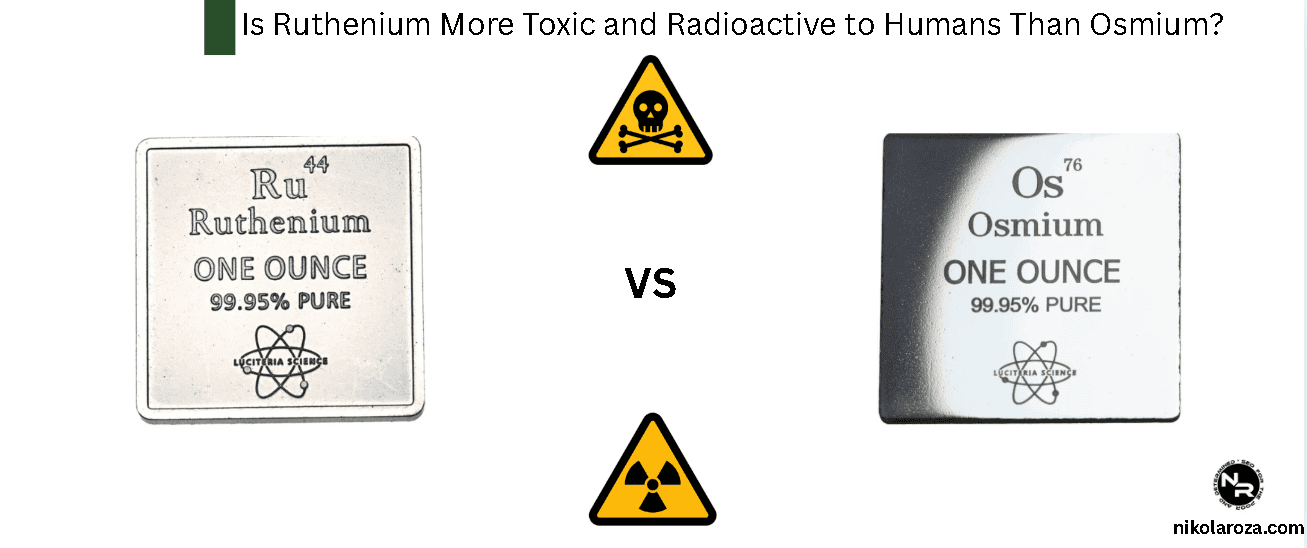
Both ruthenium and osmium share similar safety profiles in solid form, but differ in their toxic compounds and radioactivity.
Solid ruthenium is safe and non-toxic, but ruthenium tetroxide is extremely dangerous when inhaled, causing severe respiratory damage. Standard ruthenium contains seven stable, non-radioactive isotopes, though radioactive isotopes like Ruthenium-106 and Ruthenium-103 exist in nuclear facilities.
Osmium is similarly safe in solid form, but powdered osmium reacts with oxygen to form osmium tetroxide, which causes burning, coughing, pulmonary edema, and death. Osmium is technically radioactive, but its primary isotopes are effectively stable.
Overall, neither ruthenium nor osmium is clearly more dangerous. Both pose risks only through specific compounds or isotopes, not in everyday use.
References:
- Ruthenium Tetroxide- https://en.wikipedia.org/wiki/Ruthenium_tetroxide
- Black Ruthenium Vermeil- https://www.explorerealm.com/collections/sterling-silver-black-ruthenium
- Isotopes of ruthenium- https://en.wikipedia.org/wiki/Isotopes_of_ruthenium
- A massive atmospheric release of radioactive ruthenium in 2017 was likely caused by an undeclared nuclear accident at the Mayak Production Association in southern Russia according to a comprehensive analysis of European radionuclide monitoring data.- https://www.reddit.com/r/science/comments/cjn3v2/a_massive_atmospheric_release_of_radioactive/

Nikola Roza
Nikola Roza is the owner of Nikola Roza- Everything You Can Learn About Precious Metals. He writes for people who love precious metals and jewelry and who're interested in adding gold, silver platinum and palladium to their Gold IRAs and retirement portfolios.