Disclosure: Some of the links you’ll encounter are affiliate links. If you click and buy something, I’ll get a commission. If you’re reading a review of some precious metals company, please understand that some of the links are affiliate links that help me pay my bills and write about what I love with no extra cost to you. Thank you!
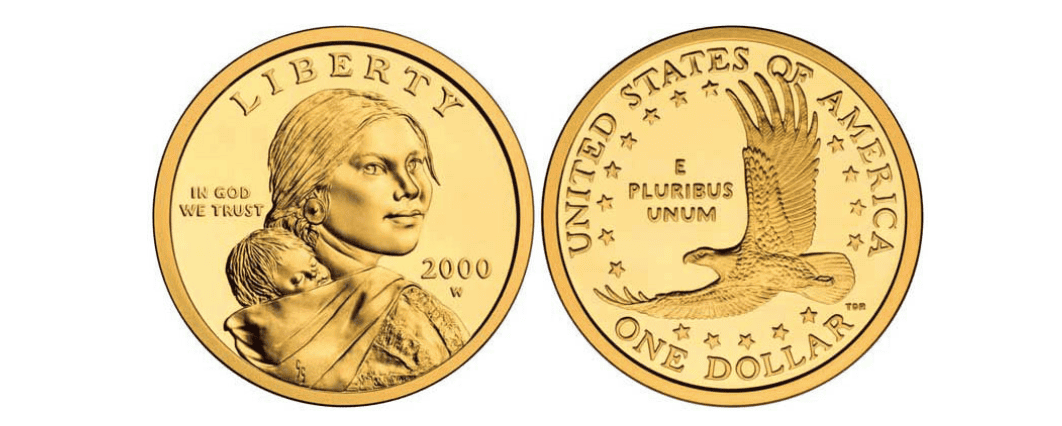
The Sacagawea dollar, first minted in 2000, features Sacagawea and her son on the front.
Despite its golden color, it’s made of manganese brass over copper, not gold.
The coin proved unpopular, leading to decreased production. Most are worth only $1, but rare varieties are highly valuable.
Notable examples include the “Cheerios Dollar” with enhanced tail feathers (5,500 distributed in cereal boxes) and minting errors like the “Wounded Eagle” variety.
While standard coins contain no precious metals, a few genuine gold versions exist: 39 experimental 22-karat coins from 1999 (12 went to space) and a limited 2025 24-karat anniversary edition.
Learn more right below!
Take this quiz and test your knowledge on Sacagawea coins. Read my guide first for your best results.
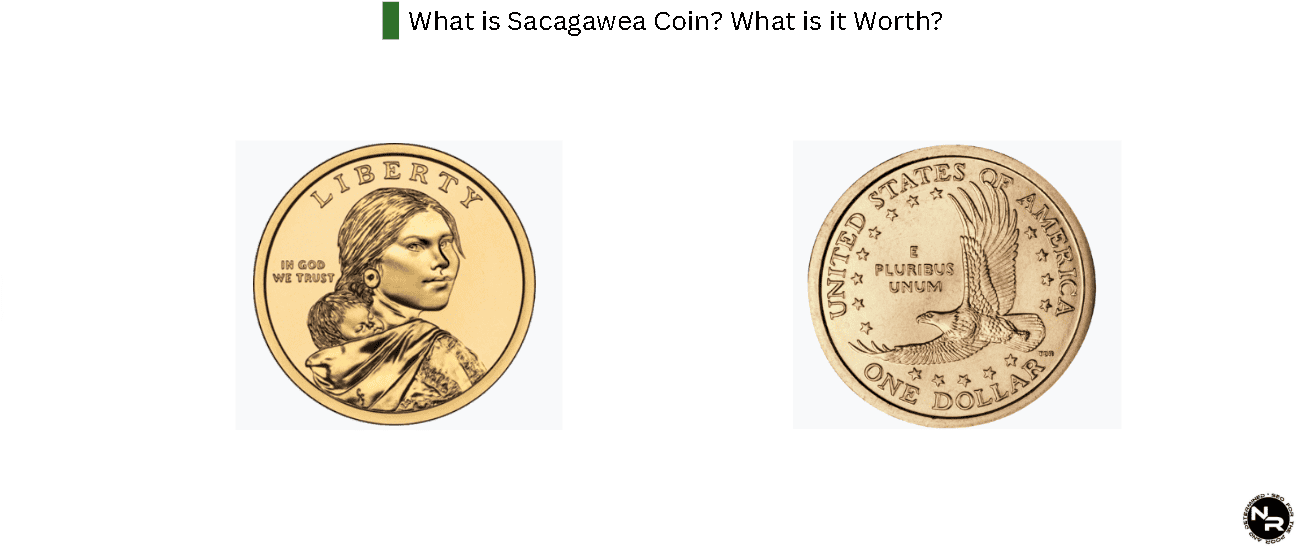
What is Sacagawea Coin?
The Sacagawea coin is a U.S. dollar coin featuring Sacagawea and her son on the obverse (front) and initially a flying eagle on the reverse (back).
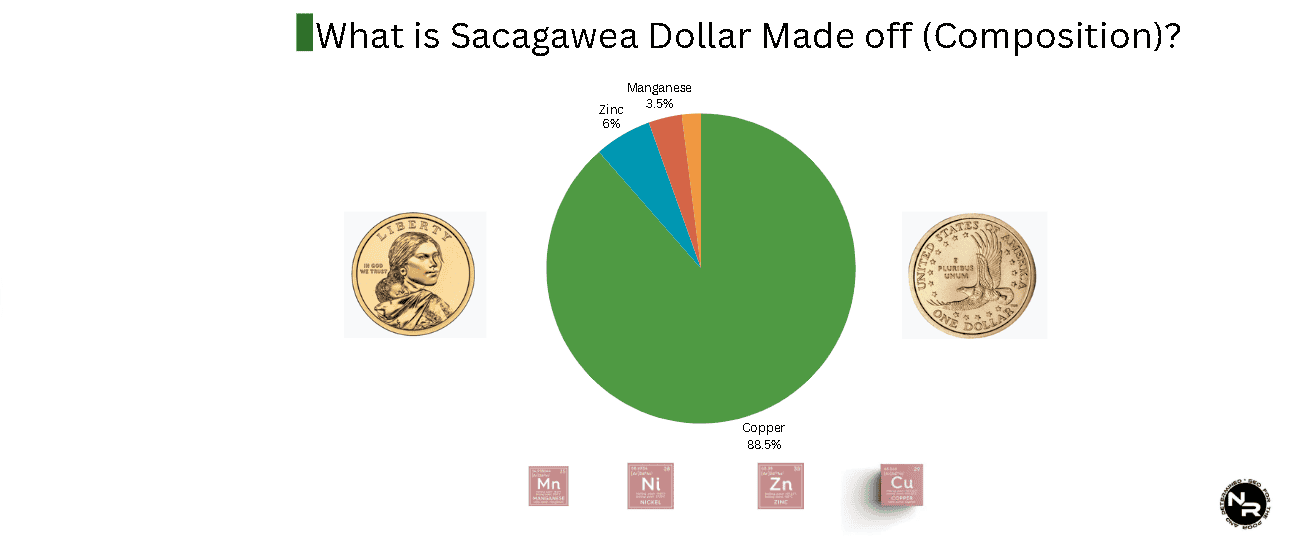
This coin looks like it’s made of gold, but it isn’t. Sacagawea coins sport a bright golden color due to a manganese brass outer layer covering the pure copper core.
Note: the exact composition of the coin is 88.5% copper, 6% zinc, 3.5% manganese, and 2% nickel
Sacagawea coin was first minted in 2000 as part of the initiative to introduce new dollar coins into the circulation.
Up until 2009 the reverse was a flying eagle surrounded by 17 stars (stars represent the number of states in the Union at the time of the Lewis and Clark expedition).
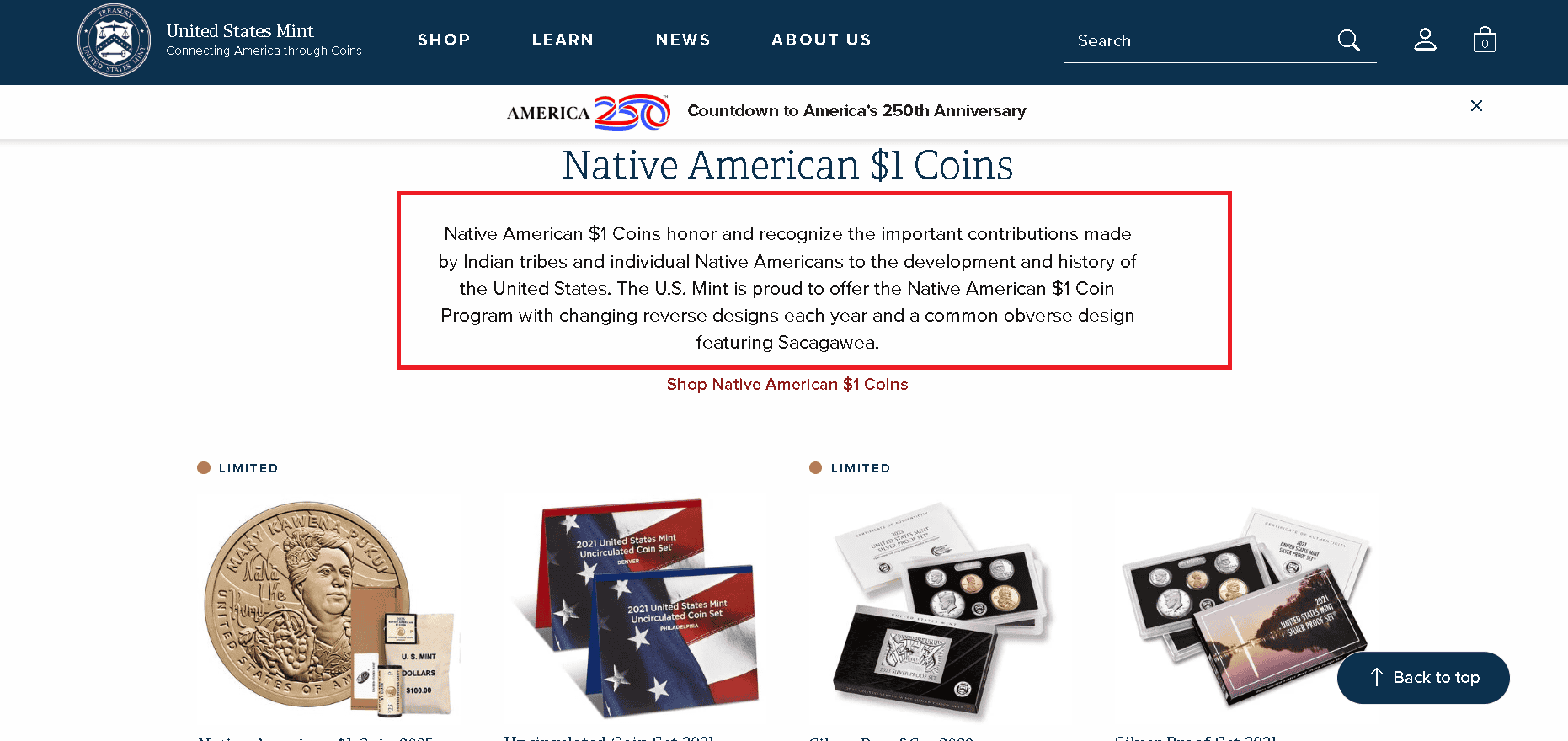
But, since 2009, the reverse has changed annually to honor Native American history and culture, and the series is now known as the Native American $1 Coin Program.
| Design | Profile of Sacagawea with her child, Jean Baptiste Charbonneau |
| Year of issue: | 2000-Present |
| Mint marks | P (Philadelphia) D (Denver) S (San Francisco) W (West Point, special strikings only) |
| Mintage (Circulation): | High: 767,140,000 (2000-P); Low: 1,260,000 (Various) |
| Mintage (Proof): | High: 4,047,904 (2000-S); Low: 745,815 (2021-S) |
| Alloy: | Outer layers of .770 copper, .12 zinc, .070 manganese, and .040 nickel (manganese-brass); inner core of pure copper |
| Weight: | 8.1 g |
| Diameter: | 26.5 mm |
| Edge: | Plain (2000-08); Lettered (2009-Present): Date, Mintmark, E PLURIBUS UNUM |
| OBV Designer: | Glenna Goodacre |
| REV Designer: | Thomas D. Rogers, Sr. (2000-2008); Various (2009-) |
Where is Sacagawea Coin Minted?
The Sacagawea dollar coin is minted at the Philadelphia (P), Denver (D), and San Francisco (S) U.S. Mint facilities.
Sacagawea coins for circulation are produced in Philadelphia and Denver, whereas proof coins for investors and collectors are made in San Francisco.
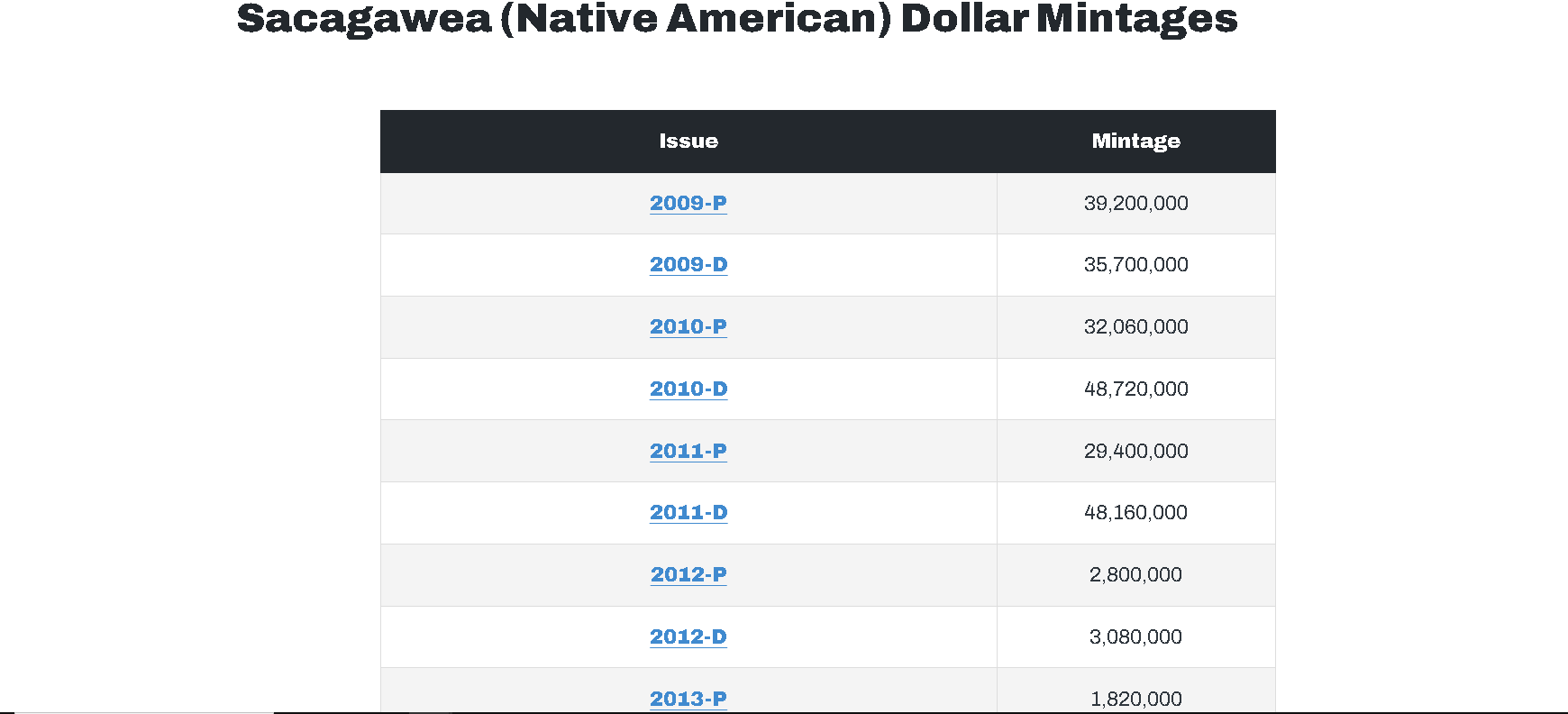
| Issue | Mintage |
|---|---|
| 2000-P | 767,140,000 |
| 2000-D | 518,916,000 |
| 2001-P | 62,468,000 |
| 2001-D | 70,939,500 |
| 2002-P | 3,865,610 |
| 2002-D | 3,732,000 |
| 2003-P | 3,080,000 |
| 2003-D | 3,080,000 |
| 2004-P | 2,660,000 |
| 2004-D | 2,660,000 |
| 2005-P | 2,520,000 |
| 2005-D | 2,520,000 |
| 2006-P | 4,900,000 |
| 2006-D | 2,800,000 |
| 2007-P | 3,640,000 |
| 2007-D | 3,920,000 |
| 2008-P | 1,820,000 |
| 2008-D | 1,820,000 |
Note: the Sacagawea dollar series was discontinued in 2008 and was in 2009 replaced with the Native American $1 Coin Program.
In these coins Sacagawea and her infant son are still featured on the obverse but the reverse of these coins changes each year to honor Native Americans and their contribution to US’s history.
Did West Point Mint Any Sacagawea Coin?
Yes, the West Point Mint has minted Sacagawea coins in the past, though most Sacagawea coins were minted in three other U.S. mints (San Francisco, Philadelphia and Denver).
Sacagawea coins minted at West Point carry the classic “W” stamp and these coins are considered more valuable that other Sacagawea coins given that they’re far fewer of them on the market.
Notable Sacagawea coins minted at West Point are:
- 2015 Enhanced Uncirculated. Sacagawea dollars with a “W” mintmark were included in the 2015 Native American Coin and Currency Set.
- 25th Anniversary Gold Proof Coin (minted in 2025). A special 24K gold proof coin celebrating the 25th anniversary of the Sacagawea dollar was minted at the West Point Mint and sold by the United States Mint.
- 2000-W Experimental Gold Dollars. A small number of experimental 22-karat gold dollar coins with a “W” mintmark were struck in 1999, with the “W” indicating a future public release that didn’t happen.
- 2000-W Burnished Proof Sacagawea Dollar. A small group of experimental burnished proof coins, with only about five confirmed examples, were also struck at the West Point Mint.
What is the Value of Sacagawea Dollar? What’s its Worth?
Most Sacagawea dollars are worth their face value of $1, but rare errors or uncirculated examples are worth significantly more.
The price of these rare coins ranges from a few dollars to thousands or even millions for extremely rare mistakes.
The Cheerios dollar and the Speared Eagle variety are some of the more valuable common varieties (you can even find them on eBay) and truly unique coins go for tens of thousands of dollars on auctions.
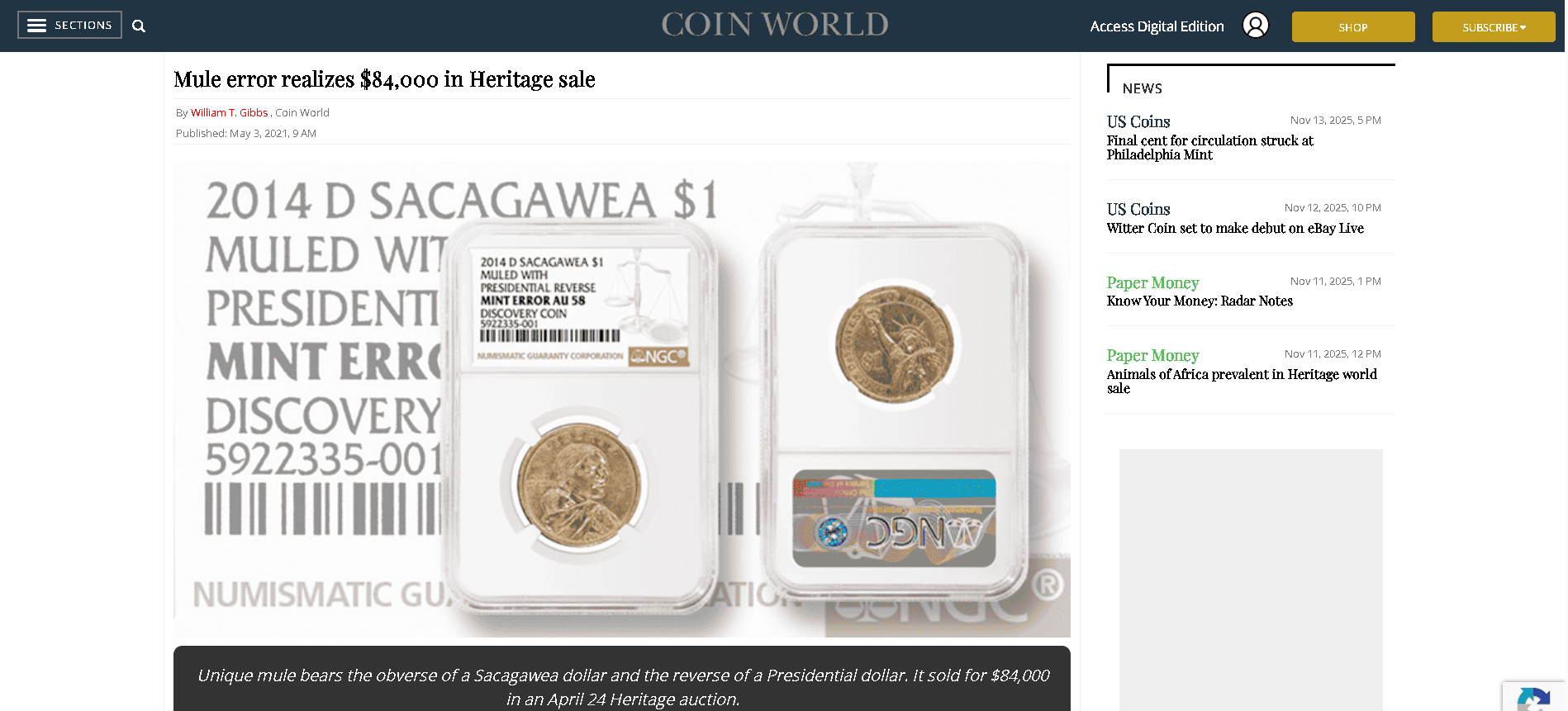
For example, a unique 2014 mule with a Sacagawea dollar obverse and Presidential dollar reverse sold for $84,000 on April 24 in Heritage Auctions’ Platinum Night auction in Dallas, in its first appearance in the marketplace.
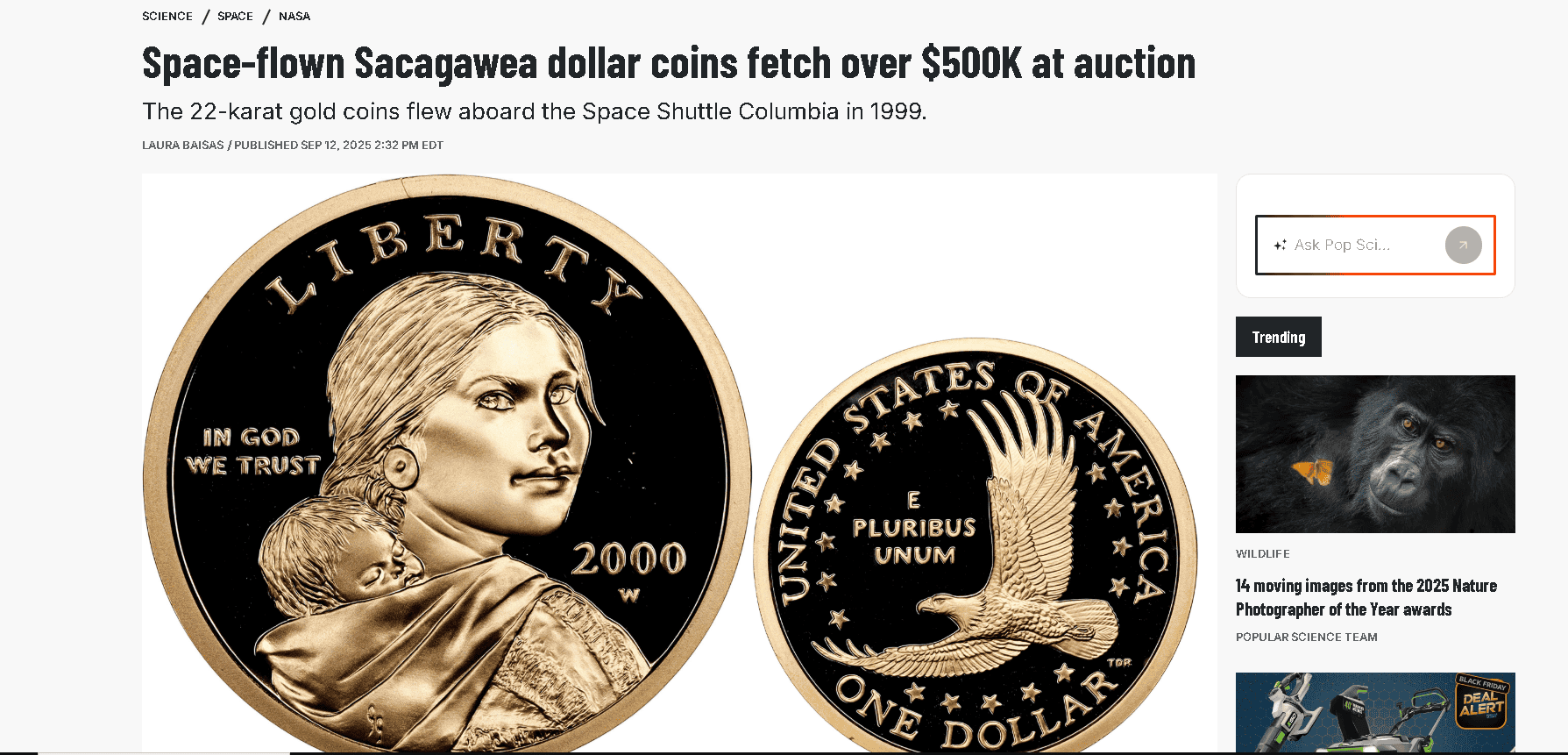
And this Space-flown extremely rare Sacagawea dollar coin fetched over $500k in a recent auction (happened in 2025).
The above examples are out of reach for most people.
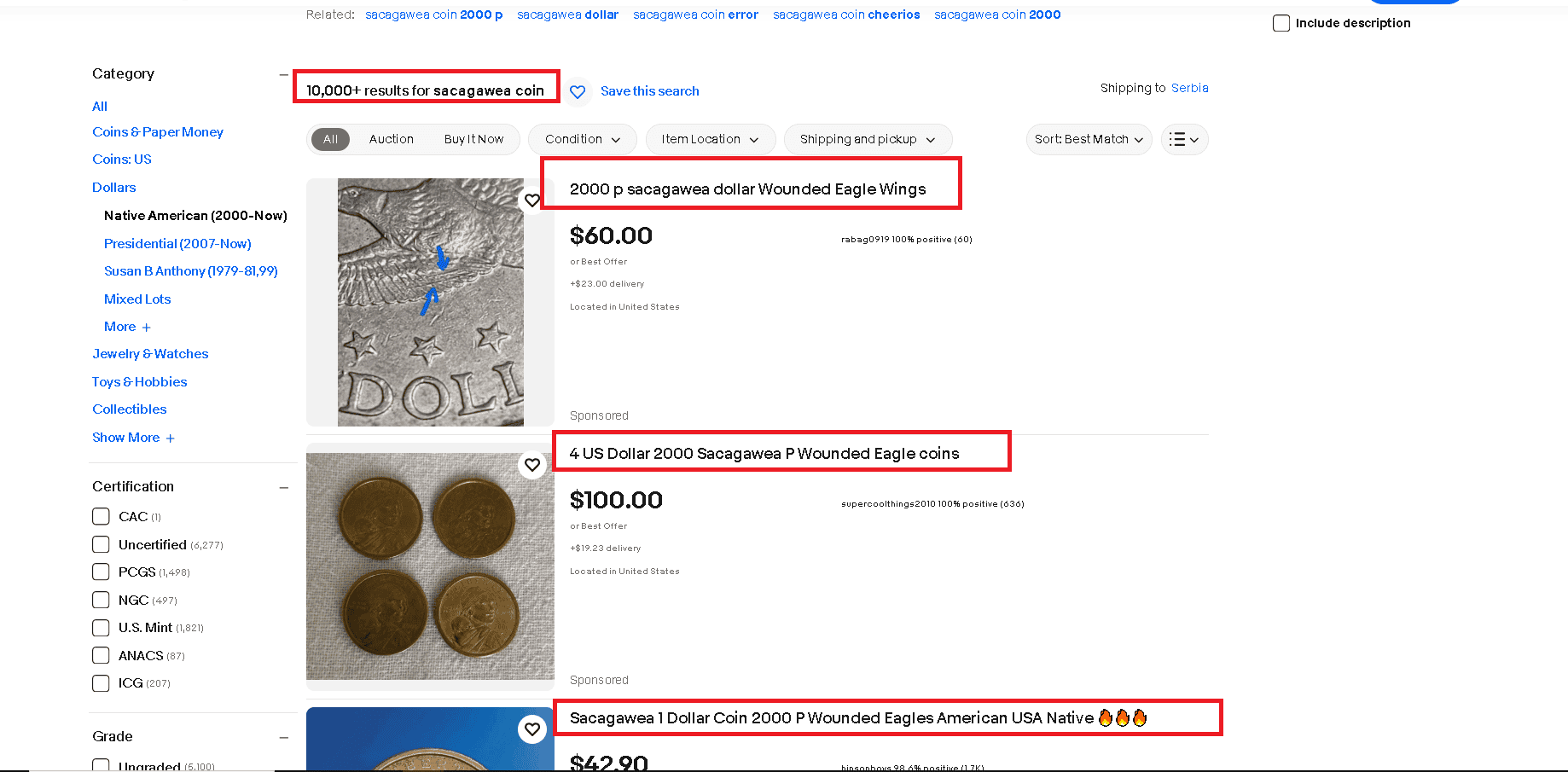
But you can find many rare Sacagawea coins sold on eBay, with the most popular variants being Cheerios Sacagawea coins and coins with wounded eagle mint mark error.
What is a Sacagawea Cheerios Dollar?
A Sacagawea “Cheerios Dollar” is a rare 2000-dated Sacagawea dollar coin that was inserted into 5,500 boxes of Cheerios cereal as part of a promotional campaign by the U.S. Mint.
Cheerios Sacajawea dollars are extra valuable to collectors. It’s because many of these coins were struck with a special reverse die that has more detailed eagle tail feathers compared to the standard dollars.
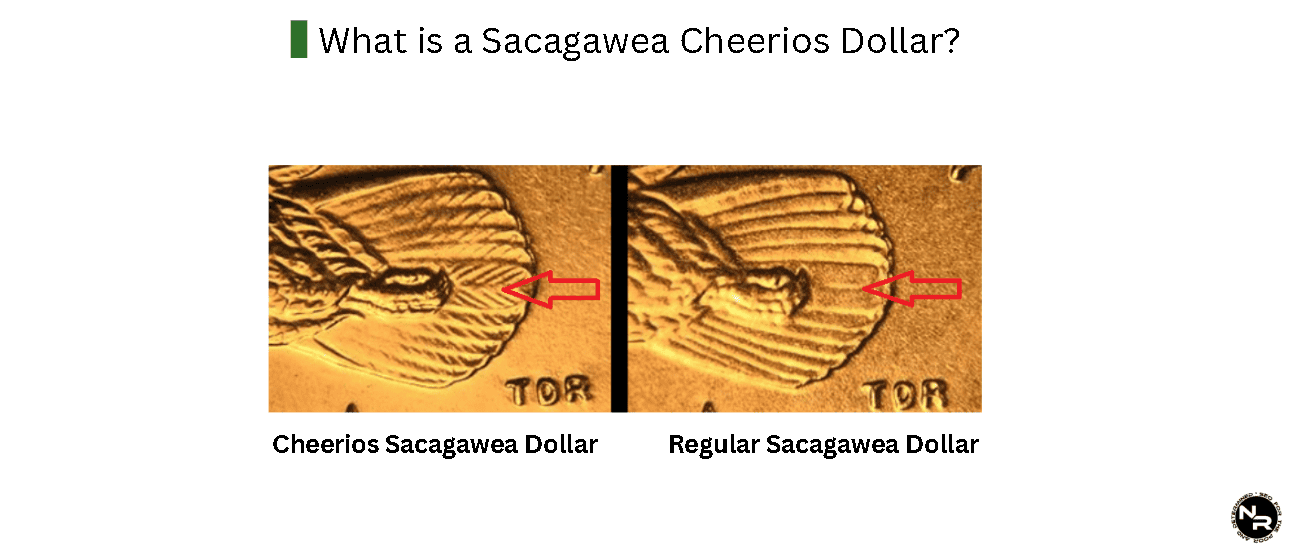
The main difference between regular and Cheerios Sacagawea Dollar coins is the detail of the eagle’s tail feathers on the reverse side.
The “Cheerios” dollar has more detailed, bolder lines representing the feathers, while the regular Sacagawea dollar has a less detailed, lighter tail.
Take a look below.
| Feature | Cheerios Sacagawea Dollar | Regular Sacagawea Dollar |
|---|---|---|
| Tail Feathers | Bolder, more detailed lines, with a visible central line on the shafts. | Smoother, less detailed, and lighter tail feathers, because the central lines were removed to make the design look more realistic. |
| Origin | A 2000-P Sacagawea dollar given away in a limited promotion by General Mills in some boxes of Cheerios. | The standard 2000 Sacagawea dollar minted for general circulation. |
| Minting | Struck using an early die that had more detail. | Struck using a modified die that was lighter and less detailed on the tail feathers. |
Note: Notice how every year fewer and fewer Sacagawea coins were minted?
It’s because Sacagawea coin series wasn’t popular with the American public and many coins were never put in circulation due to low popularity, demand and large remaining stockpiles.
Note: officially, 5,500 coins were randomly distributed in Cheerios boxes.
However, experts believe the number of examples with the enhanced tail feathers is significantly lower, as some coins were possibly replaced or were not struck with the prototype die.
What are Some Sacagawea Coin Minting Errors?
Some of the Sacagawea coin minting errors are:
- Washington Quarter/Sacagawea Dollar Mule;
- Sacagawea Dollar/Presidential Dollar Mule;
- 2000-P Wounded Eagle Variety.
Washington Quarter/Sacagawea Dollar Mule

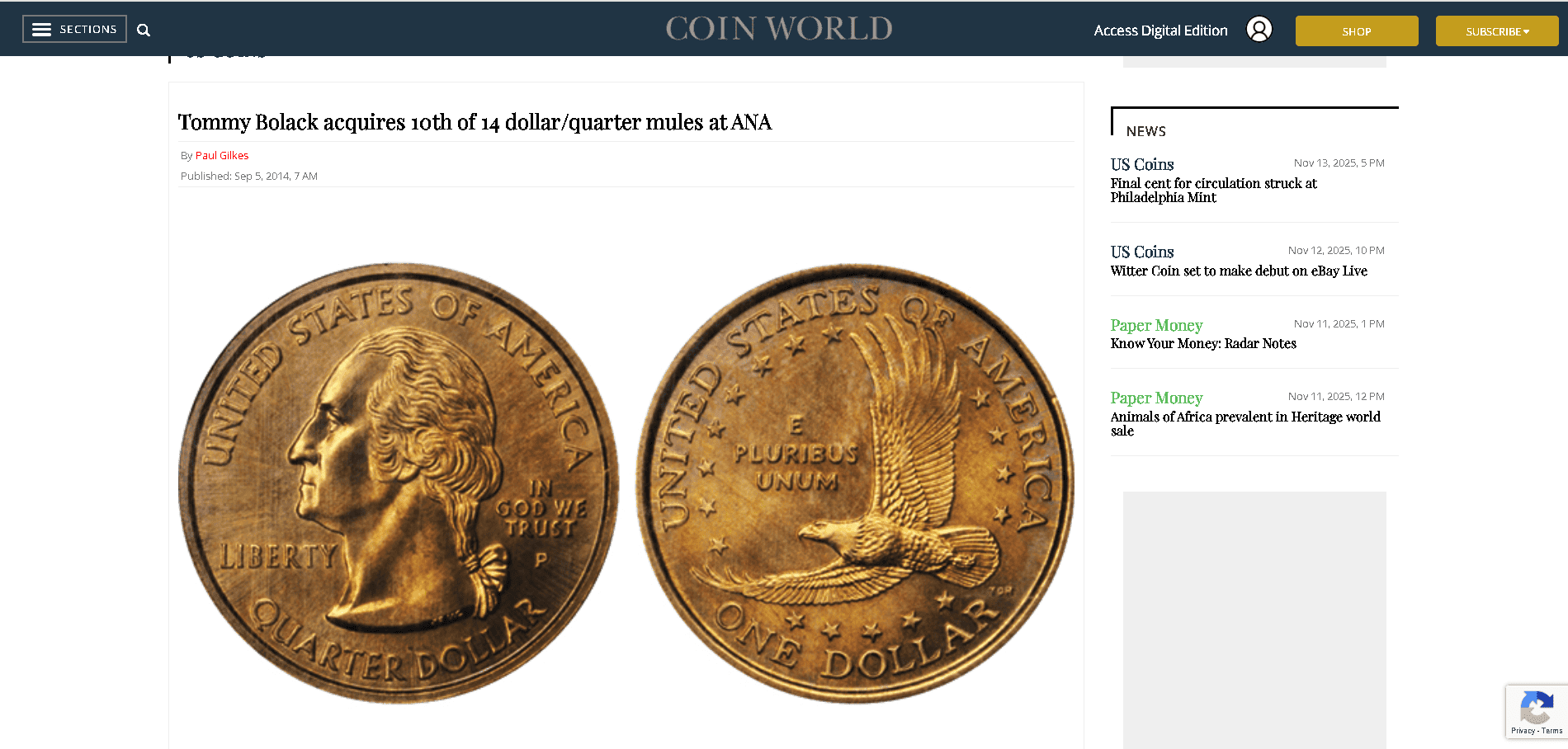
The Washington Quarter/Sacagawea Dollar mule was discovered in May 2000 by collector Frank Wallis of Mountain View, Arkansas.
It’s a coin that features the obverse of a State Quarter and the reverse of the Sacajawea Dollar.
In August 2000, the Mint conducted an extensive internal investigation, destroying several thousand coins and charging two Mint workers with removing mule errors and selling them for thousands of dollars.
Today, a New Mexico collector Tommy Bolack owns most (10 out of the 14 known pieces) of the double-denomination 2000-P Sacagawea dollar/Statehood quarter dollar mule error coins.
Note: because they’re so rare these error coins are sometimes called the “Holy Grail of U.S. Mint errors”.
Sacagawea Dollar/Presidential Dollar Mule
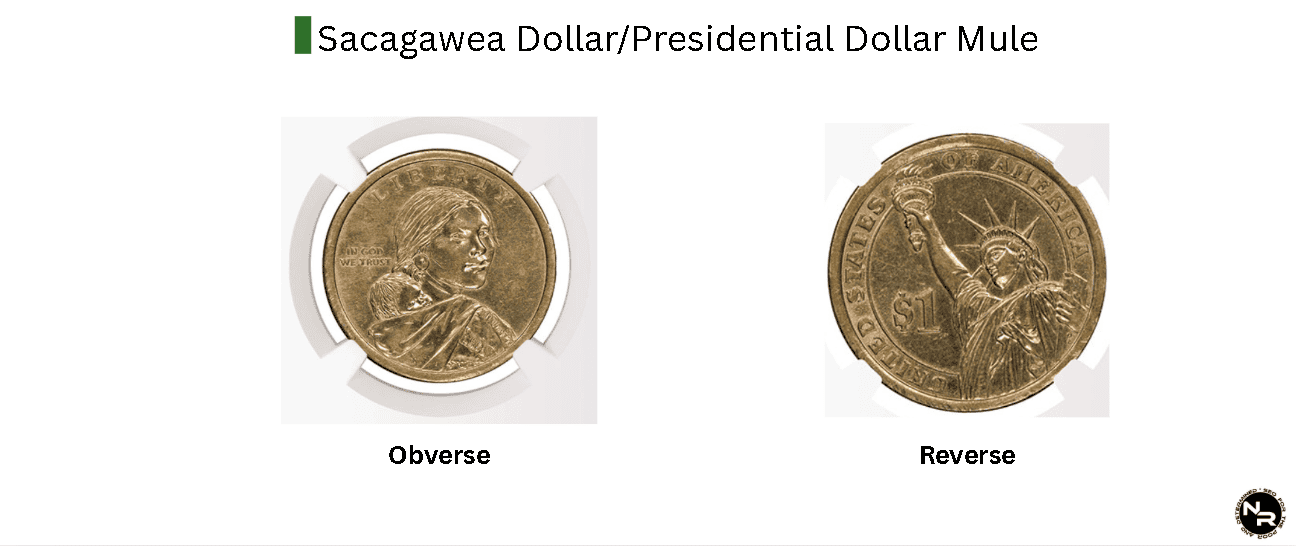
A Sacagawea Dollar/Presidential Dollar Mule is a rare and valuable U.S. mint error coin from 2014.
It features a Sacagawea Dollar obverse and a Presidential Dollar reverse and was struck at the Denver Mint.
This rare error gained national attention upon its discovery given the popularity of the Sacagawea dollar/State quarter mule I described above.
The coin sold for $84,000 on April 24, 2021, at Heritage Auctions’ Platinum Night sale in Dallas, Texas.
To date, no other example of this error has been reported.
See below what it looks like.
2000-P Wounded Eagle Variety
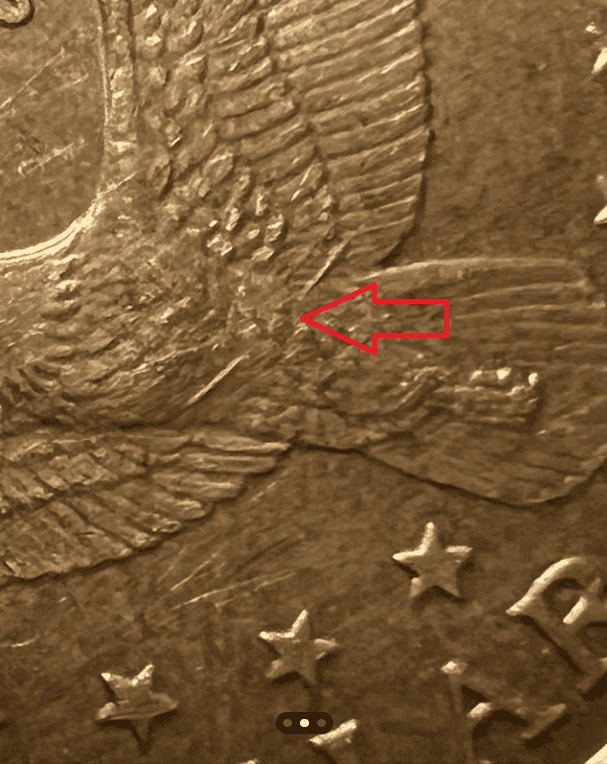
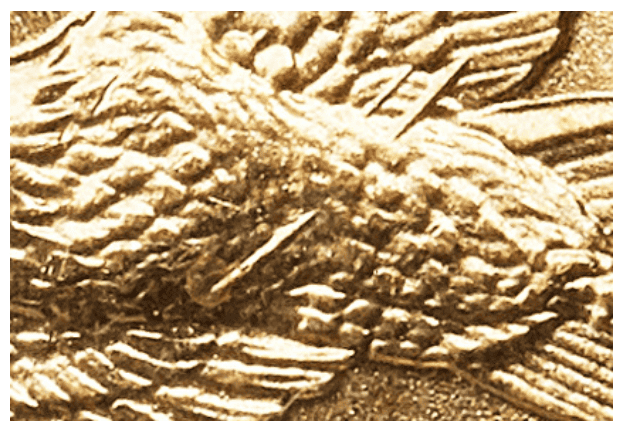
The 2000-P “Wounded Eagle” is a rare variety of the Sacagawea dollar coin, so-named because of a raised die flaw that looks like a spear or slash cutting across the eagle’s body on the reverse side.
This die flaw resulted from an error during the minting process and is a sought-after mint error for collectors.
Note: not all wounded eagle varieties are the same. Some are quite noticeable with naked eye, and for some you need a magnifying glass to properly see it.
See examples of both below.
Are There Sacagawea Coins Made of Gold? Do These Exist?
Yes, gold Sacagawea dollar coins exists. They’re real, but extremely rare.
There’re two types of gold Sacagawea dollar coins.
First, there’re 39 22-karat gold Sacagawea Dollars struck at West Point in 1999 (though dated 2000).
12 of these 39 real gold dollars went to space on Space Shuttle Columbia in July 1999, becoming one of the rare U.S. coins to have left our home planet
Upon returning to Earth, these 12 gold coins were deposited at Fort Knox for safekeeping The remaining 27 coins were melted down.
Second, there’s the 25th Anniversary Proof Coin.
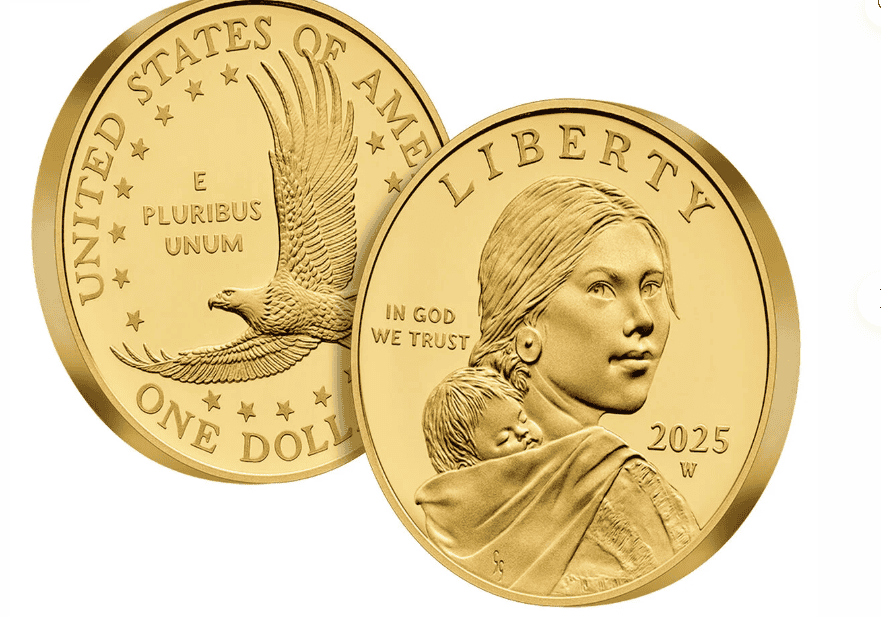
In 2025, the U.S. Mint produced a special 24-karat gold proof version of the Sacagawea dollar coin to celebrate its 25th anniversary.
This was a limited-edition collector’s item not meant for circulation (only 7.500 were minted) and containing a half-ounce of pure gold.
Are There Sacagawea Coins Made of Silver? Do These Exist?
No, there’re no Sacagawea coins made of silver.
Silver Sacagawea coins don’t exist and have never been minted by the U.S. Mint.
Some private mints, like the Washington Mint, have produced non-official, privately issued “silver rounds” or “medals” that feature the Sacagawea design and are made of pure silver (.999 fine silver).
These aren’t legal tender U.S. dollar coins, but rather bullion items.
Bottom line is that any official U.S. Mint Sacagawea dollar coin that appears silver has likely been plated or altered outside the mint.
Are There Sacagawea Coins Made of Platinum? Do These Exist?
No, there’re no Sacagawea coins made of platinum.
Platinum Sacagawea coins don’t exist and have never been minted.
Are There Sacagawea Coins Made of Palladium? Do These Exist?
No, there’re no Sacagawea coins made of palladium.
Palladium Sacagawea coins don’t exist and have never been minted.
Did The Sacagawea Coin First Come Out in 1979? Was it Minted Then?
No, the Sacagawea dollar coin didn’t first come out in 1979. Instead, it was first minted and released in the year 2000.
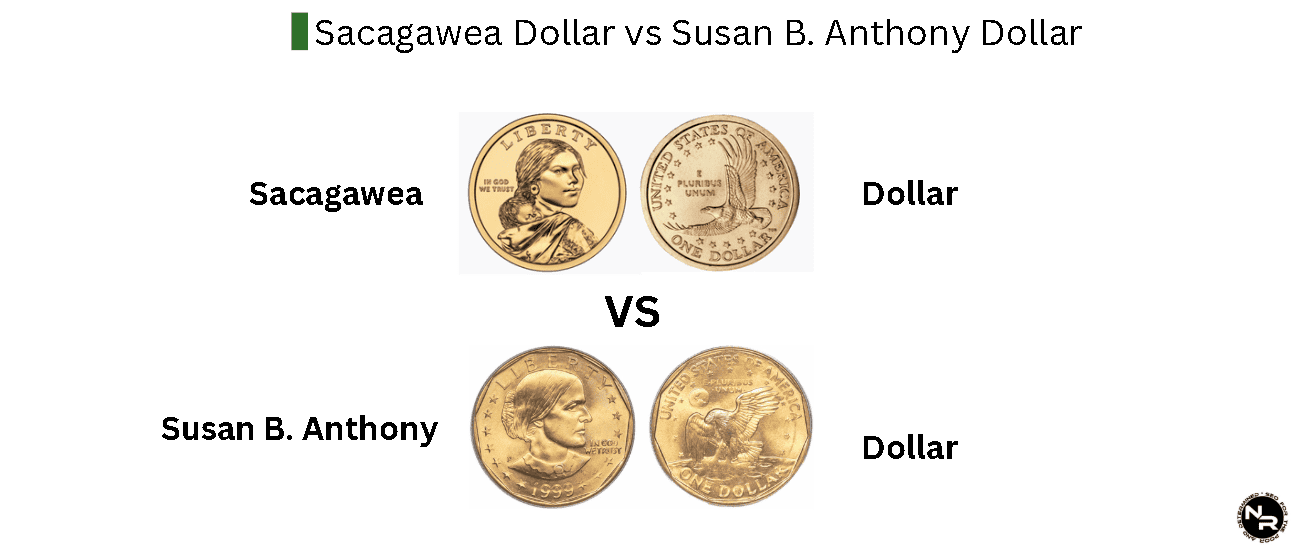
Susan B. Anthony dollar was the dollar coin that was first released and minted in 1979.
The Sacagawea coin was later introduced to replace the unpopular Susan B. Anthony dollar, and Sacagawea and Susan B. Anthony dollar coins are often confused as they’re similar in size, color and denomination ($1).
Are Sacagawea Coins IRA Approved?
No, Sacagawea coins aren’t IRA approved and eligible.
The IRS allows gold, silver, platinum and palladium coins and bars to be included as part of a gold IRA account.
The bullion has to be exceedingly pure and has to come from a certified and IRA-approved mint.
Sacagawea dollar coins are made of copper, zinc, nickel and manganese and none of these metals is approved by the IRS.
Note: the rare extant samples of gold and silver Sacagawea coins are also not IRA-eligible as numismatic items aren’t allowed to be included in a gold IRA account.
You can open a gold IRA account with this safe US gold investment company and they’ll help you along the way and supply you with eligible bullion that can be a part of a gold IRA.
What is a Sacagawea Coin? What is it Worth? Conclusion
The Sacagawea dollar is a U.S. coin first minted in 2000, featuring Sacagawea and her son on the front.
Despite its golden appearance, it’s made of manganese brass over copper, not actual gold. The coin was initially unpopular, leading to reduced production over time.
Since 2009, the reverse design has changed annually as part of the Native American $1 Coin Program.
Most Sacajawea dollars are worth only their $1 face value, but rare varieties command premium prices.
Notable examples include the “Cheerios Dollar” (5,500 coins distributed in cereal boxes with enhanced tail feather details) and various minting errors like the “Wounded Eagle” variety and extremely rare mule errors combining different coin designs.
While standard Sacagawea coins contain no precious metals, a few genuine gold versions exist: 39 experimental 22-karat coins from 1999 (12 went to space) and a limited 2025 24-karat anniversary edition.
References:
- Sacagawea Dollar Mintages- https://sacagaweadollarguide.com/sacagawea-dollar-mintages/
- 2000 “Cheerios” Sacagawea Dollar- https://sacagaweadollarguide.com/2000-cheerios-sacagawea-dollar/
- 2000 Sacagawea dollar – Washington quarter mule- https://en.wikipedia.org/wiki/2000_Sacagawea_dollar_%E2%80%93_Washington_quarter_mule
- “Wounded Eagle” Sacagawea Dollar.- https://www.reddit.com/r/coins/comments/18bvori/wounded_eagle_sacagawea_dollar/
- Tommy Bolack acquires 10th of 14 dollar/quarter mules at ANA- https://www.coinworld.com/news/us-coins/tommy-bolack-ana-worlds-fair-of-money-mule-error-coins-coin-world-stacks-bowers-auctions-numismatics-coin-collecting-hobby.html
- “Wounded Eagle” Sacagawea Dollar.- https://www.reddit.com/r/coins/comments/18bvori/wounded_eagle_sacagawea_dollar/
- 2000 P Sacagawea Wounded Eagle Dollar Value- https://coinauctionshelp.com/2000-p-sacagawea-wounded-eagle-dollar-value/
- 2000-W 22-Karat Gold Sacagawea Dollars- https://sacagaweadollarguide.com/2000-w-22-karat-gold-sacagawea-dollars/
- 25th Anniversary Sacagawea 2025 Golden Dollar 24K One Half-Ounce Gold Proof Coin- https://www.usmint.gov/25th-anniversary-sacagawea-2025-golden-dollar-24k-one-half-ounce-gold-proof-coin-25SG1.html
- The Susan B. Anthony Dollar- https://www.numismaticnews.net/collecting-101/the-susan-b-anthony-dollar
- Mule error realizes $84,000 in Heritage sale- https://www.coinworld.com/news/us-coins/mule-error-realizes-84-000-dollars-in-heritage-sale

Nikola Roza
Nikola Roza is a blogger behind Nikola Roza- SEO for the Poor and Determined. He writes for bloggers who don't have huge marketing budget but still want to succeed. Nikola is passionate about precious metals IRAs and how to invest in gold and silver for a safer financial future. Learn about Nikola here.