
Disclosure: Some of the links you’ll encounter are affiliate links. If you click and buy something, I’ll get a commission. If you’re reading a review of some precious metals company, please understand that some of the links are affiliate links that help me pay my bills and write about what I love with no extra cost to you. Thank you!
The global silver industry produces 26,000 metric tons annually, with production growing 2% year-over-year. Mexico leads production at 199 million ounces yearly, followed by China and Peru.
Approximately 560,000 metric tons of known silver reserves remain, with experts estimating 120 years of undiscovered reserves at current rates.
Global demand reaches 1.21 billion ounces annually, with 56% for industrial applications, 18% for jewelry, and 26% for investment. The electronics industry dominates industrial use, driven by AI, 5G, and solar energy. Silver recycling contributes 193.9 million ounces yearly.
The silver market, valued at $31.1 billion, is one-tenth the size of gold but 50-80 times more volatile.
Learn more in my updated silver industry statistics guide for 2026.
Use this jump link to jump to the KEY STATS section.
All the references and resources I used in crafting my stats guide are listed at the bottom of the page.
Jump here: Key Silver Industry Statistics, Facts and Trends| Detailed Silver Industry Statistics, Facts and Trends for this Year

Table of Contents
Key Silver Industry Statistics, Facts and Trends
Key Silver Industry Statistics, Facts and Trends for 2026
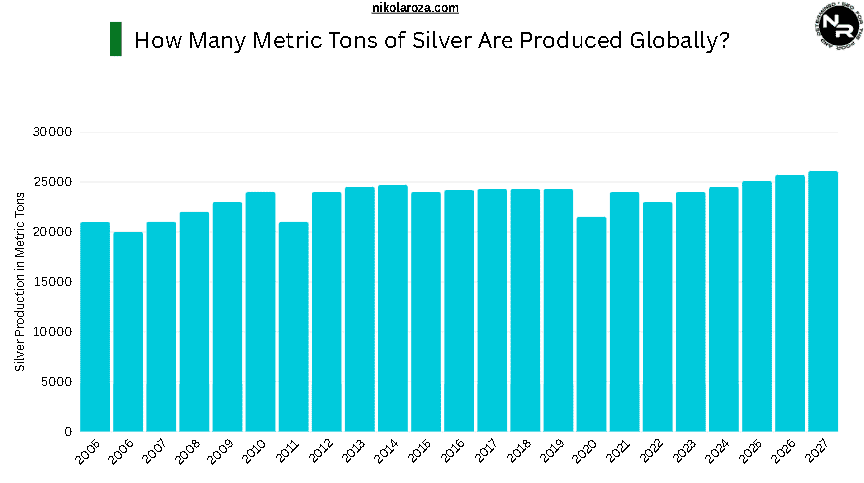
- 26,000 metric tons of silver are produced globally every year. That is 917,123,759 ounces or 26,000,000 kg of silver produced annually. (Source)
- The global silver production rises by ~2% YoY so more silver will be mined and produced globally next year than the year before. (Source)
- By 2035 it’s estimated that the annual silver production will hit 45 000 metric tons (45,000,000 kg or 1,440,000,000 ounces)(Source)
- According to the USGS, roughly 1.74 million metric tons of silver has ever been mined worldwide to date. (Source)
- There’s only 560,000 metric tons of known and confirmed silver reserves left to be mined and extracted from the ground. (Source)
- All the silver that has ever been mined, if melted and shaped into a cube, would create a cube that measures 55 meters (180.5 feet) on each side. (Source)
- Mexico produces more than 199 million ounces of silver per year, making it the world’s largest silver producing country. (Source)
- China is the second-largest silver producer globally, producing roughly 109.3 million ounces of silver per year. (Source)
- Peru is the third-largest silver producer globally, producing roughly 107.1 million ounces of silver per year. (Source)
- Chile is the fourth-largest silver producer globally, producing roughly 52 million ounces of silver per year. (Source)
- Australia is the fifth-largest silver producer globally, producing roughly 34-35 million ounces of silver per year. (Source)
- The top three silver-producing countries (Mexico, China, and Peru) collectively account for over half of the world’s silver production. (Source)
- Peru is estimated to have the largest silver reserves in the world, estimated at roughly 93,000 metric tons. (Source)
- Australia has the second-largest silver reserves in the world, with an estimated 90,000 metric tons. (Source)
- Russia has 45,000 metric tons of silver reserves waiting to be extracted from the ground. This is 50% of the amount Peru has on its territory. And Russia is 13.3 times bigger in territory than Peru. (Source)
- China possesses significant silver reserves estimated at 41,000 metric tons. (Source)
- Mexico has considerable silver reserves estimated at 37,000 metric tons. (Source)
- Chile has estimated silver reserves of 26,000 metric tons. (Source)
- The United States has estimated silver reserves of 25,500 metric tons. (Source)
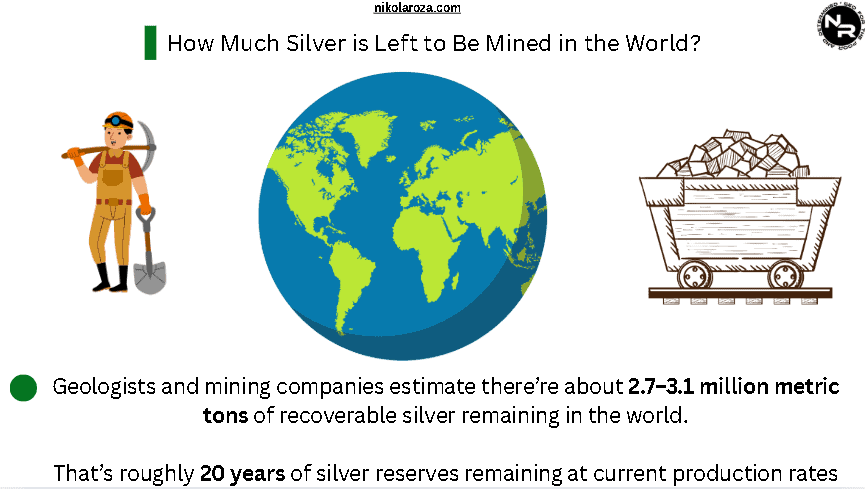
- Geologists and mining companies estimate there’re about 2.7-3.1 million metric tons of recoverable silver remaining in the world. This includes both known and currently undiscovered silver deposits. (Source)
- Experts estimate we have roughly 120 years of nonidentified and undiscovered silver reserves remaining at current production rates. (Source)
- The global demand for silver is roughly 1.21 billion ounces per year, including usage across all industries, jewelry, and for investing purposes. (Source)
- Demand for silver globally isn’t static and in general is growing at a steady rate of 1% year-over-year. (Source)
- Silver demand is expected to rise to 2% per year in the next 5-10 years due to AI and industries heavily influenced by renewable energy sectors. (Source)
- Industrial applications represent approximately 56% of total silver demand. (Source)
- The global jewelry industry accounts for 18% of the global silver demand. (Source)
- Silver used as an investment vehicle and store of value represents 25-26% of total silver demand. (Source)
- The silver market is approximately one-tenth the size of the gold market by value. (Source)
- Silver prices are typically 50-80 times more volatile than gold prices. (Source)
- The price of silver is more volatile than the price of gold due to silver’s smaller market size and higher industrial demand. (Source)
- More than 193.9 million ounces of silver is recycled (melted scrap silver) per year. And that number is rising as more and more silver is mined each year. (Source)
- High-end AI GPUs incorporate 3-8 grams of silver in substrate and interconnect materials, plus an additional 2-3 grams in packaging and thermal interface applications. (Source)
- Enterprise server motherboards incorporate 2-5 grams of silver in conductive traces, vias, and connector plating. (Source)
- A typical AI server farm requires 2-3 times the silver content of traditional data centers due to higher power density, more complex cooling systems, and greater interconnection requirements. (Source)
- A typical 5G base station incorporates 50-100 grams of silver distributed across antenna arrays, RF filters, power amplifiers, and connector systems. (Source)
- More than 10% of global industrial silver use now goes toward electronics and chips, with analysts expecting this figure to rise to 15-20% within the next five years. (Source)
- A single 500-megawatt solar array is enough to power one hyperscale data center and it requires roughly 300 metric tons of silver. (Source)
Detailed Silver Industry Statistics, Facts and Trends for this Year
How Many Metric Tons of Silver Аrе Produced Globally Every Year?
26,000 metric tons of silver are produced globally every year. That is 917,123,759 ounces or 26,000,000 kg of silver produced annually. (Source)
The global silver production rises by ~2% YoY so more silver will be mined and produced globally next year than the year before. (Source)
By 2035 it’s estimated that the annual silver production will hit 45 000 metric tons (45,000,000 kg or 1,440,000,000 ounces)(Source)
| Year | Production (in metric tons) |
|---|---|
| 2020 | 19,658 |
| 2021 | 21,312 |
| 2022 | 22,499 |
| 2023 | 24,850 |
| 2024 | 24,800 |
| 2025 | 26,000 |
| 2035 | 45,000 (estimate) |
Note: according to the USGS, there were roughly 2.34 million metric tons of silver in the world before humans recognized its value and started mining it many years ago. (Source)
Roughly 1.74 million metric tons of silver has been mined to date. (Source) This means most of the world’s known silver deposits have been exhausted and there’s only 560,000 metric tons left to be mined and extracted from the ground. (Source)
This is information about the currently known silver sources.
Geologists and mining companies estimate there’re additional 2.7–3.1 million metric tons of currently unidentified recoverable silver remaining in the world. (Source)
Experts estimate we have roughly 120 years of nonidentified and undiscovered silver reserves remaining at current production rates. (Source)
Note: thousands of tons of silver produced annually dwarfs the mined output of some other precious metals.
Good examples are rhodium (only 1 million ounces of rhodium are produced annually), iridium (only 248 000 million ounces of iridium are produced annually), ruthenium (only 30 metric tons of ruthenium are produced annually) and osmium (only 1-2 metric tons of osmium are produced annually).
Which Countries are the World’s Largest Silver Producers?
The world’s largest silver producing countries are Mexico, China, and Peru, with Mexico leading the pack in terms of overall output.
These three countries collectively account for >50% of the world’s silver production.
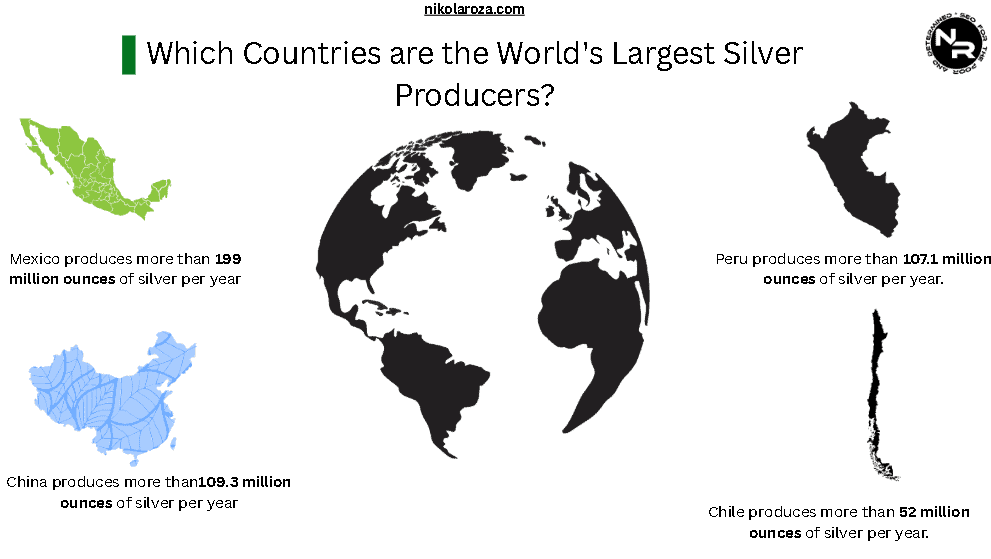
Mexico is the world’s largest silver producing country. They produce roughly 24% of the total global silver output. In numbers that’s ~199 million ounces (5,641,555 kg or 5,641 metric tons) of silver per year. (Source)
Mexico’s silver mining is concentrated in the central and northern regions of the country.
50% of silver is mined in Penasquito, Fresnillo and Saucito mines (Zacatecas); 25% is mined in San Julian and Dolores mines (Chihuahua); and historic areas like Guanajuato, Plomosas (Sinaloa) and San Jose (Oaxaca) contribute the remaining 25%. (Source)
These silver mines all part of the rich Sierra Madre Occidental belt.
Mexico’s total silver output is growing at a slow but steady rate. By 2035 it’s predicted Mexico will be producing >220 million ounces of silver per year. (Source)
Major Mexican silver mining companies are Industrias Peñoles (parent of Fresnillo plc), Grupo México, First Majestic Silver, and Pan American Silver, alongside international players like Newmont. These conglomerates produce 99% of Mexico’s silver per year. (Source)
| Year | Production (in ounces) |
|---|---|
| 2020 | 179 million |
| 2021 | 182 million |
| 2022 | 185 million |
| 2023 | 189 million |
| 2024 | 190 million |
| 2025 | 199 million |
| 2035 | 220 million (estimate) |
Mexico exports most of the silver it produces in a year. They silver exports are valued at $3 billion and the three major importers of Mexican’s silver are United States ($2.65B), Canada ($168M), and Japan ($106M). (Source)
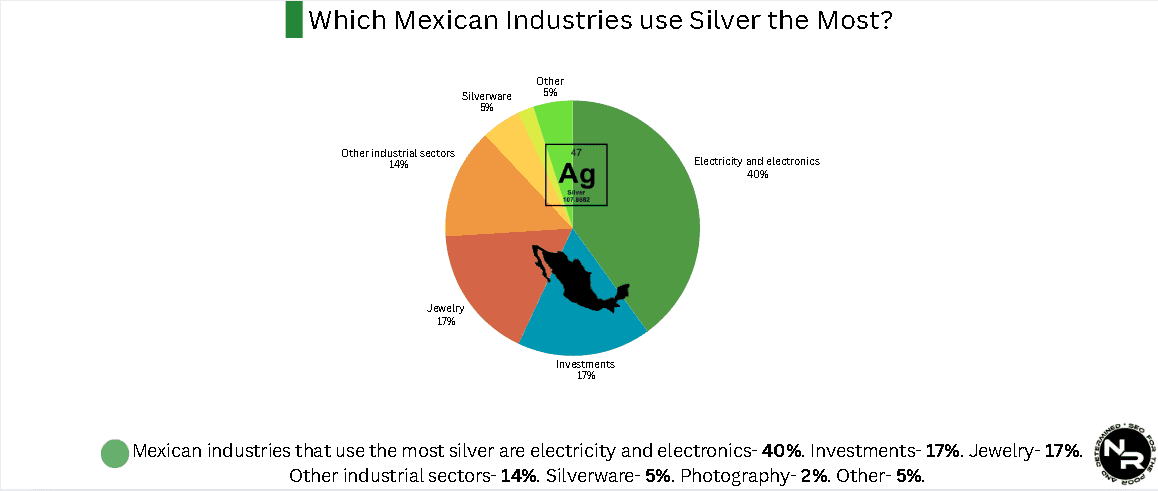
Most of Mexico’s domestic silver usage goes to this metal’s industrial applications.
- Electricity and electronics: 40%.
- Investments: 17%.
- Jewelry: 17%.
- Other industrial sectors: 14%.
- Silverware: 5%.
- Photography: 2%.
- Other: 5%.
(Source)
China is the world’s second largest silver producing country. They produce roughly 13% of the total global silver output. In numbers that’s 109.3 million ounces (3,098,603 kg or 3,098 metric tons) of silver per year. (Source)
Chinese silver mines are spread across the country, with major deposits and high production in Inner Mongolia (20%), Henan (7%), Jiangxi (11%), and Shaanxi (15%). The remaining 43% of Chinese silver production is spread across the country across dozens on mines and deposit sources. (Source)
China’s silver production has decreased in recent years. Production was 3,300 metric tons in 2024, down from 3,399 metric tons in 2023, and 3,477 metric tons in 2022. (Source)
The primary reasons for the production decline include lower ore grades at maturing mines and stringent domestic environmental policies which restrict new mining projects in ecologically sensitive areas. (Source)
However, future forecasts suggest potential growth in the medium term and by 2035 it’s excepted China will produce roughly 4,000 metric tons of silver, or roughly 15% of the world’s total silver output. (Source)
Major Chinese silver mining companies include Zijin Mining Group and Jiangxi Copper. Other key players are Shenzhen Zhongjin Lingnan Nonfemet (operator of the Fankou Mine) and the Canadian-listed Silvercorp Metals, which operates several large Chinese silver mines. (Source)
These companies extract silver often as a byproduct of copper, lead, and zinc mining.
| Year | Production (in metric tons) |
|---|---|
| 2020 | 3,412 |
| 2021 | 3,457 |
| 2022 | 3,477 |
| 2023 | 3,399 |
| 2024 | 3,300 |
| 2025 | 3,350 |
| 2035 | 4,000 (estimate) |
China exports most of the silver it produces in a year. They silver exports are valued at $4.2 billion and the three major importers of Chinese’s silver are Hong Kong ($2.37 billion), Taiwan ($414 million), and United Kingdom ($465 million). (Source)
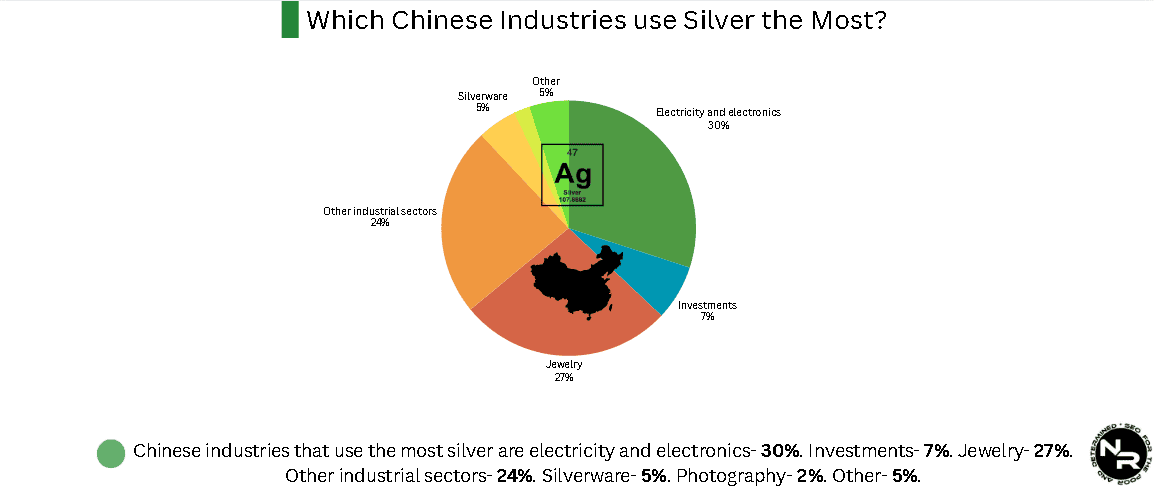
Roughly 90% China’s domestic silver usage goes to this metal’s industrial applications.
- Electricity and electronics: 30%.
- Investments: 7%.
- Jewelry: 27%.
- Other industrial sectors: 24%.
- Silverware: 5%.
- Photography: 2%.
- Other: 5%.
Peru is the world’s third largest silver producing country. They produce roughly 12% of the total global silver output. In numbers that’s 107.1 million ounces (3,036234 kg or 3,036 metric tons) of silver per year. (Source)
Most of Peru’s silver comes from the the Andean regions like Puno, Pasco (Cerro de Pasco), and Arequipa, with major mines including Berenguela (24%), Huarón (24%), and Santa Ana (35%). The remaining 17% of Peru’s silver production is distributed across many smaller mines in the country. (Source)
Mining companies like Volcan, Glencore, Nexa Resources, Hochschild Mining, and Buenaventura are key players in Peruvian silver extraction.
Peru’s total silver output is growing at a slow and steady rate. By 2035 it’s predicted Peru will be producing >120 million ounces of silver per year. That’s roughly 3,401,943 kg and 3,402 metric tons of silver produced annually. (Source)
| Year | Production (in ounces) |
|---|---|
| 2020 | 99.3 |
| 2021 | 99.5 million |
| 2022 | 100 million |
| 2023 | 102.1 million |
| 2024 | 106 million |
| 2025 | 107.1 million |
| 2035 | >120 million (estimate) |
Peru exports most of the silver it produces in a year. Their silver exports are valued at $500 million and the three major importers of Peru’s silver are China ($396M), South Korea ($49.4M), and Germany ($19.2M). (Source).
Most of Peru’s silver that’s not exported ends up being used in various industries where silver is needed.
- Electricity and electronics: 60%.
- Solar energy production: 20%.
- Investments: 7%.
- Jewelry: 7%.
- Other industrial sectors: 6%..

Chile is the fourth largest silver producing country in the world. They produce roughly 6% of the total global silver output. In numbers that’s 52 million ounces (1,474,175 kg or 1,474 metric tons) of silver per year. (Source)
Chilean silver mines are primarily located in the arid Atacama Desert in northern Chile and also in the Antofagasta and Tarapacá regions. More than 80% of Chile’s total silver output comes from silver mines from these areas. (Source)
The remaining 20% of Chile’s silver production is spread out evenly across silver mines throughout the country.
Major Chilean silver producers include state-owned Codelco, operating mines like Chuquicamata and Ministro Hales, alongside global miners like BHP (Escondida), Glencore (Collahuasi), Kinross Gold (La Coipa), and Yamana Gold (El Peñon).
As is the case with silver mining mined silver is a byproduct of copper or gold mining.
Chile’s silver production has slightly decreased in recent years. Production was 1,400 metric tons in 2024, down from 1,422 metric tons in 2023, and 1,477 metric tons in 2022.
It’s expected that Chile’s total silver output will start growing in the near future with some estimates having Chile produce >2,000 metric tons of silver in a year by 2035.
| Year | Production (in metric tones) |
|---|---|
| 2020 | 1,360 |
| 2021 | 1,424 |
| 2022 | 1,477 |
| 2023 | 1,422 |
| 2024 | 1,400 |
| 2025 | 1,415 |
| 2035 | >2,000 (estimate) |
Chile exports most of the silver it produces in a year. Their silver exports are valued at $250 million and the three major importers of Chinese’s silver are United States ($247M), Brazil ($576k), Argentina ($339k) and United Kingdom ($318k). (Source)
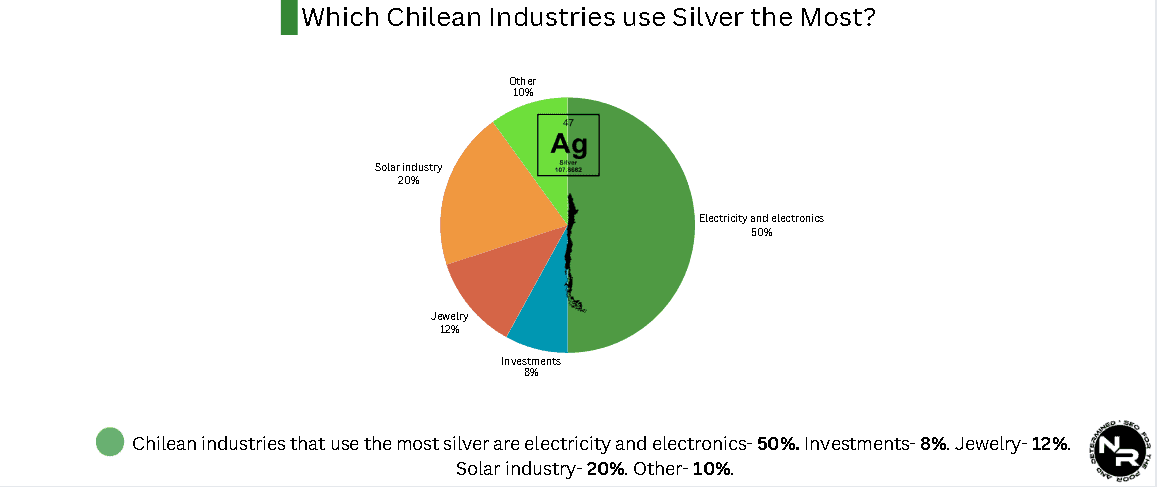
Most of Chile’s domestic silver usage goes to this metal’s industrial applications.
- Electricity and electronics: 50%.
- Solar energy production: 20%.
- Investments: 8%.
- Jewelry: 12%.
- Other industrial sectors: 10%..
Australia is the world’s fifth largest silver producing country. They produce roughly 4% of the total global silver output. In numbers that’s ~35 million ounces (992,233 kg or 992 metric tons) of silver per year. (Source)
Australia’s silver mines are located across several states, with major operations in Cannington, Mt Isa (38%) Broken Hill, Bowdens (24%), Olympic Dam, Prominent Hill, Wheal Watkins (12%), and Western Australia Golden Grove in Western Australia (5%).
The remaining 21% of Australia’s silver production is spread out evenly across silver mines throughout this continent-sized country.
Australia’s silver production has slightly decreased in recent years. Production was 1,312 metric tons in 2024, down from 1,322 metric tons in 2023, and 1,416 metric tons in 2022.
It’s expected that Australia’s total silver output will start growing in the near future with some estimates having it produce >1,600 metric tons of silver in a year by 2035.
| Year | Production (in metric tones) |
|---|---|
| 2020 | 1,400 |
| 2021 | 1,406 |
| 2022 | 1,416 |
| 2023 | 1,322 |
| 2024 | 1,312 |
| 2025 | 1,415 |
| 2035 | >1,600 (estimate) |
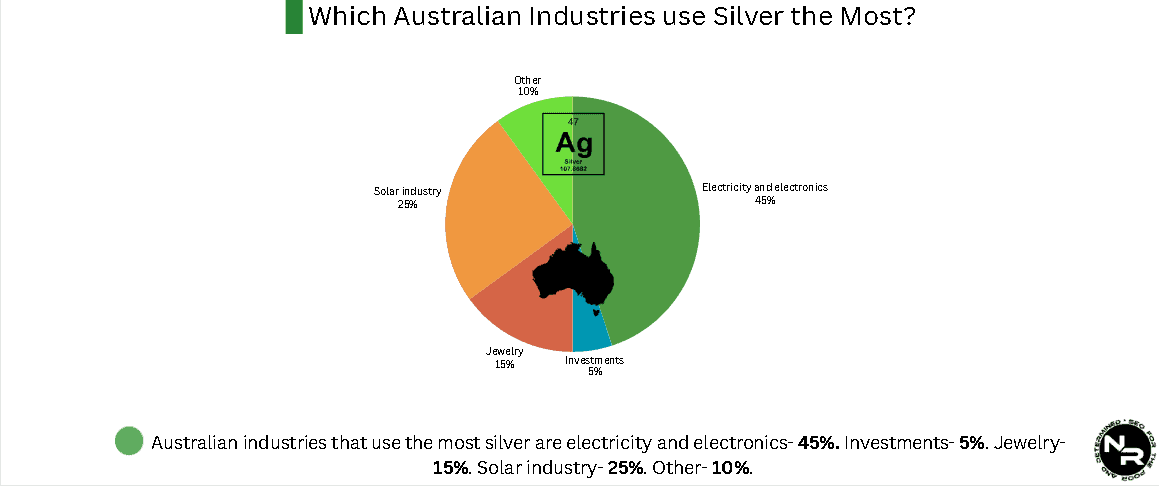
Most of Australia’s domestic silver usage goes to this metal’s industrial applications.
- Electricity and electronics: 45%.
- Solar energy production: 25%.
- Investments: 5%.
- Jewelry: 15%.
- Other industrial sectors: 10%..
Which Countries Have the World’s Largest Confirmed Silver Reserves?
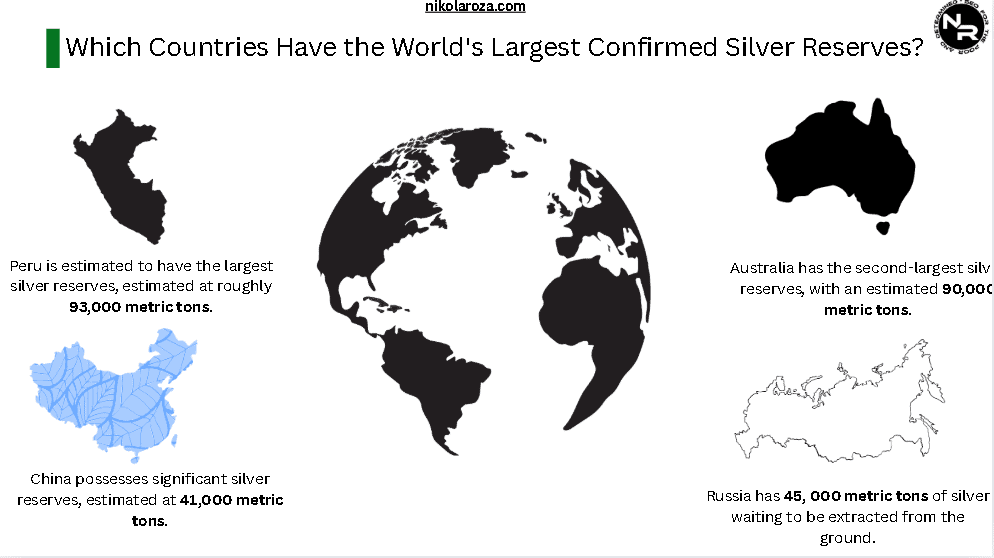
Peru, Australia and Poland have the world’s largest confirmed silver reserves. Other countries with significant silver reserves are Russia, China, Mexico, Chile, and the United States.
- Peru is estimated to have the largest silver reserves, estimated at roughly 93,000 metric tons. (Source)
- Australia has the second-largest silver reserves, with an estimated 90,000 metric tons. (Source)
- Russia has 45,000 metric tons of silver waiting to be extracted from the ground. That’s 50% of the amount Peru has on its territory. And Russia is roughly 13x larger in territory than Peru. (Source)
- China possesses significant silver reserves, estimated at 41,000 metric tons. (Source)
- Mexico is the biggest silver producer in the world, but they don’t have the largest silver reserves in the world. Mexico’s silver reserves are estimated at 37,000 metric tons. (Source)
- The last two countries worth mentioning individually are Chile (estimated silver reserves are 26,000 metric tons) and United States with silver reserves estimated at 25,500 metric tons. (Source)
Which Continents Hold the Largest Silver Reserves in the World?
The continents of North America, South America and Asia hold the most significant silver reserves. (Source)
South America has Peru’s, Chile’s and Bolivia’s silver resources on its territory. Asia has Russia and China, two huge countries with large confirmed silver deposits and possibly even more silver waiting to be discovered.
North America as a union between U.S. and Canada also has significant silver reserves on it’s territory. The United States and Canada combined have approximately 30,000 metric tons of silver reserves.

What’s the Global Demand for Silver per Year? Is it Rising or Falling?
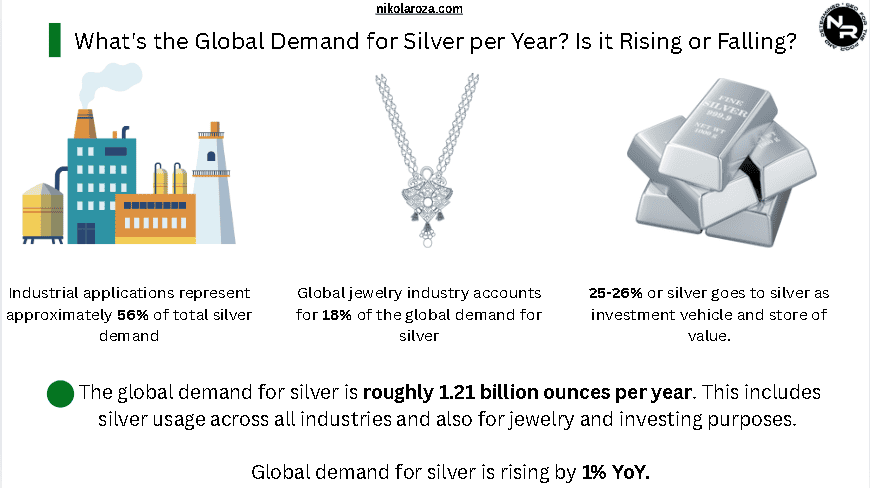
The global demand for silver is roughly 1.21 billion ounces per year. This include silver usage across all industries and also for jewelry and investing purposes. (Source)
Demand for silver isn’t static. In fact, it’s rising by 1% YoY and it’s expected AI + industries heavily influenced by AI and renewable energy sectors will push the demand for silver to rise to 2% per year in the next 5-10 years. (Source)
Note: industrial applications represent approximately 56% of total silver demand. And the electronics and electrical engineering industry is the number one buyer of silver. (Source)
This particular industry requires up to 700 million ounces of silver per year across a broad range of sectors within it. Silver is used in consumer electronics, 5G technology, electric vehicle production, solar energy production and more.(Source)
Global jewelry industry accounts for 18% of the global demand for silver and the remaining 25-26% or silver goes to silver as investment vehicle and store of value. (Source)
Note: silver used for investment purposes is refined into coins and bars and is usually bought by people with silver IRA accounts.
Meaning, people who bought IRA eligible silver and investment-grade silver, gold, platinum (only 20% of newly mined platinum goes into making investment-grade platinum coins and bars) and palladium (5-10% of palladium is used for investment purposes, mainly for producing investment grade palladium coins and bars.) to use as hedges against inflation and uncertain economic times.
What is the Market Size of Global Silver Industry?
The global silver market is currently valued at $31.1 billion. The market is projected to reach $61.1 billion by 2035, rowing at a CAGR of ~9.6% per year. (Source)
The silver market is projected to rapidly grow due to strong demand in artificial intelligence, solar energy, electronics, and jewelry, alongside its role as an investment asset. (Source)
How Much Silver Is Recycled In a Calendar Year?
More than 193.9 million ounces of silver is recycled in a calendar year. This represents about 15-20% of the total yearly silver supply. (Source)
Roughly 50% of all silver produced in a year is recycled and reused for different purposes.
North America holds the largest silver recycling market share at approximately 27%, followed by Europe at 24%, and China at 19%. (Source)
In the near future (by 2035) Asia-Pacific is expected to dominate the silver recycling market due to rapid industrialization in countries like China and India (Source)
| Country | Silver recycling market share |
|---|---|
| United States | 19% |
| Canada | 6% |
| European Union | 24% |
| China | 19% |
| Japan | 15% |
| South Korea | 8% |
| Rest of the world | 9% |
Who Owns the Most Silver in the World?
No single owner has the most silver, as it is held by a mix of private investors, industrial users, financial institutions, and governments. (Source)
However, Mexico is the largest silver-producing country, and the United States is the largest consumer and investor in silver. (Source)
Large institutions like the iShares Silver Trust (SLV) hold substantial physical silver, while individuals own vast quantities through jewelry, coins, and other forms.
It is unknown which induvial investor owns the most silver as an investment vehicle, either as part of a retirement account or as physical bullion. (Source)
How Does the Silver Market Compare to the Gold Market?
The gold and silver markets, while both precious metal markets, have significant differences in volatility, market size, and industrial applications. (Source)
Silver is generally more volatile than gold (silver prices are typically 50-80 times more volatile than gold prices) due to its smaller market size and higher industrial demand. (Source)
The gold market is larger and more liquid, meaning it can absorb larger transactions with less impact on price. Gold is also often seen as a more stable investment and an inflation hedge. (Source)
The silver market is approximately 1/10th the size of the gold market by value. (Source)
Silver Industry Statistics, Facts and Trends Guide (Conclusion)
My updated guide for 2026 lists the best and latest statistics, facts, trends and data about silver industry and how this precious metal is used worldwide.
I hope you enjoyed it because the guide is now over.
References:
- Half a Decade of Silver Deficits: Trends Driving the Shortage
Ripple Effects of Six Years of Silver Deficits- https://auronum.co.uk/half-a-decade-of-silver-deficits-trends-driving-the-shortage/ - Silver Demand and Supply Trends to Watch- https://sprott.com/insights/silver-demand-and-supply-trends-to-watch/
- Silver Market Size & Share Analysis – Growth Trends & Forecasts (2025 – 2030)- https://www.mordorintelligence.com/industry-reports/silver-market
- Silver’s Impressive Strength- https://sprott.com/insights/silvers-impressive-strength-in-2024/
- Mine production of silver worldwide from 2005 to 2024- https://www.statista.com/statistics/253293/silver-production-volume-worldwide/
- How Much Silver Has Ever Been Mined in the World? How Much Silver Reserves Are Estimated to Yet Be Extracted? https://www.investopedia.com/articles/markets-economy/083116/10-countries-produce-most-silver.asp

Nikola Roza
Nikola Roza is a blogger behind Nikola Roza- SEO for the Poor and Determined. He writes for bloggers who don't have huge marketing budget but still want to succeed. Nikola is passionate about precious metals IRAs and how to invest in gold and silver for a safer financial future. Learn about Nikola here.