Disclosure: Some of the links you’ll encounter are unique links. Click and buy something and I’ll earn some money, at zero expense to you. Thank you!
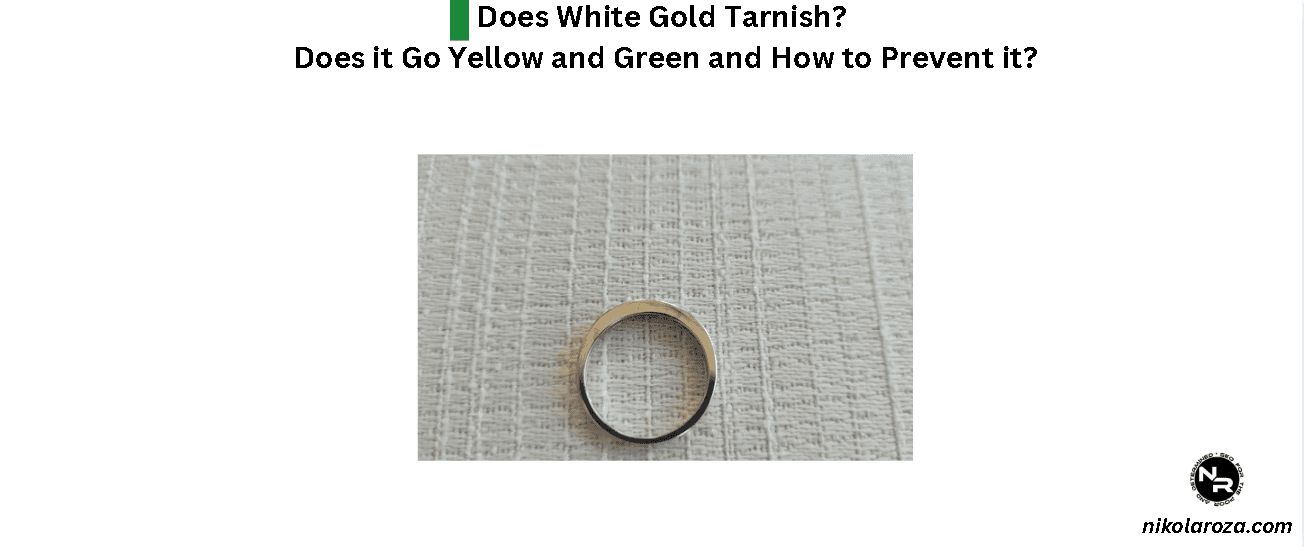
White gold doesn’t technically tarnish, but it discolors over time with wear and tear.
The rhodium plating that gives white gold its bright white appearance gradually wears away, revealing the natural pale yellowish white gold alloy underneath.
This discoloration happens in patches as the rhodium coating flakes off unevenly. Both plated and non-plated white gold (in 10k, 14k, and 18k variants) eventually turns from white to a mild yellow color. Non-plated white gold changes uniformly, while rhodium-plated pieces develop yellow patches where the plating has worn off.
White gold doesn’t turn skin green, but white gold vermeil does when the plating wears through to the sterling silver base. To clean white gold, use warm water with mild dish soap and a soft brush, avoiding bleach, baking soda on heavily plated pieces, or chlorine.
Professional re-plating restores the original bright white appearance.
Does White Gold Tarnish, Yes or No?
No, white gold doesn’t tarnish. However, white gold over time and with regular wear and tear loses its sheen and luster and fades to a natural pale yellow color. This fading and discoloration happen because the rhodium plating that gives white gold its bright white appearance wears away, revealing the natural white gold alloy underneath. The color change usually happens in patches, as rhodium coating falls and flakes off in pieces.
Below are all the potential tarnish-causing substances and their effect on white gold jewelry items.
| Substance | Tarnish (Yes/No) |
|---|---|
| Water | White gold doesn't tarnish in water. Water has zero effect on white gold and can't tarnish or corrode it. Saltwater negatively affects white gold jewelry items, especially when the rhodium plating is damaged. Saltwater then speeds up the plate's degradation process. |
| Fire | Fire and strong flames don't tarnish and corrode white gold. However, thin rhodium plates on white gold can get damaged by strong fires and cause the plating to fall off and expose the underlying base metal. |
| Chlorine | Chlorine tarnishes and corrodes white gold. Chlorine leaches out some of the metals from the alloy leaving the whole item structurally weakened. However, you'd need to be spending hours every day in a pool of chlorinated water for this to happen. Or you'd need to shower daily while wearing your white gold jewelry. |
| Bleach | Bleach tarnishes and corrodes white gold. This effect is minimal when the plating is intact. And it's pronounced and quick when the rhodium plating is damaged or loosened up. |
| Baking soda | White gold doesn't tarnish when exposed to baking soda. Baking soda is commonly used as a gentle cleaning agent to remove dirt and restore shine of white gold jewelry. |
| Toothpaste | Toothpaste doesn't tarnish and corrode white gold. However, the abrasive particles in toothpaste make tiny, microscopic scratches on the alloy's surface. Over time this degrades the metal's surface and causes it to develop a pale yellow color, instead of original white. Don't use toothpaste to clean your white gold jewelry. |
| Vinegar | Vinegar neither tarnishes not corrodes white gold with its rhodium plate intact. However, vinegar's acetic acid accelerates the degradation of already damaged rhodium plating. |
| Hydrogen peroxide | White gold doesn't tarnish and corrode when exposed to hydrogen peroxide. You can use hydrogen peroxide to clean your white gold jewelry. However, damaged rhodium-plated white gold jewelry shouldn't be exposed to hydrogen peroxide so no further damage is done. |
| Lemon juice | Lemon juice doesn't tarnish and rust white gold. It also doesn't oxidize and corrode it. Lemon juice's acids are unable to penetrate through rhodium plating on white gold jewelry items. |
| Makeup | Makeup has no effect on white gold. It doesn't tarnish, corrode, oxide or rust white gold jewelry items. |
| Nitric acid | Nitric acid doesn't tarnish white gold. It also doesn't oxidize and corrode it. Aqua Regia, a mixture of nitric acid and hydrochloric acid dissolves yellow gold within the white gold alloy. |
| Alcohol | Alcohol doesn't tarnish or corrode white gold. You can use rubbing alcohol (isopropyl alcohol) to clean your white gold jewelry. However, don't use alcohol to clean your white gold jewelry too often. The rhodium plating of your white gold jewelry will wear off much quicker if you do. |
White gold tarnish isn’t the same as white gold patina. White gold patination is a natural, often desirable, change in the white gold’s surface. And tarnish is an undesirable, superficial layer of oxidation that ruins the looks of white gold jewelry.
You’re reading about white gold tarnishing properties and how to prevent it. This means you like white gold, which means you like true gold, especially in coin and bar form.
Check this out next if you’re a proud American worried about the economy and curious about investing in gold and other precious metals.
Does 18k White Gold Tarnish?
No, 18k white gold doesn’t tarnish. This is true for both rhodium plated and non-plated 18k white gold variants.
However, both white gold types discolor with time and sufficient wear and tear. Rhodium-plated white gold over time loses its plating which exposes the white gold underneath.
Places exposed to Earth’s elements and anything else your jewelry comes in contact with (chemicals, perfumes, sweat…) adopt an unpleasant yellow color that noticeably stands out from the bright white luster of undamaged rhodium.
Non-plated 18k white gold also over time starts to turn from white to mild yellow. In this case the change is uniform as the entire white gold object changes color evenly.
Some people like this change on their 18k white gold jewelry, most don’t.
You’re reading about white gold tarnishing properties and how to prevent it. This means you like white gold, which means you like true gold, especially in coin and bar form.
Check this out next if you’re a proud American worried about the economy and curious about investing in gold and other precious metals.
Does 14k White Gold Tarnish?
No, 14k white gold doesn’t tarnish. This is true for both rhodium plated and Non-plated 14k white gold variants.
However, both types discolor with time and sufficient wear and tear. Non-plated 14k white gold over time starts to turn from white to mild yellow. This discoloration is uniform as the entire white gold object changes color evenly.
Rhodium-plated white gold over time loses its plating which exposes the white gold underneath. Places exposed to Earth’s elements and anything else your jewelry comes in contact with (chemicals, perfumes, sweat…) adopt an unpleasant yellow color that noticeably stands out from the bright white luster of undamaged rhodium.

Rhodium-plated 14k white gold with yellow patches drags the value and aesthetics of the entire piece down and savvy jewelry owners prevent this with regular maintenance and replating.
You’re reading about white gold tarnishing properties and how to prevent it. This means you like white gold, which means you like true gold, especially in coin and bar form.
Check this out next if you’re a proud American worried about the economy and curious about investing in gold and other precious metals.
Does 10k White Gold Tarnish?
No, 10k white gold doesn’t tarnish. This is true for both rhodium plated and non-plated 10k white gold variants. However, both types discolor with time and sufficient wear and tear.
Non-plated 10k white gold over time starts to turn from white to mild yellow. This discoloration is uniform as the entire white gold object changes color evenly. Some people like this, most don’t.
Rhodium-plated white gold over time loses its plating which exposes the white gold underneath. Places exposed to Earth’s elements and anything else your jewelry comes in contact with (chemicals, perfumes, sweat…) adopt an unpleasant yellow color that noticeably stands out from the bright white luster of undamaged rhodium.
Rhodium plated 10k white gold with yellow patches drags the value and aesthetics of the entire piece down and savvy jewelry owners prevent this with regular maintenance and replating.

Everything I described above for 10k white gold applies for 9k white gold as well. 9k white gold is chemically very similar to the 10k variant.
You’re reading about white gold tarnishing properties and how to prevent it. This means you like white gold, which means you like true gold, especially in coin and bar form.
Check this out next if you’re a proud American worried about the economy and curious about investing in gold and other precious metals.
Does White Gold Turn Human Skin Green?
No, white gold doesn’t turn human skin green. Sterling silver turns human skin green upon prolonged contact but white gold contains no sterling silver at all. However, white gold vermeil does turn skin green when the white gold plating is damaged or severely worn out.
It’s because because under that white gold plating is real sterling silver which gives a pronounced greenish hue to susceptible human skin.
This is why you should replate white gold vermeil as soon as you start seeing the underlying sterling silver base. Here’s an example of what a damaged white gold vermeil ring can do to your skin if you’re not careful.

The green skin discoloration is 100% harmless and you can easily wipe if off with soap and warm water.
You’re reading about white gold tarnishing properties and how to prevent it. This means you like white gold, which means you like true gold, especially in coin and bar form.
Check this out next if you’re a proud American worried about the economy and curious about investing in gold and other precious metals.
Does White Gold Eventually Turn Yellow?
Yes, white gold turns yellow over time. This happens to both non-plated white gold and rhodium-plated white gold.
Non-plated white gold over time loses its bright, silvery luster and adopts a warmer, slightly yellowish or champagne hue. This effect is more pronounced in higher karatage white gold (for example 18k white gold) compared to a lower karatage alloy like 10k white gold.
Rhodium-plated white gold also turns yellow as the plating flakes of in chunks. The difference is that only the exposed area turns yellow while the parts under the plating keep their original color.
Replating white gold is the best (and cheapest) solution here.
The time amount needed for rhodium plating to fall off widely varies between different white gold jewelry pieces (presumably based on quality of the work).
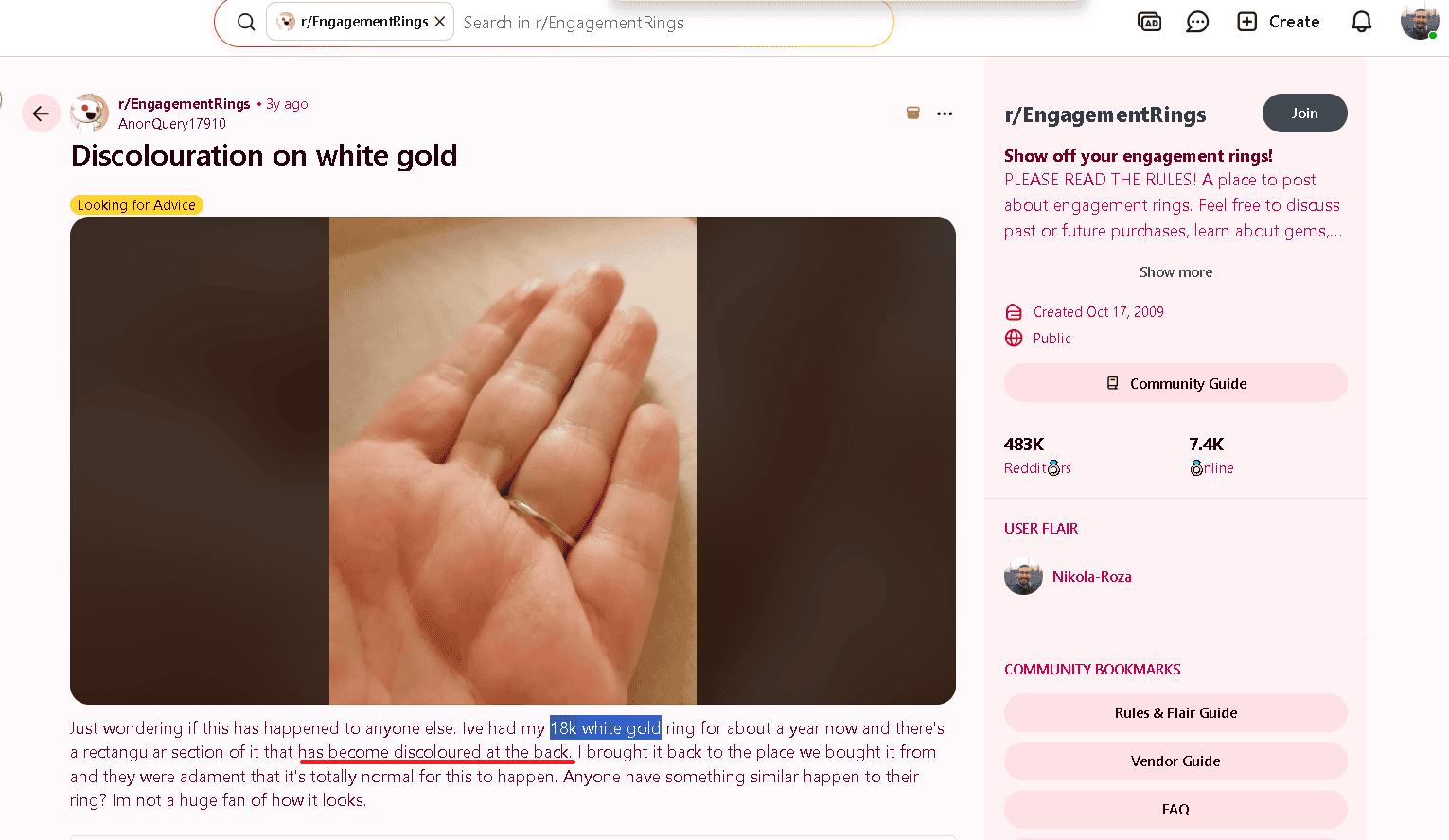
Here’s an example from Reddit where someone complained their white gold ring has lost nearly all of its rhodium coating in a month.
And then in the comment section of that thread someone says they’ve been wearing their rhodium-plated white gold ring for 20 years and and it’s almost as good as new. Very minimal yellowing of the alloy.

You’re reading about white gold tarnishing properties and how to prevent it. This means you like white gold, which means you like true gold, especially in coin and bar form.
Check this out next if you’re a proud American worried about the economy and curious about investing in gold and other precious metals.
How to Clean Tarnish off White Gold?
To clean tarnish or discoloration off white gold, soak it for 20-30 minutes in a solution of warm water and mild, fragrance-free dish soap. Next, gently scrub with a soft-bristled toothbrush to remove grime, then rinse thoroughly with lukewarm water and dry with a soft cloth.
Don’t use bleach, baking soda (if it’s heavily plated), or chlorine, as these can strip the rhodium plating.
Finally, the rhodium plating has worn off if the white gold has turned yellow or black despite cleaning. Professional white gold re-plating is required in this case.
- Ring Turned Finger Green- https://www.reddit.com/r/jewelry/comments/1d5cfpd/ring_turned_finger_green/
- 10k white gold ring never worn, kept in box until engagement is rusting- https://www.reddit.com/r/jewelry/comments/1d6jcu6/10k_white_gold_ring_never_worn_kept_in_box_until/
- What are these dark spots on my new 14k white gold ring?- https://www.reddit.com/r/jewelry/comments/1dcs3hb/what_are_these_dark_spots_on_my_new_14k_white/
- 14k gold but has this tarnish or something?- https://www.reddit.com/r/jewelry/comments/1he7wk4/14k_gold_but_has_this_tarnish_or_something/
- How long does white gold typically last until you need to get it re-plated?- https://www.reddit.com/r/EngagementRings/comments/1nd3xif/how_long_does_white_gold_typically_last_until_you/

Nikola Roza
Nikola Roza is the owner of Nikola Roza- Everything You Can Learn About Precious Metals. He writes for people who love precious metals and jewelry and who're interested in adding gold, silver platinum and palladium to their Gold IRAs and retirement portfolios.