Disclosure: Some of the links you’ll encounter are unique links. Click and buy something and I’ll earn some money, at zero expense to you. Thank you!
Green gold is a real gold alloy made from gold and silver, with its distinctive greenish hue coming from the high silver content. Small amounts of copper, zinc, and nickel are sometimes added to green gold’s alloy for added durability.
Green gold exists in both natural and man-made forms. The natural variety is known as electrum, historically sourced from Lydia (modern Turkey) and now primarily from Anatolia, Nevada, and Russia.
Green gold isn’t magnetic and is considered hypoallergenic, as the trace amounts of allergenic metals like nickel are too small to trigger reactions. Green gold tarnishes and corrodes when exposed to substances like chlorine, bleach, saltwater, and certain acids. This green-colored gold alloy is available in 14k, 18k, and 19k varieties, with lower karats displaying a more pronounced green tint.
Green gold can’t be included in a Gold IRA, as it doesn’t meet the required purity standards for IRA-eligible precious metals.

What is Green Gold? Is it Real Gold? What is Green Gold Made of?
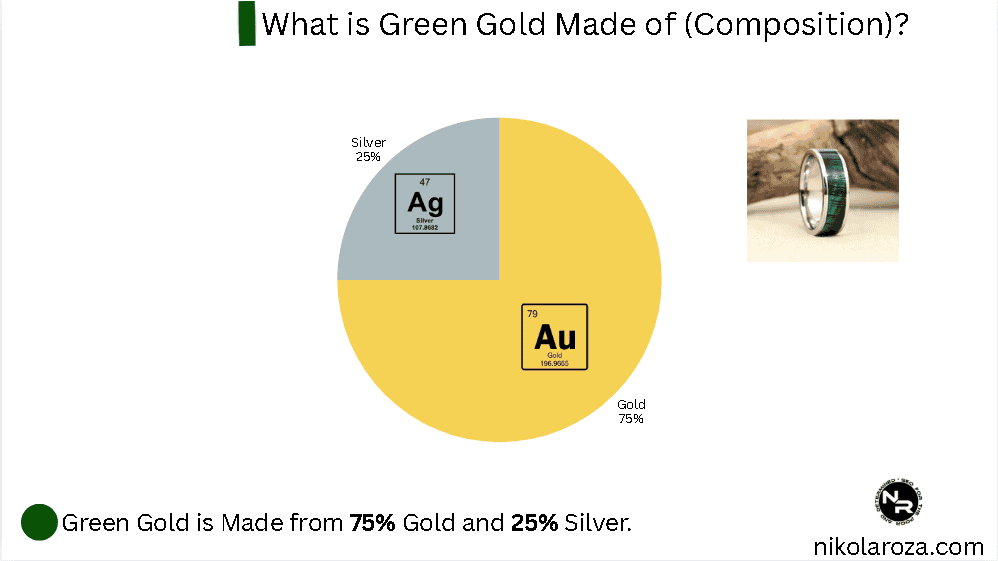
Green gold is an alloy of gold and silver. It consist of 75% pure gold and 25% silver and it’s the silver content that gives a greenish hue to green gold. Zinc, copper and nickel are also added to green gold alloy to strengthen it, though in trace amounts compared to silver.
Green gold is found in nature and natural green gold is called Electrum.
Green gold ores exist and they’re are the same ores yellow gold is extracted from. In mining locales gold and silver are often found together and occasionally they make a natural alloy (Electrum) which can be mined.
Historically, a major Electrum source was Lydia, around the Pactolus River in modern Turkey. Anatolia is a primary source of Electrum nowadays. Smaller amounts of natural green gold have been found in Nevada, USA. Electrum is also mined in Russia, at the Talnakh Cu-Ni Deposit.

Green gold made with cadmium was common in the past as cadmium was added to the alloy to achieve a pronounced green tint. Just 2-4% cadmium was enough for this purpose (2% cadmium gives a light green tint. 4% cadmium gives a dark shade of green).
Cadmium is no longer used in green gold production as it’s highly toxic to humans.
You like green gold which means you like real, yellow gold as well, right? Check this out next if you answered yes!
Is There Green Gold Jewelry? Is it Real and Is it Common?
Yes, green gold jewelry exists. It’s real, but uncommon. Green gold jewelry is rare compared to yellow gold, rose gold and white gold variants.
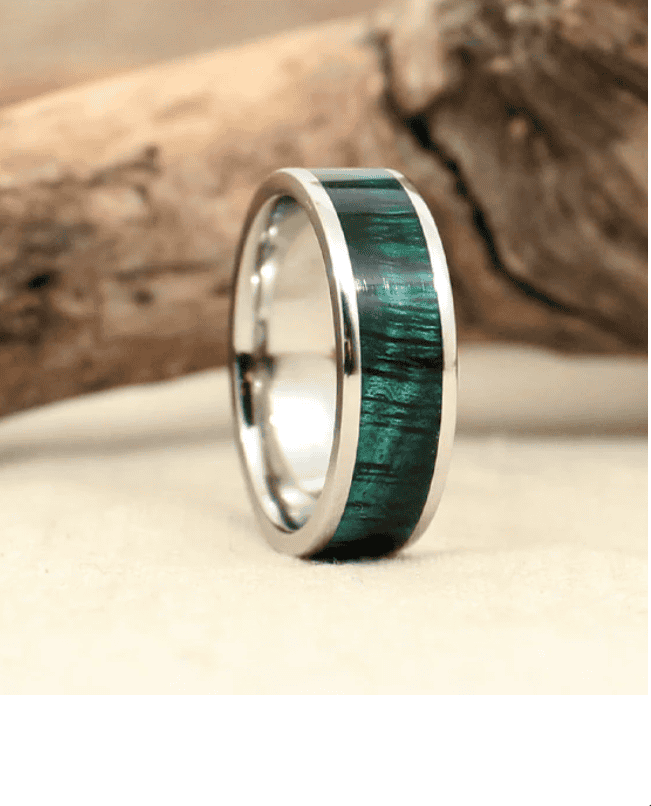
Green gold jewelry has a subtle greenish-yellow hue that distinguishes it from conventional gold tones. It shares the malleability and corrosion resistance of standard gold, making it ideal for intricate designs and everyday wear.
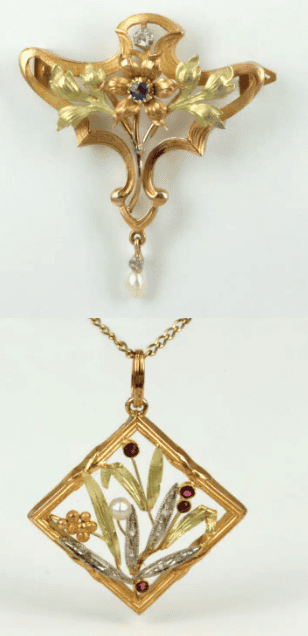
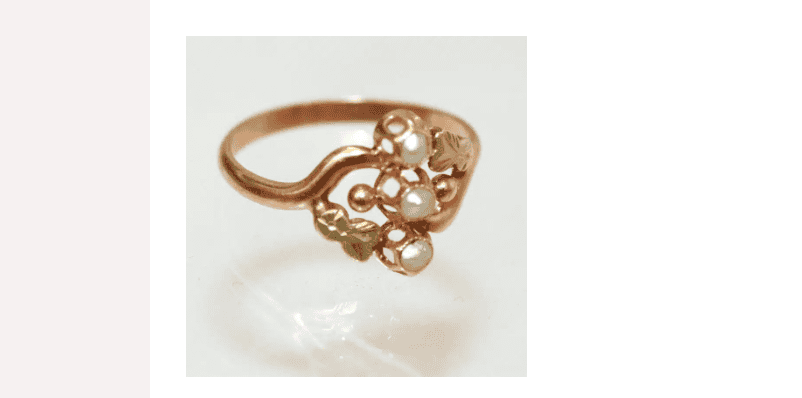
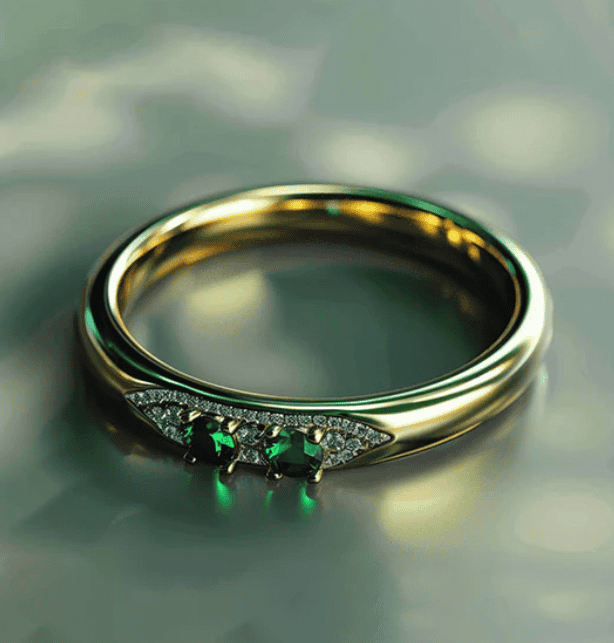
I’ve gathered below some example of green gold jewelry for you to check out.
Which Karats is Green Gold Available in?
Green gold comes in 18k and 14k options. 14k green gold has a more pronounced greenish tint than 18k green gold because it contains less pure gold and more silver in its alloy.
Note: pure gold isn’t green, but a shade of orange.
| Green Gold Alloy Type | Gold (%) | Silver (%) |
|---|---|---|
| 18k Green Gold | 75 | 25 |
| 14k Green Gold | 58.3 | 41.7 |
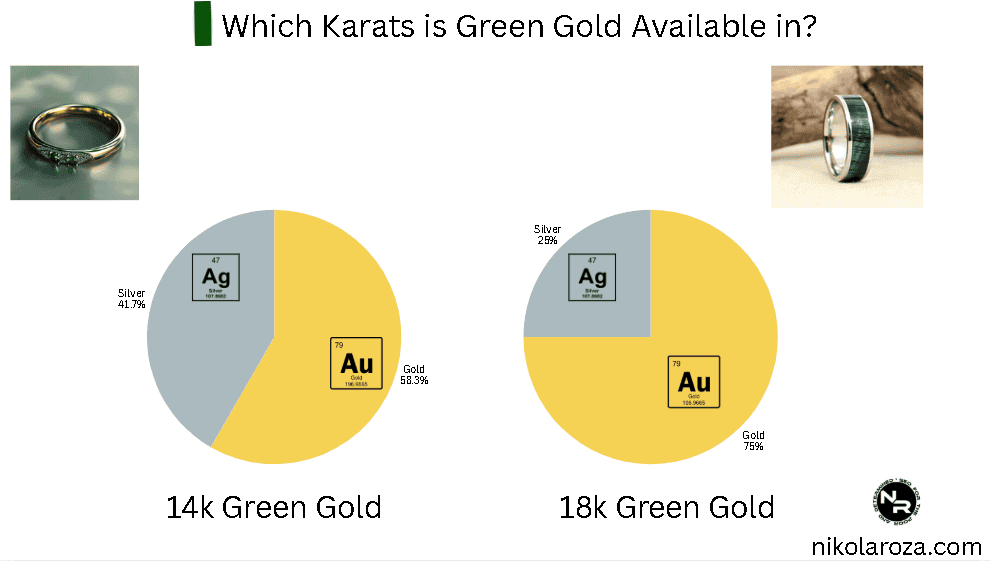
19k green gold (79.1% pure gold and 20.9% pure silver) is also available on the market. It’s rarer than 14k and 18k green gold and has the weakest green tint of the three as it contains the least amount of silver.
You like green gold which means you like real, yellow gold as well, right? Check this out next if you answered yes!
What is Green Gold’s Melt Value? Is it Worth Anything and What is its Worth Per Gram?
Green Gold’s melt value depends on the current gold and silver market prices which fluctuate from moment to moment based on the demand/supply interplay.
To determine the worth of your green gold item first you need to measure its weight. Second, determine the amount of pure gold in your green gold item. This will also give you the amount of pure silver with the alloy. Third, multiply the weight of gold by the gold spot price and then by 1 (for 100% purity) to get the melt value. Fourth, multiply the weight of silver by the silver spot price and then by 1 (for 100% purity) to get the melt value. Fifth, combine the values of gold and silver within your green gold item to get its melt value.
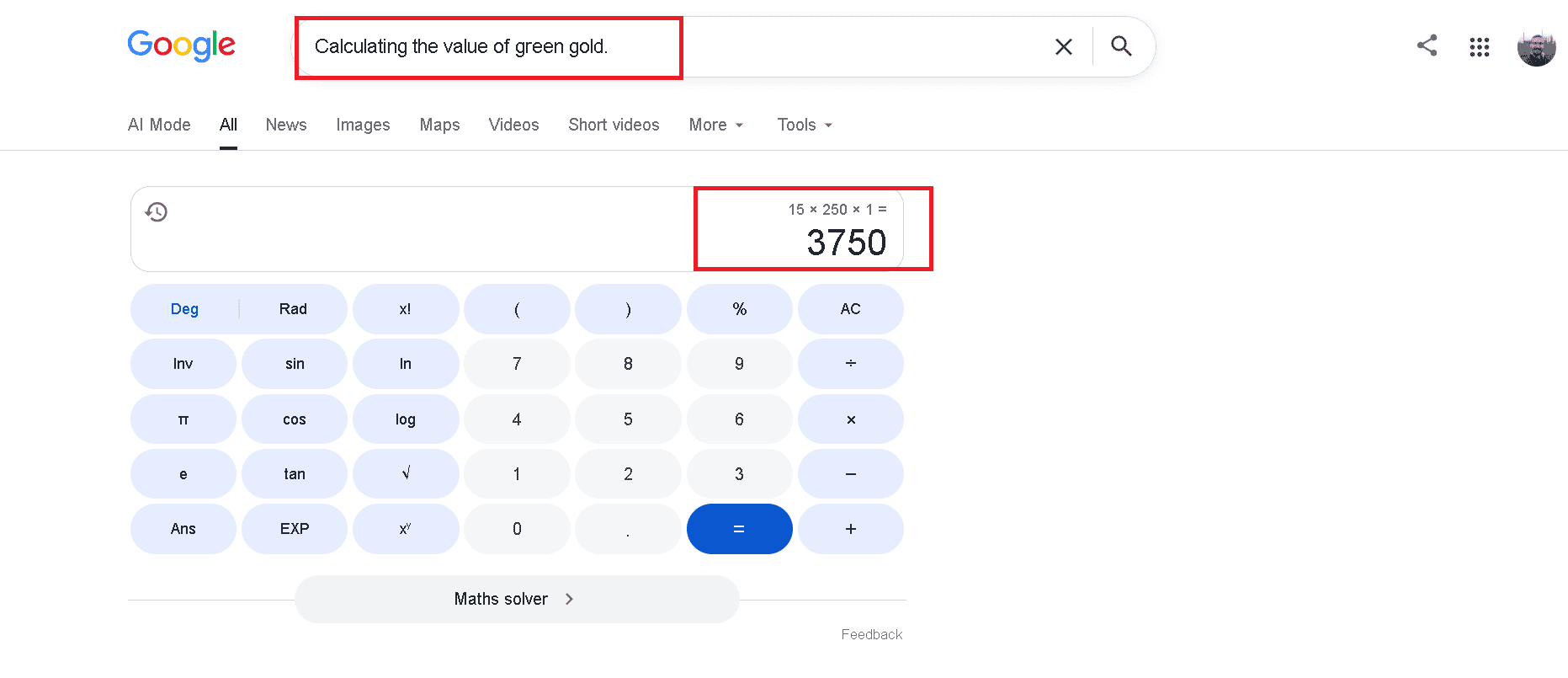
For example, let’s say the current price of gold is $250 per gram. And there’s 15 grams of gold in your green gold jewelry item. That’s 15 x 250 x 1= $3750.
For example, let’s say the current price of silver is $4 per gram. And there’s 5 grams of silver in your green gold jewelry item. That’s 5 x 4 x 1= $20
The exact worth of that green gold item would be $3750+ $20= $3770.
Does Green Gold Tarnish? Does it Corrode, Rust and Oxidize?
Yes, green gold tarnishes. Green gold is an alloy of yellow gold and silver+ some other metals in trace amounts. All yellow gold forms tarnish with the exception of 24k gold (pure gold). And the only difference is the tarnishing speed because higher-karat yellow gold tarnishes slower than lower-karat gold.
All silver forms tarnish, with the exception of fine silver (100% purity) including the silver used to make green gold.
Below are all the tarnishing-causing substances and their effect on green gold jewelry items.
- Fire. Fire tarnishes green gold. The heat from the flame affects the high silver content in the alloy and causes it to change color. Brief flame exposure doesn’t hurt green gold items in any way. Green gold doesn’t corrode, rust or oxidize when exposed to fire.
- Water. Green gold tarnishes when exposed to water. Water has a negative effect on silver and silver is a large part of green gold alloy. Saltwater and chlorinated water are especially damaging to green gold and can corrode it. Don’t shower or go into public pools while wearing your green gold jewelry.
- Chlorine. Chlorine tarnishes and corrodes green gold. Silver and copper chemically react to chlorine and start tarnishing quickly after the initial exposure. Prolonged green gold exposure to chlorine will cause it to corrode and oxidize.
- Toothpaste. Toothpaste doesn’t tarnish and corrode green gold. However, the abrasive particles in toothpaste make tiny, microscopic scratches green gold item’s surface. Over time this degrades the metal’s surface and diminishes its greenish tint and luster.
- Bleach. Bleach both tarnishes and corrodes green gold. The silver and copper in green gold are particularly vulnerable to this chemical. Bleach and chlorine within it cause quick discoloration of green gold and I advise you to keep bleach away from your green gold jewelry.
- Hydrogen peroxide. Hydrogen peroxide tarnishes green gold, but doesn’t corrode and oxidize it. Typical hydrogen peroxide you find in your kitchen cupboard is a mild oxidant unlikely to cause significant damage or discoloration to your green gold jewelry items.
- Lemon juice. Lemon juice tarnishes green gold. The citric acid reacts with silver and causes discoloration. At first, that discoloration is barely perceptible. But, tarnish will spread and become more visible if you use lemon juice to clean your green gold jewelry. Don’t do it!
- Vinegar. Vinegar tarnishes green gold due to its acids reacting with the silver and copper content within the alloy. Green gold’s prolonged exposure to vinegar will cause it to develop permanent tarnish and discoloration. Vinegar doesn’t corrode and oxidize green gold.
- Nitric acid. Nitric acid doesn’t tarnish green gold. However, nitric acid is very destructive to silver and easily dissolves it to create silver nitrate. Don’t get your green gold anywhere near nitric acid.
- Alcohol. Alcohol doesn’t tarnish or corrode green gold. You can use rubbing alcohol (isopropyl alcohol) to clean your green gold jewelry. However, I don’t recommend frequent cleaning of green gold with alcohol as alcohol dries out the metal and affects the copper content over time. The amount of copper in green gold alloy is small, but it’s not zero and eventually you’ll notice some tarnishing and patina with repeated cleanings.
- Makeup. Makeup tarnishes green gold when it contains zinc oxide. Makeup without zinc oxide doesn’t tarnish, corrode or oxidize green gold.
You like green gold which means you like real, yellow gold as well, right? Check this out next if you answered yes!
Is Green Gold Magnetic?
No, green gold isn’t magnetic.
Green gold is an alloy of yellow gold (yellow gold isn’t magnetic), silver (silver isn’t magnetic) and trace amounts of nickel, zinc and copper.
Nickel is magnetic, but zinc and copper aren’t. The amount of nickel in a green gold alloy is very small and not enough to elicit any magnetic reaction.
Bottom line is that genuine green gold doesn’t magnetize.
Is Green Gold Hypoallergenic or Allergenic?
Green gold is hypoallergenic. It’s not allergenic. Green gold is made of yellow gold, silver and very small amounts of copper, zinc and nickel for added strength and durability. Yellow gold is hypoallergenic. Silver is hypoallergenic too.
Copper, zinc and nickel are common allergenic metals. But green gold alloy has very little of these metals within it so they’re unlikely to cause an allergic reaction even in the most sensitive individuals.
This means green gold jewelry is hypoallergenic and safe for people with known metal allergies. Make sure you test your skin first before investing in green gold jewelry.
You like green gold which means you like real, yellow gold as well, right? Check this out next if you answered yes!
Is it Possible to Include Green Gold as Part of a Gold IRA Account?
No, it isn’t possible to include green gold as part of a gold IRA. Green gold coins and bars aren’t IRA eligible and approved. You can only include IRA approved gold bullion in your IRA account. Other possibilities are IRA-approved silver, IRA-eligible palladium and IRA-approved platinum coins and bars.
Bullion from all these four precious metals has to meet strict requirement to be eligible. For example, IRA-approved gold coins and bars must be 99.5% pure and must be produced by an IRA-approved mint. Small gold bars must meet exact weight specifications. And IRA-eligible silver coins and bars must be at least 99.9% pure.
You can buy IRA-approved precious metals through an online dealer or a safe U.S. gold IRA company. I recommend Augusta Precious Metals as one of the best gold investment companies in the USA. You can read my review of Augusta Precious Metals here.

Green gold bars don’t exist.
I thoroughly researched and the closest thing I found was green gold bars from Valcambi. However, these aren’t bars made from green gold (75:25% gold to silver ratio), but .999 gold bars where gold was ethically sourced with Earth’s natural ecosystems in mind.
They’re “green gold bars” because they were produced without harming the Earth’s ecosystem.

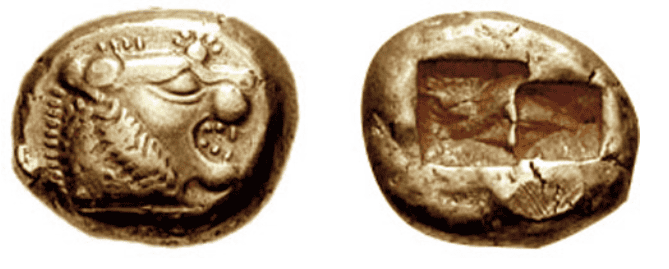
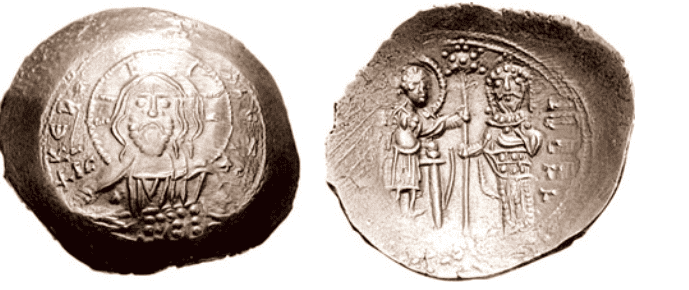
Green gold coins are no longer massively produced, but in the distant past they were much more common. Good examples are electrum coins from Lydia and Byzantine Empire.
You like green gold which means you like real, yellow gold as well, right? Check this out next if you answered yes!
Is it Possible to Turn Green Gold into Yellow Gold?
Yes, it’s possible to turn green gold into yellow gold. However, it’s an intricate process that only a professional jeweler with the right tools and knowledge can do.
First, the jeweler melts the green gold. Second, they remove silver because silver gives a greenish tint to green gold. Third, they add other metals to the remaining yellow gold to increase the alloy’s strength and durability without changing its natural yellow color.
The jeweler then solidifies and reshapes the yellow gold alloy into a desirable jewelry item.
And that’s how to turn green gold into yellow gold.
Green Gold vs Gray Gold- What are the Differences?
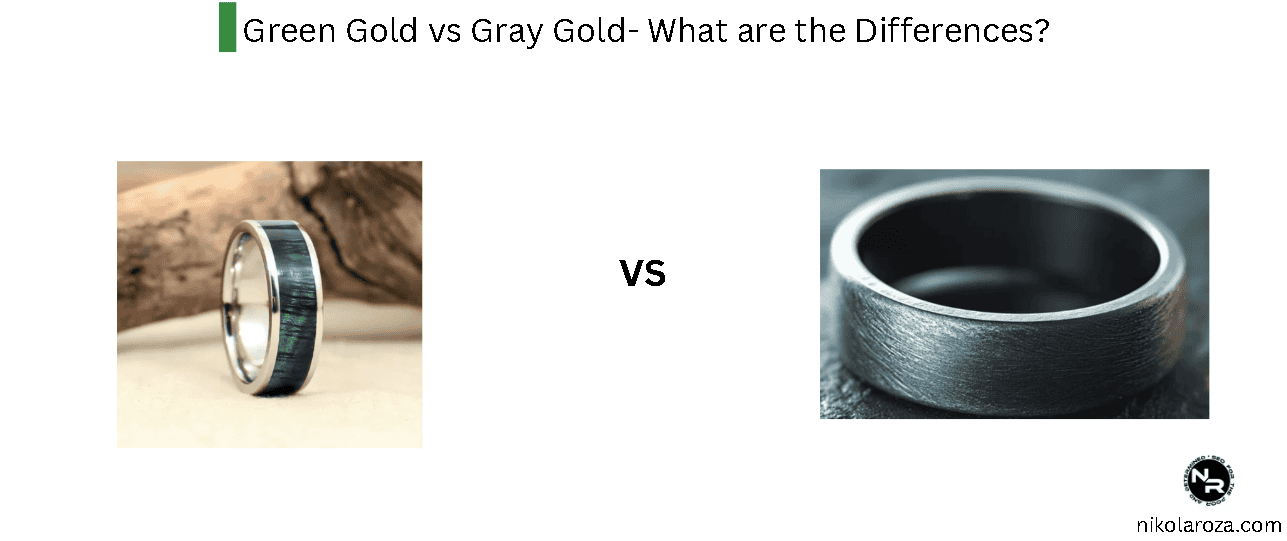
Green gold is an alloy of gold and silver, typically 75% gold and 25% silver, where the high silver content produces its distinctive greenish hue. Gray gold gets its color from combining yellow gold with metals like palladium, silver, manganese, or copper.
Green gold exists in both natural and man-made forms, with the natural variety known as electrum. Gray gold is entirely man-made as no raw gray gold exists in nature.
Both green and gray gold are available in 14k and 18k, are hypoallergenic, and ineligible for Gold IRAs.
Gray gold becomes magnetic if iron is used in its alloy, while green gold is consistently non-magnetic.
| Comparison | Green Gold | Gray Gold |
|---|---|---|
| Composition | Yellow gold +silver+ low amounts of zinc, nickel and copper. | Yellow gold +palladium+ low amounts of manganese and copper. |
| Color and tarnish resistance | Green gold doesn't tarnish as both of its main constituent parts (pure gold and pure silver) don't tarnish. | Gray gold is highly resistant to tarnishing because both yellow gold and palladium are tarnish resistant. |
| Durability and scratch resistance | Green gold is durable, strong, scratch resistant and suitable for jewelry applications. | Gray gold is moderately durable and scratch resistant. |
| Cost | Green gold is less expensive than gray gold because gray gold contains gold+palladium whereas green gold is made of gold+silver. Palladium is worth much more than silver. | Gray gold is more expensive than green gold. |
| Skin tone compatibility | The best skin tone for green gold is the warm skin undertone, characterized by green or yellowish veins on the wrist and a tendency to tan rather than burn. | The best skin tone for gray gold is natural warm, cool, or neutral undertones |
| Hypoallergenic properties | Green gold is hypoallergenic to most people. Allergies to silver within the green gold alloy are rare, but possible. | Gray gold is hypoallergenic because all constituent parts of gray gold alloy are hypoallergenic. |
Green Gold vs Black Gold- What are the Differences?
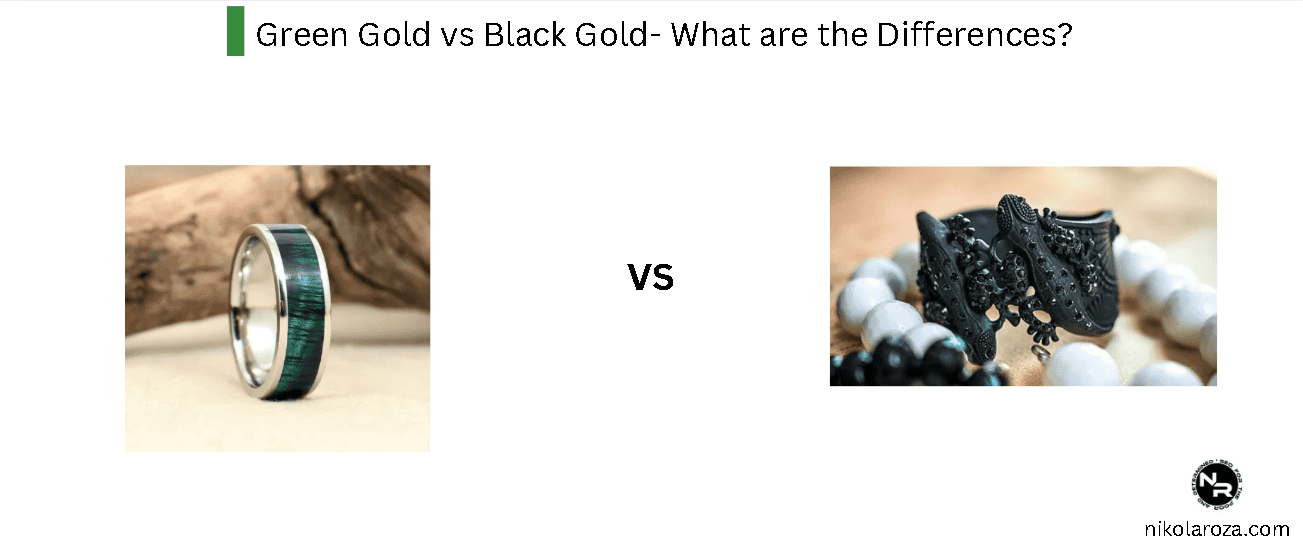
Green gold is an alloy of gold and silver. Its greenish hue comes from high silver content, and exists in both natural (electrum) and man-made forms.
Black gold, by contrast, is entirely human-made and doesn’t occur naturally. It’s made through electroplating yellow gold with black rhodium or ruthenium, alloying it with metals like cobalt, laser treatment, or oxidation.
Green gold is hypoallergenic and non-magnetic. Black gold is also non-magnetic. The key practical difference is durability: electroplated black gold’s coating wears off over time, requiring re-plating, whereas green gold’s color is inherent to its alloy composition and permanent.
| Comparison | Green Gold | Black Gold |
|---|---|---|
| Composition | Yellow gold +silver+ low amounts of zinc, nickel and copper. | Yellow gold coated with a thin layer of a dark metal like rhodium or ruthenium. |
| Color and tarnish resistance | Green gold doesn't tarnish as both of its main constituent parts (pure gold and pure silver) don't tarnish. | Black gold doesn't tarnish because its core is real gold, which doesn't tarnish. |
| Durability and scratch resistance | Green gold is durable, strong, scratch resistant and suitable for jewelry applications. | Black gold that has rhodium or ruthenium plating is exceptionally strong, durable and scratch resistant. Electroplated black gold scratches easily. |
| Cost | Green gold is less expensive than black gold because black gold contains gold+ruthenium or rhodium, whereas green gold is made of gold+silver. Ruthenium and rhodium are worth more than silver. | Black gold is more expensive than green gold because of the higher yellow gold content. |
| Skin tone compatibility | The best skin tone for green gold is the warm skin undertone, characterized by green or yellowish veins on the wrist and a tendency to tan rather than burn. | The best skin tone for black gold is natural warm, cool, or neutral undertones. |
| Hypoallergenic properties | Green gold is hypoallergenic to most people. Allergies to silver within the green gold alloy are rare, but possible. | Black gold is hypoallergenic. Yellow gold as base is hypoallergenic and both rhodium and ruthenium as coating are non-allergenic. |
Green Gold vs Blue Gold- What are the Differences?
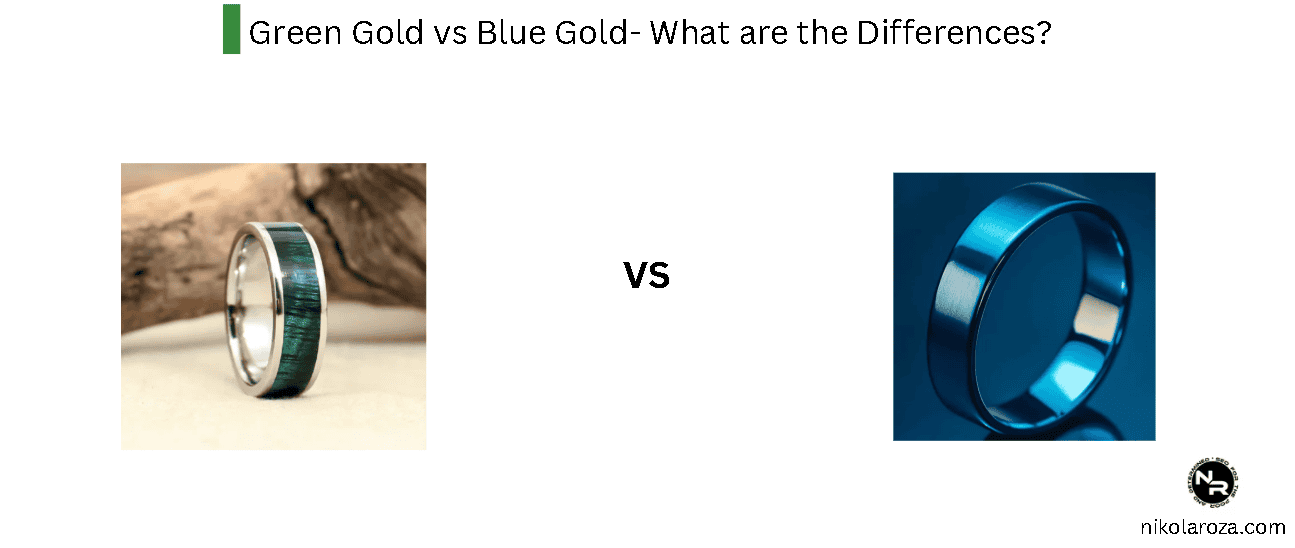
Green gold is an alloy of gold and silver, with its greenish hue coming from high silver content, and exists in both natural and man-made forms. Blue gold, by contrast, is purely man-made, created by combining yellow gold with either indium or gallium.
Green gold and blue gold also differ in karat range. Green gold is available in 14k, 18k, and 19k varieties, while blue gold is only available in 11k and 14k variants. Both are hypoallergenic and non-magnetic. However, blue gold is notably brittle and fragile, making it a true novelty alloy made more for testing than commercial purposes. Green gold is practical for everyday jewelry wear.
| Comparison | Green Gold | Blue Gold |
|---|---|---|
| Composition | Yellow gold +silver+ low amounts of zinc, nickel and copper. | Yellow gold +gallium or indium |
| Color and tarnish resistance | Green gold doesn't tarnish as both of its main constituent parts (pure gold and pure silver) don't tarnish. | Blue gold tarnishes when blue gold is made from yellow gold and gallium. Blue gold doesn't tarnish when it's made from yellow gold and indium. |
| Durability and scratch resistance | Green gold is durable, strong, scratch resistant and suitable for jewelry applications. | Blue gold is extremely brittle and not very durable and scratch resistant. |
| Cost | Green gold is less expensive than blue gold. | Blue gold is more expensive that green gold because it's much rarer and harder to produce so jewelers charge high premiums on it. |
| Skin tone compatibility | The best skin tone for green gold is the warm skin undertone, characterized by green or yellowish veins on the wrist and a tendency to tan rather than burn. | The best skin tone for blue gold is a cool skin tone or a neutral undertone. |
| Hypoallergenic properties | Green gold is hypoallergenic to most people. Allergies to silver within the green gold alloy are rare, but possible. | Blue gold is hypoallergenic to most people. Allergies to indium and gallium are rare, but possible. |
Green Gold vs Purple Gold- What are the Differences?
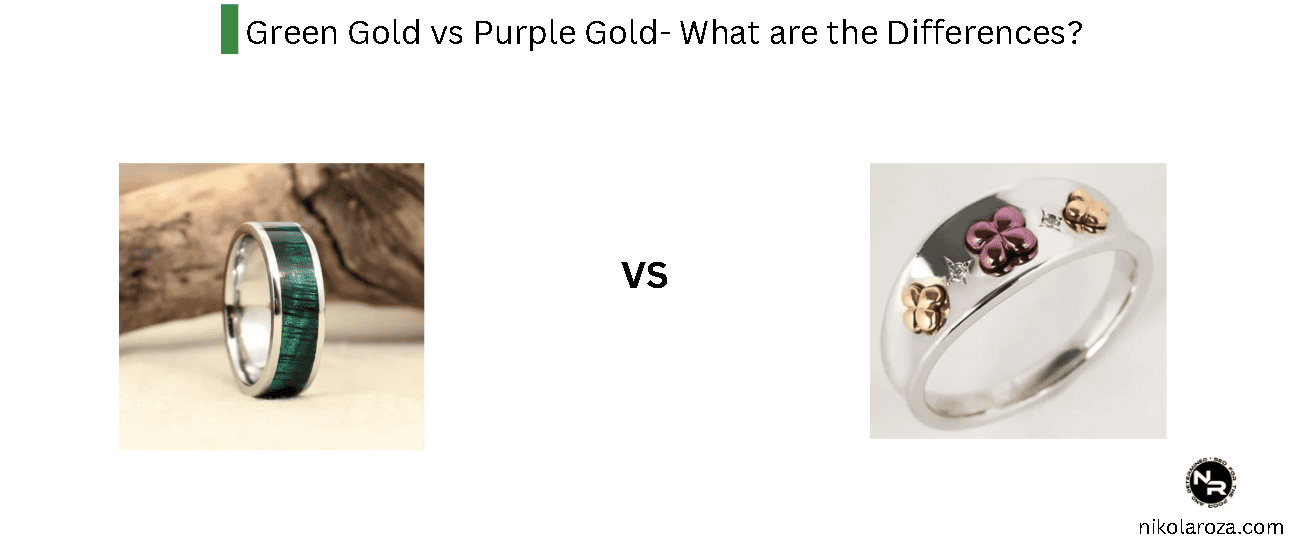
Green gold is an alloy of gold and silver, with its greenish hue coming from high silver content, and exists in both natural and man-made forms. Purple gold, by contrast, is a manufactured alloy of 79% gold and 21% aluminum, forming the intermetallic compound AuAl₂.
A major practical difference between green gold and purple gold is durability. Green gold is malleable and suitable for everyday jewelry wear. Purple gold is extremely brittle and can shatter, making it unsuitable for solid pieces and is instead used only as small decorative inlays.
Green gold is available in 14k, 18k, and 19k, while purple gold is only available in 18k. Both are non-magnetic, but purple gold can be allergenic due to its aluminum content.
| Comparison | Green Gold | Purple Gold |
|---|---|---|
| Composition | Yellow gold +silver+ low amounts of zinc, nickel and copper. | Yellow gold + aluminum |
| Color and tarnish resistance | Green gold doesn't tarnish as both of its main constituent parts (pure gold and pure silver) don't tarnish. | Purple gold tarnishes because of the presence of aluminum. |
| Durability and scratch resistance | Green gold is durable, strong, scratch resistant and suitable for jewelry applications. | Purple gold is extremely brittle and not very durable and scratch resistant. |
| Cost | Green gold is more expensive than purple gold. | Purple gold is less expensive than green gold because gold+ aluminum (purple gold alloy) is cheaper than gold+silver (green gold alloy). |
| Skin tone compatibility | The best skin tone for green gold is the warm skin undertone, characterized by green or yellowish veins on the wrist and a tendency to tan rather than burn. | The best skin tone for purple gold is a cool skin tone or a neutral undertone. |
| Hypoallergenic properties | Green gold is hypoallergenic to most people. Allergies to silver within the green gold alloy are rare, but possible. | Purple gold is allergenic because aluminum is a known allergenic metal. |
- What is Green Gold Jewelry? (And Where to Buy It)- https://jewelryinformer.com/gold/green-gold/
- Why don’t more people work with green gold?- https://www.reddit.com/r/jewelers/comments/15yrw6b/why_dont_more_people_work_with_green_gold/
- Green Gold vs. Yellow Gold- https://www.reddit.com/r/EngagementRings/comments/14y6gru/green_gold_vs_yellow_gold/
- What Is Green Gold? Your Guide to Green and Other Gold Colors- https://www.coffinandtrout.com/what-is-green-gold-your-guide-to-green-and-other-gold-colors/
- Green Gold-Gold which contains a high proportion of silver, causing a greenish hue- https://www.josephjewelry.com/guide/glossary/green+gold
- Electrum- https://en.wikipedia.org/wiki/Electrum
- An article on green gold- https://www.kalmarantiques.com.au/articles/an-article-on-green-gold/
- What is green gold?- https://www.renesim.com/en/pages/green-gold
- Electrum Mineral Facts: Chemical Formula: Au(Ag) Gold and Silver alloy, more than 20% silver by weight.- https://nevada-outback-gems.com/mineral_information/Electrum_mineral_info.htm

Nikola Roza
Nikola Roza is the owner of Nikola Roza- Everything You Can Learn About Precious Metals. He writes for people who love precious metals and jewelry and who're interested in adding gold, silver platinum and palladium to their retirement portfolios. Nikola is passionate about gold IRAs and investing in multiple asset types for a safer financial future. He also runs a successful online jewelry store where you can buy precious metal jewelry and various replicas of famous coins and bars. Learn about Nikola here.