
Disclosure: Some of the links you’ll encounter are affiliate links. If you click and buy something, I’ll get a commission. If you’re reading a review of some precious metals company, please understand that some of the links are affiliate links that help me pay my bills and write about what I love with no extra cost to you. Thank you!
The global aluminum market is estimated at 76.47 million tons in 2026, expected to reach 107.3 million tons by 2035, valued at $190.98 billion growing to $222.4 billion.
China dominates production at 60% of global output, followed by India (6%), Russia (5%), Canada (4%), and UAE (4%).
Primary uses include transportation (29%), construction (26%), and packaging (16%). Global bauxite reserves total 55-75 billion tons, with Guinea, Australia, and Vietnam holding 66%. U.S. aluminum demand is 12.2 million metric tons annually, with 80% from recycling.
China produces 43 million metric tons annually, projected to reach 60 million by 2035. Nearly 75% of all aluminum ever produced remains in use today.
Learn more in my updated aluminum industry statistics guide for 2026.
All the references and resources I used in crafting my stats guide are listed at the bottom of the page.
Take this quiz and test your knowledge on aluminum production and usage across the globe and various industries. Take the quiz after reading my guide for your best results.
Key Aluminum Industry Statistics, Facts and Trends
Key Aluminum Industry Statistics, Facts and Trends for 2026
- Global resources of bauxite are estimated to be between 55 billion and 75 billion tons and are sufficient to meet world demand for aluminum metal for thousands of years into the future. Guinea, Australia, and Vietnam together hold 66% of the world’s total bauxite reserves.
- The global aluminum market is estimated at 76.47 million tons in 2026 and is expected to reach 90.07 million tons by 2030, growing at a CAGR of 3.33%. By 2035 the global aluminum market is expected to grow to 107.3 million tons in a calendar year.
- The value of global aluminum market size has reached $190.98 billion in 2026 and is estimated to grow at 5.9% CAGR from 2026 to 2035 reaching the value of $222.4 billion in 2035.
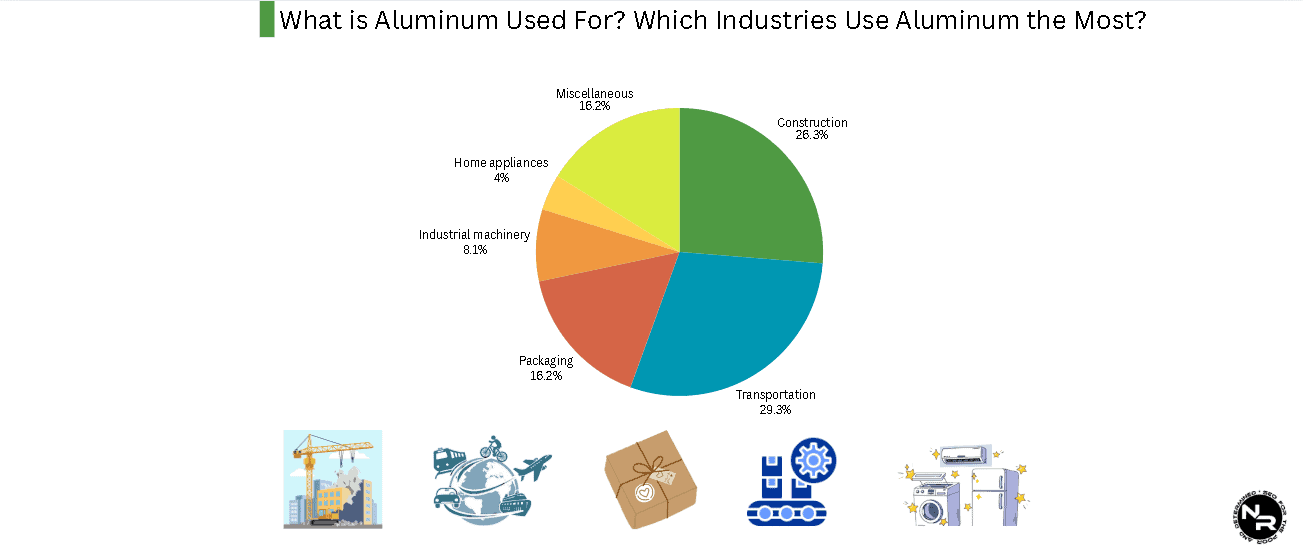
- 26.17% of the world’s aluminum is used in building and construction work.
- 29% of the world’s aluminum is used in Transportation/Automotive industry.
- 16% of the world’s aluminum is used in Packaging industry (mainly aluminum foil packaging).
- 8% of the world’s aluminum goes to producing various industrial machinery and its components.
- 4% of the world’s aluminum goes to producing appliances, cooking utensils, and various common household items.
- Roughly 16% of the world’s aluminum goes to miscellaneous uses across various industrial sectors, and increasingly for building datacenters for AI.
- China is by far the largest aluminum producer, followed by United States, India, Russia, Canada and United Arab Emirates. These six countries combined make up >80% of the global aluminum production.
- United States produce a negligible amount of bauxite for primary aluminum on their territory, with the last major mine closing decades ago. The country currently relies almost entirely on imported bauxite and alumina.
- U.S.’s aluminum demand totaled an estimated 26,969 billion pounds in 2024 (~12 247 000 metric tons), representing 3.4% growth year-over-year. United State’s aluminum demand is expected to hit 33 billion pounds in 2035 (~14 969 000 metric tons) with the expected growth being driven by major advancements in AI and data center build up.
- The aluminum industry supports $228 billion in economic activity and nearly 700,000 jobs in the United States.
- The industries in the U.S. that use the most aluminum are transportation (35.5%), construction (13%), packaging (23%), and the electrical and electronics sectors (16%).
- U.S. produces an estimated 670,000 to 720, 000 metric tons of primary aluminum in a calendar year.
- The majority of the country’s total aluminum supply comes from recycling, with secondary production reaching approximately 3.6- 4.1 million metric tons per year. This means the total amount of aluminum produced in the U.S. from both primary and secondary sources is roughly 4.3-4.7 million metric tons.
- Recycled aluminum makes up more than 80% of U.S. aluminum production. 20 years ago only 20-30% of aluminum was recycled into new products.
- The U.S. imports approximately 6.6 million metric tons of aluminum, valued at about $34.31 billion.
- China produces roughly 93 million metric tons of bauxite in a calendar year.
- Despite this high domestic production, China heavily relies on imports to meet its massive aluminum needs, as it holds a relatively small portion of global bauxite reserves.
- China’s bauxite reserves are an estimated 880 million to 1 billion tons, only 3% of global bauxite reserves).
- China’s estimated total aluminum demand (consumption) is roughly 43 million metric tons. China’s aluminum demand is projected to grow at a steady pace and reach 60 million metric tons by 2035.
- Currently, China is the world’s largest consumer and producer of aluminum, accounting for >50% of global demand.
- The main industries in China that use the most aluminum are construction (33%) and transportation (25%), followed by packaging (30%) and electrical applications (7%).
- ~850 000 people are directly employed in China’s aluminum smelting industry.
- In 2020, China recycled 7.25 million tons of aluminum, and the industry has plans to increase its output to over 15 million tons annually by 2027, and to over 20 million tons annually by 2035.
- China imports >3 million tons of unwrought aluminum in a calendar year. The primary sources for these imports are Russia, Indonesia, and India, with Russia supplying over 50% of the imports (1.5 million tons).
- China exports roughly 5.2 million tons of aluminum. That’s $34 billion in aluminum and its products, or roughly 15.8% of total global aluminum exports.
- India produces an estimated 25 million metric tons of bauxite and roughly 4.2 million metric tons of aluminum per year.
- The current demand for aluminum in India is approximately 5.5 million metric tons. The total consumption (including secondary sources) is roughly 6-6.2 million metric tons.
- The Indian aluminum industry provides livelihoods to >1 million people directly and indirectly across its value chain.
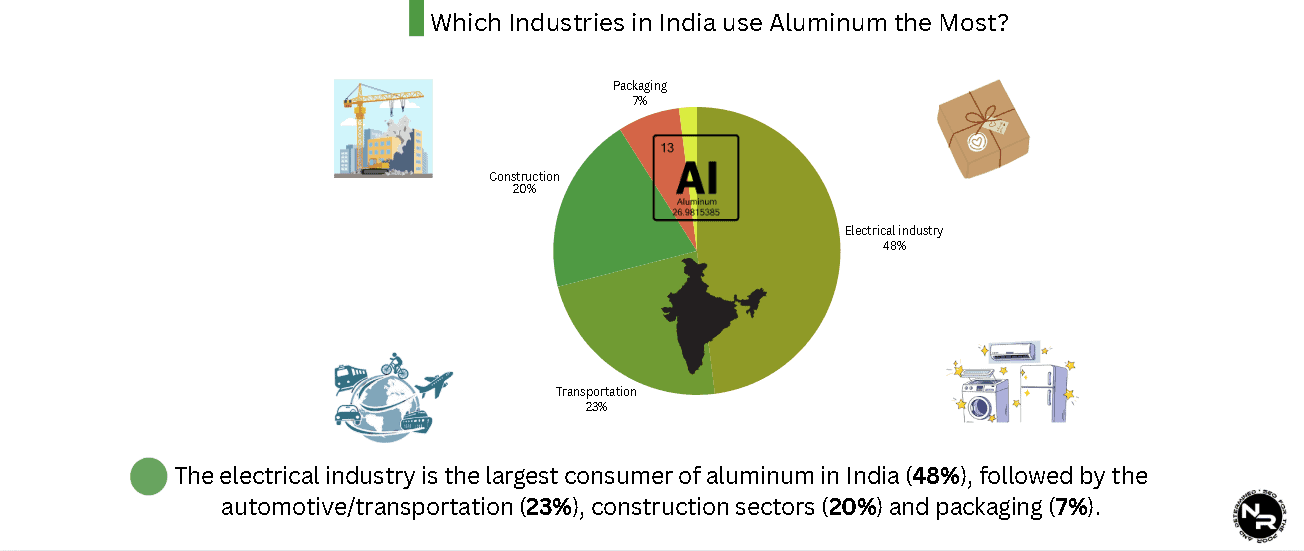
- The electrical industry is the largest consumer of aluminum in India (48%), followed by the automotive/transportation (23%), construction sectors (20%) and packaging (7%).
- India’s aluminum recycling rate is approximately 30-35%. In terms of volume, the country now sources over 2.16 million tons of its aluminum output from recycled sources. This is >40% of its total aluminum output.
- India exports roughly $5.97 billion worth of raw aluminum, making it the 4th largest exporter globally.
- Russia produces approximately 6.2 million tons of bauxite, making it the world’s seventh-largest producer.
- Russia’s domestic demand for aluminum is estimated to be around 1.2 to 1.3 million metric tons annually, with plans to increase this to 1.8 million metric tons by 2035.
- Russia produces an average of 3.8 million metric tons of aluminum, which is about 5% of the global aluminum production.
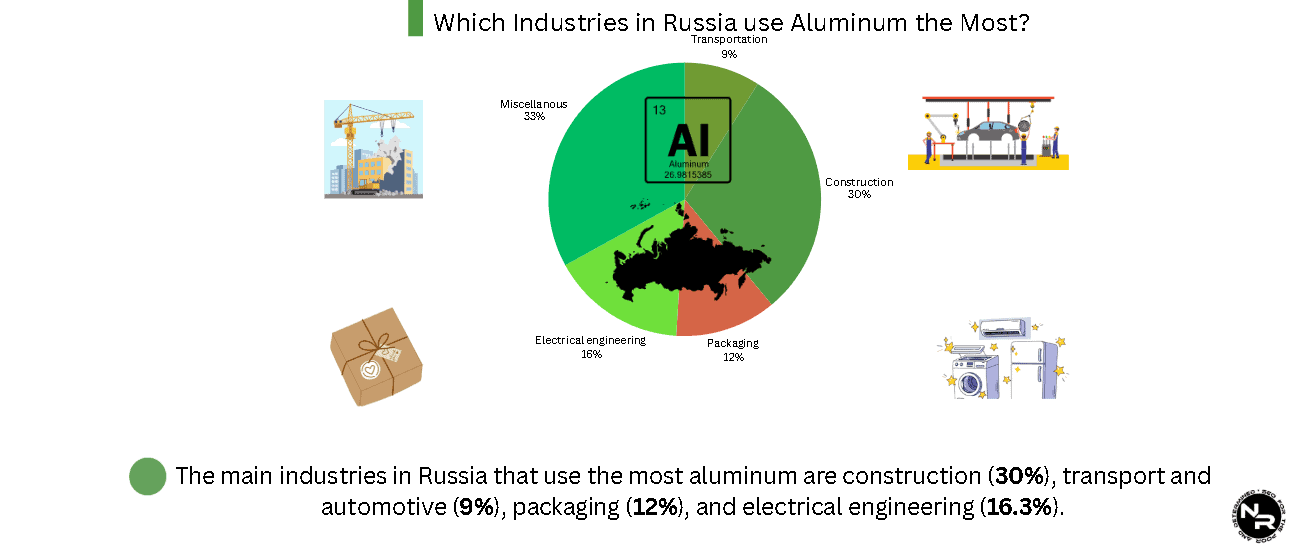
- The main industries in Russia that use the most aluminum are construction (30%), transport and automotive (9%), packaging (12%), and electrical engineering (16.3%).
- The Russian aluminum industry provides employment for >600,000 people.
- Canada doesn’t have bauxite mines. The country is a major global producer of primary aluminum by importing bauxite and refining it into alumina, which is then smelted into aluminum, mainly using Canada’s abundant hydroelectric power.
- Canada imports ~3.7 million metric tons of bauxite in a calendar year.
- Canada’s domestic aluminum demand is around 0.66 million metric tons, but the country is a net exporter, consuming only about 19% of its own production.
- Canada produces roughly 3.3 million metric tons of primary aluminum per year.
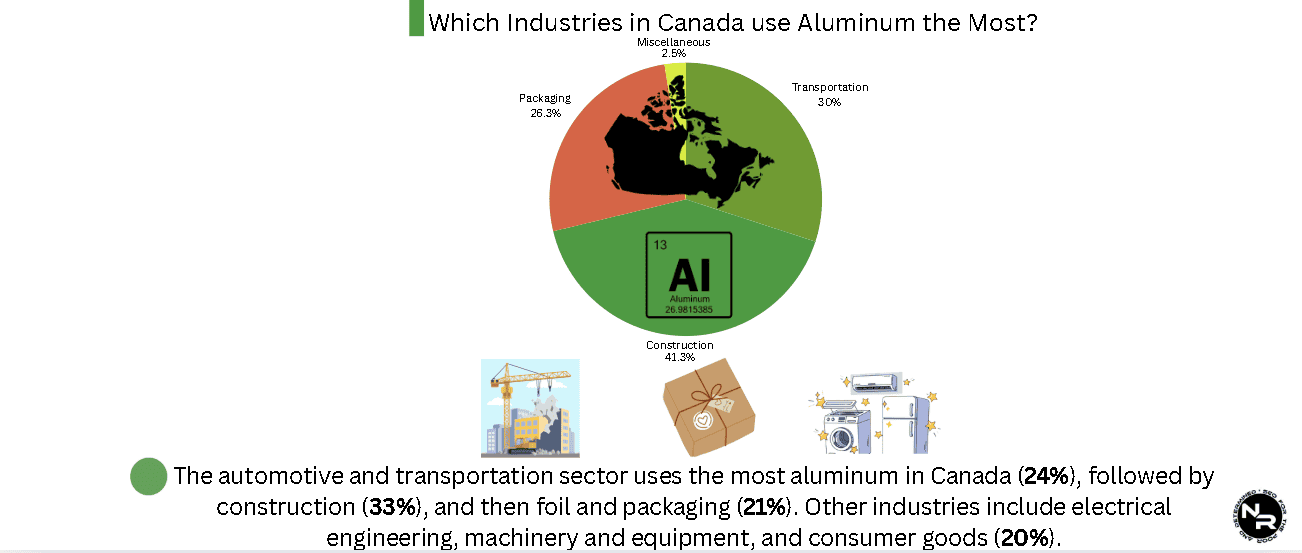
- The automotive and transportation sector uses the most aluminum in Canada (24%), followed by construction (33%), and then foil and packaging (21%). Other industries include electrical engineering, machinery and equipment, and consumer goods (20%).
- The Canadian aluminum industry directly employs around 9,500 to 11,000 people, with most jobs located in Quebec.
- Canada has strong aluminum recycling rates, particularly for beverage cans at 80-85% and over 90% for automotive and construction applications.
- The average aluminum can in Canada contains 70% recycled content, and the country exports significant amounts of used beverage cans to the US. Combined, the US and Canada annually recycle approximately five million tons of aluminum.
- Canada imports an estimated $553 million in raw aluminum with most of it coming from the United States. Canada also imports $9.5 billion worth of various aluminum products including bauxite and alumina.
- The global aluminum alloys for semiconductor market reached $3.8 billion in 2024 and is expected to grow to $7.8 billion by 2035, representing a CAGR of roughly 7.5%.
- Nearly a billion tons (~75%) of all aluminum produced in history is still in use today. This is because aluminum can be recycled indefinitely without losing on quality and workability.
- In many industrial markets like automotive and building, recycling rates for aluminum exceed 90%.
- Recycling aluminum requires around 5% of the energy needed to make new aluminum.
Detailed Aluminum Industry Statistics, Facts and Trends for This Year
What are the Global Resources of Bauxite?
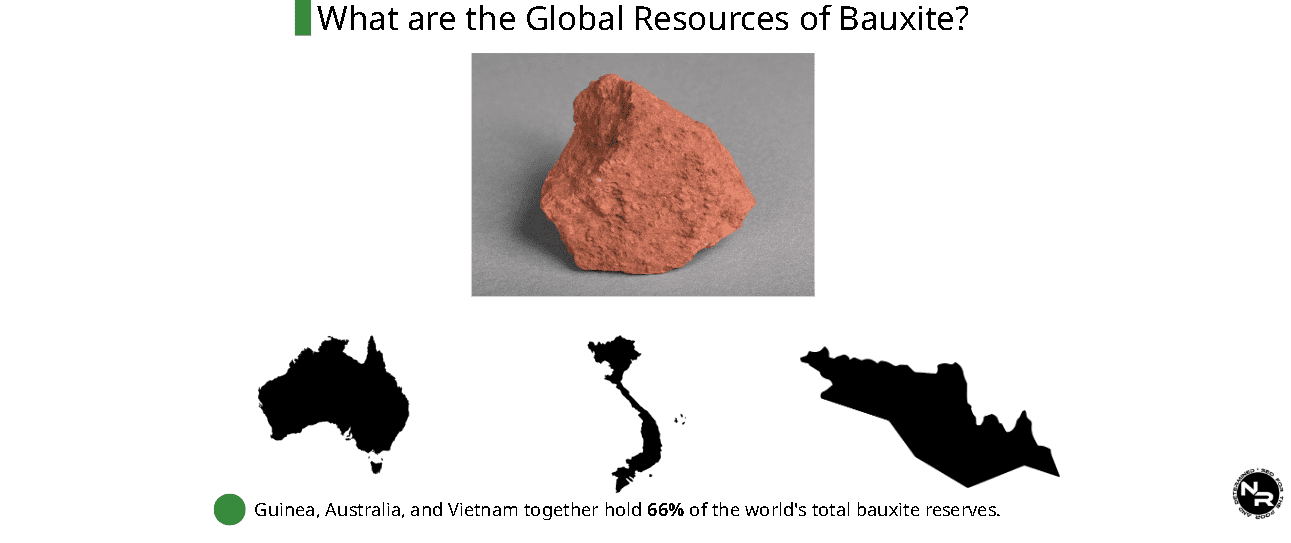
Global resources of bauxite are estimated to be between 55 billion and 75 billion tons and are sufficient to meet world demand for aluminum metal well into the future.
Guinea, Australia, and Vietnam together hold 66% of the world’s total bauxite reserves.
Guinea has roughly 25% of bauxite on its territory. That’s roughly 7.4 billion metric tons.
Australia has roughly 21% of bauxite on its territory. That’s roughly 6.005 billion metric tons.
Vietnam has roughly 20% of bauxite on its territory. That’s roughly 5.8 billion metric tons.
What is the Market Size of Global Aluminum Industry?
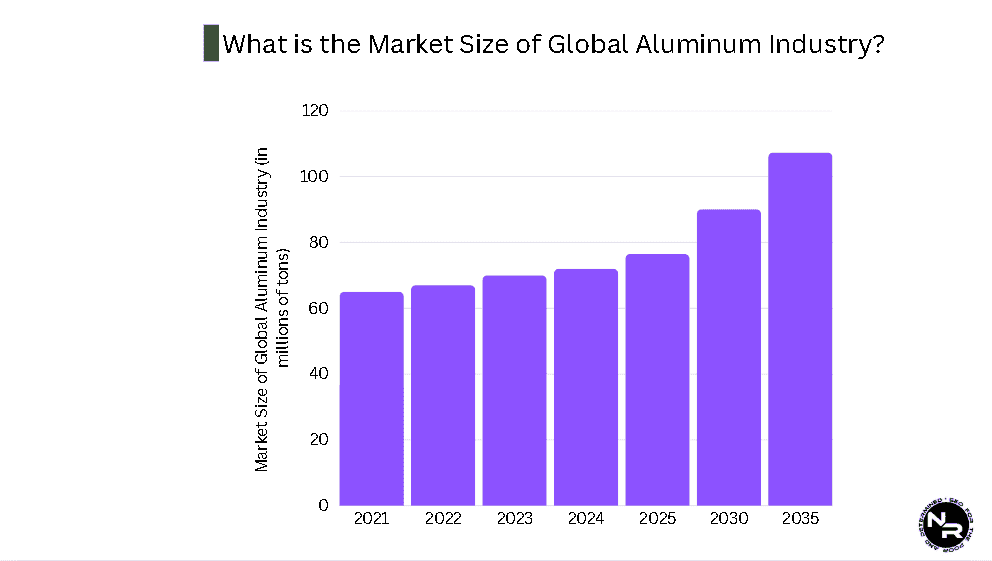
The global aluminum market is estimated at 76.47 million tons in 2026 and is expected to reach 90.07 million tons by 2030, growing at a CAGR of 3.33%.
The global aluminum market is expected to reach 107.3 million tons in a calendar year by 2035.
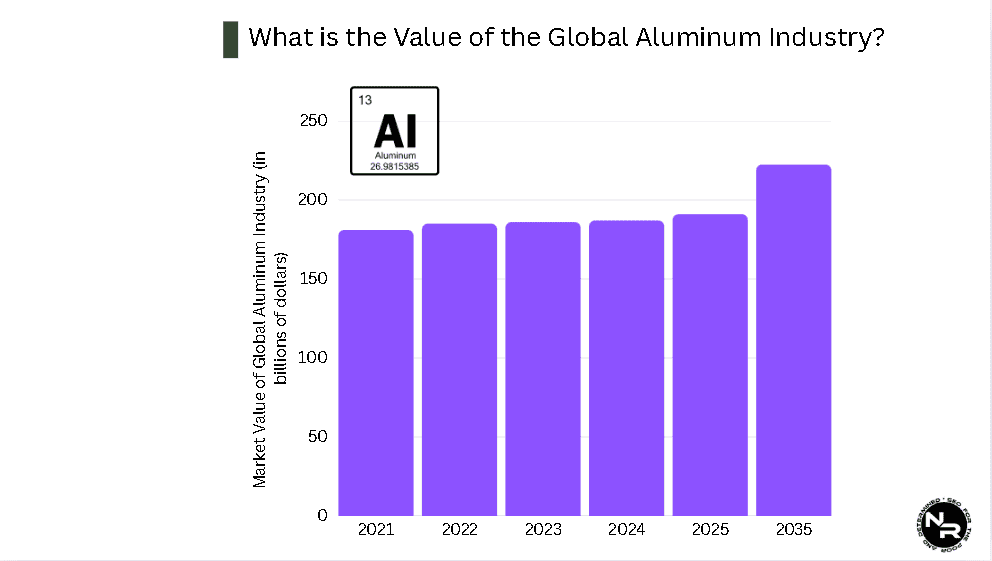
The value of global aluminum market size has ballooned to $190.98 billion in 2026 and is estimated to grow at 5.9% CAGR from 2026 to 2035 reaching the value of $222.4 billion in 2035.
What is Aluminum Used For? Which Industries Use Aluminum the Most?
Aluminum is used across various industries. Industries that use aluminum the most are construction, transportation, packaging and automotive industry.
- 26.17% of the world’s aluminum is used in building and construction work.
- 29% of the world’s aluminum is used in Transportation/Automotive industry.
- 16% of the world’s aluminum is used in Packaging industry (mainly aluminum foil packaging).
- 8% of the world’s aluminum goes to producing industrial machinery and its components.
- 4% of the world’s aluminum goes to producing appliances, cooking utensils, and various common household items (freezers, refrigerators, ovens, toasters, kettles, microwaves…).
- Roughly 16% of the world’s aluminum goes to miscellaneous uses across various industrial sectors, and increasingly for building datacenters for AI.
Which Countries are the World’s Biggest Aluminum Producers?
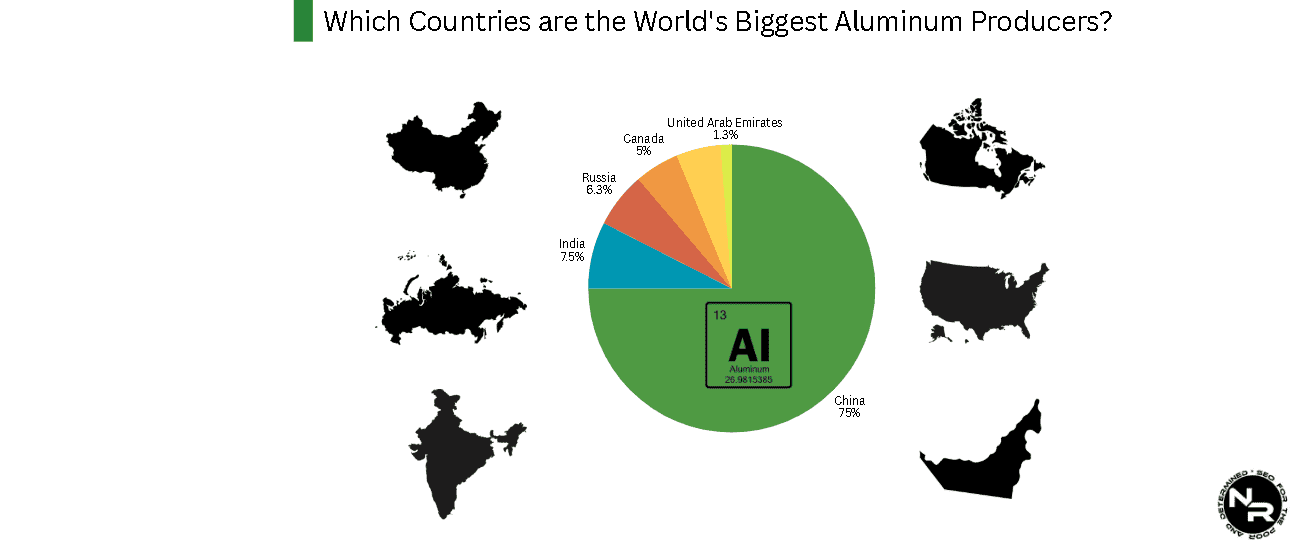
China is by far the largest aluminum producer, followed by United States, India, Russia, Canada and United Arab Emirates. These six countries combined make up >80% of global aluminum production.
- China produces 60% of the world’s aluminum in a calendar year.
- India produces 6% of the world’s aluminum in a calendar year.
- Russia produces 5% of the world’s aluminum in a calendar year.
- Canada produces 4% of the world’s aluminum in a calendar year.
- United Arab Emirates produce 4% of the world’s aluminum in a calendar year.
- United States produce 1.1% of the world’s aluminum in a calendar year.
| Aluminum producer | Percent | Tons |
|---|---|---|
| China | 60 | 43 million |
| India | 6 | 6-6.2 million |
| Russia | 5 | 3.8 million |
| Canada | 4 | 3.3 million |
| United Arab Emirates | 4 | 2.7 million |
| United States | 1.1 | 4.3-4.7 million |
What are Some Facts and Info About United State’s Aluminum Industry?
United States currently rely almost entirely on imported bauxite and alumina. It’s because bauxite is no longer mined on the U.S. soil with the last major mine closing decades ago.
U.S.’s aluminum demand totaled an estimated 26,969 billion pounds in 2024 (~12 247 000 metric tons), representing 3.4% growth year-over-year.
United State’s aluminum demand is expected to hit 33 billion pounds in 2035 (~14 969 000 metric tons) with the expected growth being driven by major advancements in AI and data center build up.
Virginia, California, and Texas are the US states with the highest number of data centers so that’s where most of the aluminum meant for AI is going.
The aluminum industry supports $228 billion in economic activity and nearly 700,000 jobs in the United States.
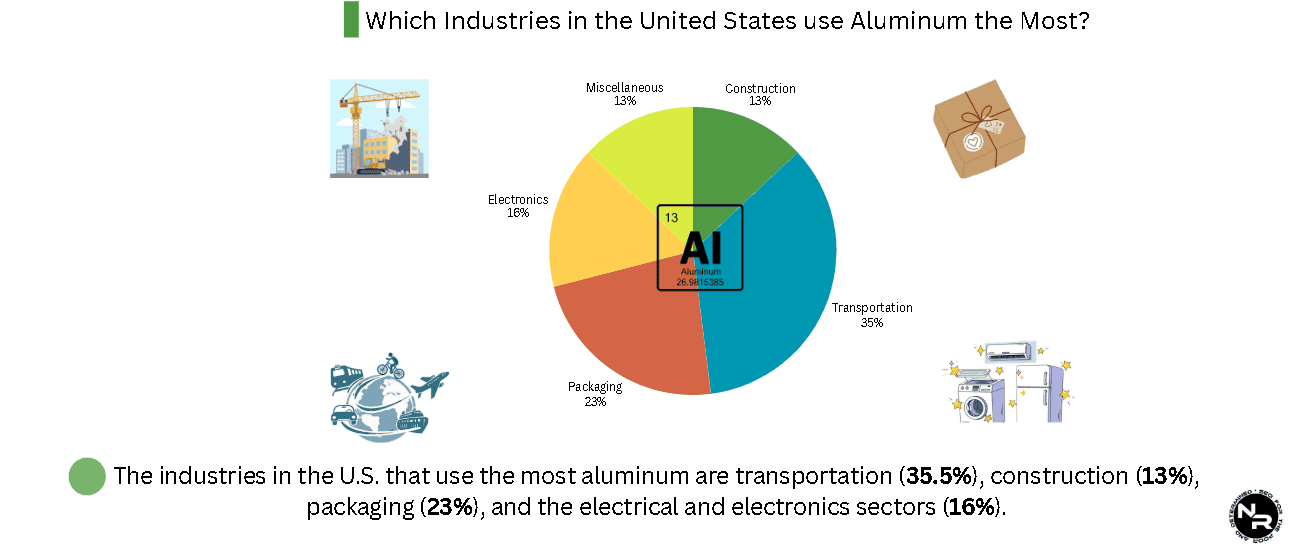
The industries in the U.S. that use the most aluminum are transportation (35.5%), construction (13%), packaging (23%), and the electrical and electronics sectors (16%).
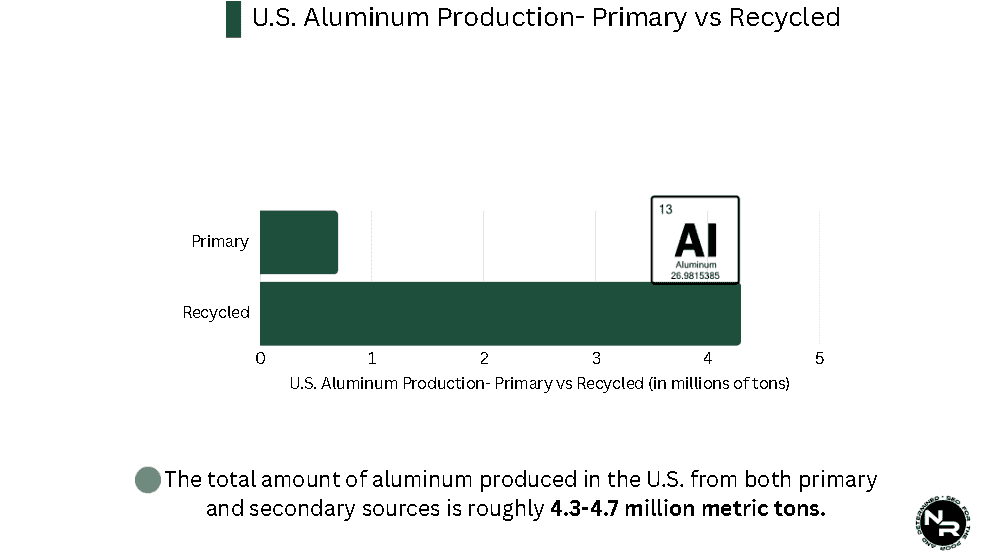
U.S. produces an estimated 670,000 to 720, 000 metric tons of primary aluminum in a calendar year.
However, the majority of the country’s total aluminum supply comes from recycling, with secondary production reaching approximately 3.6- 4.1 million metric tons per year.
This means the total amount of aluminum produced in the U.S. from both primary and secondary sources is roughly 4.3-4.7 million metric tons.
Recycled aluminum makes up more than 80% of U.S. aluminum production. 20 years ago only 20-30% of aluminum was recycled into new products.
The U.S. imports approximately 6.6 million metric tons of aluminum, valued at about $34.31 billion.
What are Some Facts and Info About China’s Aluminum Industry?
China produces roughly 93 million metric tons of bauxite in a calendar year.
Despite this high domestic production, China heavily relies on imports to meet its massive aluminum needs, as it holds a relatively small portion of global bauxite reserves (note: China’s bauxite reserves are an estimated 880 million to 1 billion tons, only 3% of global bauxite reserves).
China’s estimated total aluminum demand (consumption) is roughly 43 million metric tons and China’s aluminum demand is projected to grow at a steady pace and reach 60 million metric tons by 2035.
| Year | Aluminum demand |
|---|---|
| 2022 | 41.1 million |
| 2023 | 42 million |
| 2024 | 42.4 million |
| 2025 | 43 million |
| 2035 | 60 million (predicted demand). |
Currently, China is the world’s largest consumer and producer of aluminum, accounting for >50% of global demand.
The industries in China that use the most aluminum are construction (33%) and transportation (25%), followed by packaging (30%) and electrical applications (7%).

~328 000 people are directly employed in China’s aluminum smelting industry. Overall employment for the entire aluminum industry in China is higher, with recent estimates putting the total at around 850 000 employees in upstream and downstream sectors.
In 2020, China recycled 7.25 million tons of aluminum, and the industry has plans to increase its output to over 15 million tons annually by 2027, and to over 20 million tons annually by 2035.
China’s goal to reduce the amount of imports and reduce their reliance on foreign suppliers.
China is also an aluminum importer. They import >3 million tons of unwrought aluminum in a calendar year. The primary sources for these imports are Russia, Indonesia, and India, with Russia supplying over 50% of the imports (>1.5 million tons).
China exports roughly 5.2 million tons of aluminum. That’s $34 billion in aluminum and its products, or roughly 15.8% of total global aluminum exports.
What are Some Facts and Info About India’s Aluminum Industry?
India produces an estimated 25 million metric tons of bauxite and roughly 4.2 million metric tons of aluminum per year.
The current demand for aluminum in India is approximately 5.5 million metric tons. The total consumption (including secondary sources) is roughly 6-6.2 million metric tons.
Aluminum demand in India will reach 10 million metric tons in a calendar year by 2035.
| Year | Aluminum demand |
|---|---|
| 2022 | 4.1 million |
| 2023 | 4.2 million |
| 2024 | 4.5 million |
| 2025 | 5.5 million |
| 2035 | 10 million (predicted demand). |
The Indian aluminum industry provides livelihoods to >1 million people directly and indirectly across its value chain.
The electrical industry is the largest consumer of aluminum in India (48%), followed by the automotive/transportation (23%), construction sectors (20%) and packaging (7%).
India’s aluminum recycling rate is approximately 30-35%. In terms of volume, the country now sources over 2.16 million tons of its aluminum output from recycled sources. This is >40% of its total aluminum output.
India exports roughly $5.97 billion worth of raw aluminum, making it the 4th largest exporter globally.
This includes about 356,377 tons of unwrought, alloyed aluminum, primarily destined for Japan, South Korea, and the United States.
What are Some Facts and Info About Russia’s Aluminum Industry?
Russia produces approximately 6.2 million tons of bauxite, making it the world’s seventh-largest producer. This figure is a small fraction of global output, representing about 1.6% of the total.
Russia’s domestic demand for aluminum is estimated to be around 1.2 to 1.3 million metric tons annually, with plans to increase this to 1.8 million metric tons by 2035.
| Year | Aluminum demand |
|---|---|
| 2022 | 1.05 million |
| 2023 | 1.1 million |
| 2024 | 1.2 million |
| 2025 | 1.3 million |
| 2035 | 1.8 million (predicted demand). |
Russia produces an average of 3.8 million metric tons of aluminum, which is about 5% of the global aluminum output of the world. Their output is higher than the internal demand which makes Russia a large aluminum exporter as well.
>85% of Russia’s aluminum surplus is exported to China.
The main industries in Russia that use the most aluminum are construction (30%), transport and automotive (9%), packaging (12%), and electrical engineering (16.3%).
The Russian aluminum industry provides employment for >600,000 people. This figure encompasses direct and indirect employment across the entire domestic aluminum sector.
The primary company in the industry is UC RUSAL, which is one of largest aluminum producer in the world. RUSAL employs approximately 50,000 to 60,000 people globally across its operations in various countries, with a significant number (>45 000) of those employees based in Russia.
What are Some Facts and Info About Canada’s Aluminum Industry?
Canada produces no bauxite as it doesn’t have bauxite mines. Instead, they import ~3.7 million metric tons of bauxite in a calendar year.
The country is a major global producer of primary aluminum by importing bauxite and refining it into alumina, which is then smelted into aluminum, mainly using its abundant hydroelectric power.
Canada’s domestic aluminum demand is around 0.66 million metric tons, but the country is a net exporter, consuming only about 19% of its own production.
Canada produces roughly 3.3 million metric tons of primary aluminum per year.
The automotive and transportation sector uses the most aluminum in Canada (24%), followed by construction (33%), and then foil and packaging (21%). Other industries include electrical engineering, machinery and equipment, and consumer goods (20%).
The Canadian aluminum industry directly employs around 9,500 to 11,000 people, with most jobs located in Quebec. This includes direct jobs in mining, processing, and manufacturing, as well as indirect jobs that support the industry.
Canada has strong aluminum recycling rates, particularly for beverage cans at 80-85% and over 90% for automotive and construction applications.
The average aluminum can in Canada contains 70% recycled content, and the country exports significant amounts of used beverage cans to the US. Combined, the US and Canada recycle approximately five million tons of aluminum annually.
Canada imports an estimated $553 million in raw aluminum with most of it coming from the United States. Canada also imports $9.5 billion worth of various aluminum products including bauxite and alumina.
Who Found Aluminum?
Danish chemist Hans Christian Ørsted is credited with the discovery of aluminum in 1825, when he produced a small, impure sample of the metal.
Although his sample was not pure enough for analysis, his work was followed by German chemist Friedrich Wöhler, who was able to produce slightly larger particles in 1827 and determined some of aluminum’s properties.
Is There Bullion Made of Aluminum?
Yes, there’s bullion made of aluminum, but it’s very rare.
I searched online and found only one website (Luciteria) that’s sells aluminum bars. The same site doesn’t sell coins made of aluminum.
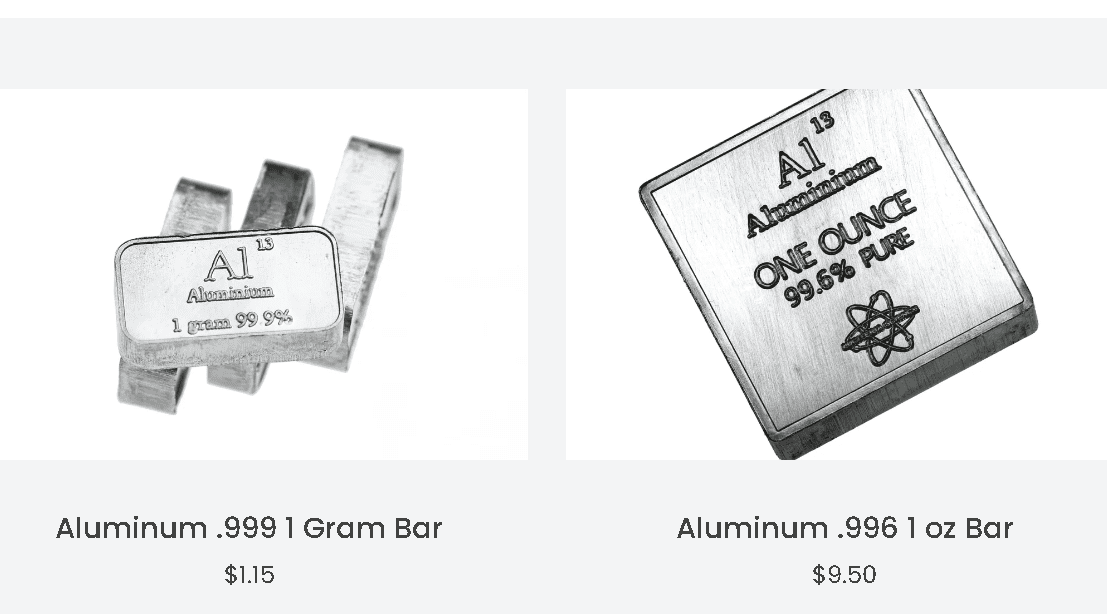
Note: 100% purity aluminum bars exists, but it doesn’t mean you can include them part of your gold IRA account.
Gold, silver, platinum and palladium are precious metals eligible to be included as part of a gold IRA.
You can buy IRA-approved metals from a company like Augusta Precious Metals. Augusta is the best gold IRA company in the United States and they can help you with all your investing needs while protecting you from common gold IRA scams.
Aluminum Industry Statistics, Facts and Trends Guide (Conclusion)
My updated guide for 2026 lists the best and latest statistics, facts, trends and data about aluminum industry and how this metal is used worldwide.
I hope you enjoyed it because the guide is now over.
References:
- Statistics- https://international-aluminium.org/statistics-overview/
- Aluminum Industry Statistics- https://www.aluminum.org/aluminum-statistics-portal
- Aluminum industry in the United States- https://en.wikipedia.org/wiki/Aluminum_industry_in_the_United_States
- Aluminum industry worldwide – statistics & facts- https://www.statista.com/topics/2072/aluminum/
- Primary Aluminum Production- https://www.usgs.gov/centers/national-minerals-information-center/aluminum-statistics-and-information
- Primary Aluminum Production- https://international-aluminium.org/statistics/primary-aluminium-production/
- Aluminum Market Size, Share & Industry Analysis, By Product (Sheet, Plate, Cast Products, Extrusion, and Others), By Alloy Type (Cast Alloy and Wrought Alloy), By End-use (Construction, Transportation {Aerospace, Automotive, and Marine}, Packaging {Food & Beverages, Cosmetics, and Others}, Electrical, Consumer Durables, Machinery & Equipment, and Others), and Regional Forecast- https://www.fortunebusinessinsights.com/industry-reports/aluminium-market-100233
- Aluminum Market Size & Share Analysis – Growth Trends And Forecast- https://www.mordorintelligence.com/industry-reports/aluminum-market

Nikola Roza
Nikola Roza is a blogger behind Nikola Roza- SEO for the Poor and Determined. He writes for bloggers who don't have huge marketing budget but still want to succeed. Nikola is passionate about precious metals IRAs and how to invest in gold and silver for a safer financial future. Learn about Nikola here.