
Disclosure: Some of the links you’ll encounter are unique links. Click and buy something and I’ll earn some money, at zero expense to you. Thank you!
The global antimony market is valued at $2.1 billion, projected to reach $4.1 billion by 2035. Worldwide production is approximately 83,000 metric tons annually, down from a 2011 peak of 178,000 metric tons.
China dominates with 640,000 metric tons of reserves (32% global total) and produces 40,000 metric tons yearly (48% of supply). Russia holds 350,000 metric tons in reserves, producing 33,000 metric tons annually.
Tajikistan produces 21,000 metric tons yearly. Primary uses include flame retardants (40-50%), lead-acid batteries (30-33%), and industrial applications. Global recycling rates are only 1-10%, with lead-acid batteries accounting for 95% of secondary antimony recovery.
Antimony is critical for AI infrastructure and semiconductor manufacturing.
Learn more in my updated antimony industry statistics guide for 2026.
All the references and resources I used in crafting my stats guide are listed at the bottom of the page.
Take this quiz and test your knowledge on antinomy and its industrial applications.
Key Antimony Industry Statistics, Facts and Trends
Key Antimony Industry Statistics, Facts and Trends for 2026
- There’s roughly 2 million metric tons of antimony waiting to be extracted from the ground. The countries with the largest antimony reserves are China (32% or 640,000 metric tons), Russia (17.5% or 350,000 metric tons), Bolivia (13.5%, 265,000 metric tons), Tajikistan (13.25% or 265,000 metric tons), Myanmar (7% or 140,000 metric tons), Australia (7% or 140,000 metric tons) and Turkey (15.65% or 313,000 metric tons).
- Worldwide antimony production is roughly 83,000 metric tons in a calendar year.
- In 2011 antimony production peaked at 178,000 metric tons in a single year, but has since stalled because of various supply constraints and because of very limited global antimony reserves.
- The global antimony market is currently valued at $2.1 billion. The market is projected to reach $4.1 billion by 2035, rowing at a CAGR of 5.5-6.6%.
- China has the largest antimony reserves in the world (640,000 metric tons).
- China produces around 40,000 metric tons of antimony in a calendar year, accounting for 48% of global yearly supply.
- China’s antimony market generated $200.6 million in revenue in 2024. Their market is projected to reach $282 million per year by 2030 and $312 million by 2035.
- China’s antimony production dropped from 60,000 metric tons in 2020-2021 to 40,000 metric tons in 2024. This happened because the Chinese government imposed stricter rules for exporting antimony derivatives.
- China imports about $10.8 million worth of antimony per year. Thailand is China’s largest antimony supplier, accounting for 69% of total import value, followed by Pakistan with 22%. The remaining 9% is divide among, Australia, Tajikistan, Oman, Bolivia, and Russia.
- China exports roughly 51,000 tons of antimony per year. China’s antimony exports are valued at roughly $500 million.
- In China, the industries that use antimony the most are the flame retardants and solar panel industries, followed by the production of lead-acid batteries and alloys.
- Flame retardants account for >50% of antimony consumption in China. Battery alloys account for 17% of China’s antimony consumption. Plastic stabilizers account for 15%, catalysts account for 10%, and other applications account for approximately 6-8% of China’s antimony consumption.
- Russia possesses approximately 350,000 metric tons of antimony reserves, the second largest in the world after China.
- Russia produces around 33,000 metric tons of antimony per year, representing approximately 35% of global antimony production. Russia’s antimony production has been highly variable, ranging from 9,000-12,000 tons in recent years to the current peak of 33,000 tons in this year.
- Russia’s antimony market was valued at approximately $36.72 million in 2024 and is projected to reach $60 million by 2030 and $74 million by 2035.
- Russia imports more than 60% of its processed antimony products (high-purity antimony and antimony trioxide) from abroad, with China being the primary source at approximately $15.1 million per year. Normally, Russia, imports <20% of antimony products, but imports have risen to 60% due to the Ukrainian war, ever stricter sanctions and higher needs for processed antimony products.
- Russia exports roughly $471,000 of antimony per year with Vietnam, Kazakhstan, and China as the main destinations.
- In 2021, Russia was the second-largest global exporter of antimony ores and concentrates by value, exporting approximately 17 tons worth $51.86 million. During the Ukraine war Russia stopped all exports.
- Flame retardants account for approximately 40-48% of Russia’s antimony consumption. Lead-acid batteries and battery alloys account for approximately 30-33% of Russia’s antimony consumption. The remaining 19-27% is distributed among chemicals, plastics stabilizers, ceramics, glass, and defense applications.
- Tajikistan ranks third globally in antimony reserves with approximately 265,000 metric tons concentrated in the Jijikrut and Konchok mineral fields in Sughd province.
- Tajikistan produces roughly 21,000 metric tons of antimony per year making it the second-largest producer globally and accounting for 25% of world production.
- Tajikistan is an antimony exporter with exports worth roughly $107 million per year.
- Tajikistan’s antimony production increased by 25% from 16,777 metric tons in 2021 to 21,000 metric tons in 2024. By 2035 it’s predicted Tajikistan will produce 30 000 metric tons of antimony per year.
- Tajikistan exports over 10,600 metric tons of antimony per year and is a net exporter of this metal with minimal imports.
- France receives roughly 66% of Tajikistan’s antimony exports every year, followed by Belgium with 27%, with 5% going to the rest of the world.
- Tajikistan has minimal domestic antimony consumption as most production is exported for processing abroad; flame retardants account for approximately 40-50% of end-use globally.
- Approximately 78% of Tajikistan’s antimony exports go to China for refining and processing into flame retardants, batteries, and defense applications.
- Currently, Tajikistan is focusing on developing domestic processing capabilities to produce finished antimony products rather than only exporting raw concentrates. It’s expected that by 2035 Tajikistan will only export refined antimony product instead of just raw material.
- Myanmar possesses approximately 140,000 metric tons of antimony reserves, making it a significant global holders of this critical mineral. Myanmar emerged as a significant antimony producer from 2013 onwards, with production steadily increasing as state-owned Chinese companies partnered with the Myanmar government to develop mines in Kayha State.
- Myanmar produces around 4,600 metric tons of antimony per year, representing about 5% of global antimony output. At this rate Myanmar will run out of antimony in roughly 30 years.
- Myanmar’s antimony market is primarily export-oriented, with the country exporting antimony concentrates valued at $7 million annually to processing facilities abroad. 97% of Myanmar’s antinomy exports end up in China, and 3% end up in Thailand.
- Myanmar has minimal domestic antimony consumption, with approximately 78% of production exported to China for processing into flame retardants, batteries, and military applications. 20% is exported to other countries and just 2% of antimony is used domestically.
- The antimony Myanmar produces is primarily used in global markets for flame retardants (50-55%), lead-acid batteries (30-33%), and other applications including semiconductors, alloys, and catalysts (15-20%).
- Myanmar’s domestic antimony consumption is negligible as the country lacks significant processing infrastructure. Instead, they focus on exporting raw ore and concentrates to be refined in China, Thailand, and other regional processing centers.
- Turkey possesses antimony reserves of approximately 313,000 metric tons with deposits located in the Karaağaç mine in southern Turkey and the Turhal antimony mine. Turkey’s antimony production comes from small-scale mines operated by companies including Eti Bakir (a subsidiary of Cengiz Holding) and other operators, with concentrates typically shipped to China and Belgium for processing.
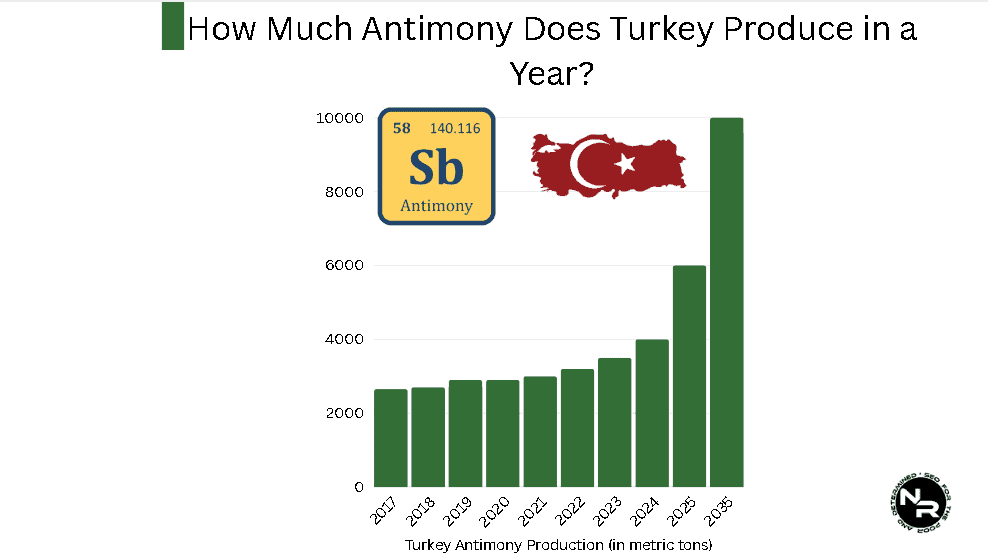
- Turkey produced 3,500 metric tons of antimony in 2023, and this grew to 4,000 metric tons in 2024. Currently, Turkey produces 6,000 metric tons of antimony in a year, making Turkey the fourth-largest producer globally. By 2035 it’s estimated Turkey will reach 10,000 metric tons of antimony produced in a calendar year.
- Turkey’s antimony market is primarily export-oriented, with exports valued at approximately $20 million per year.
- Turkey imports roughly 273 metric tons of antimony per year with imports valued at approximately $3.1 million.
- Turkey exported approximately 1,100 metric tons of antimony in 2023, with over 5 million kilograms of antimony ores and concentrates shipped to international markets.
- Italy received the largest share of Turkey’s antimony exports at 62% by value ($12.4 million), followed by Oman at 17% ($3.4 million), Austria at 13% ($2.7 million), with China and India receiving smaller amounts.
- Turkey’s domestic antimony consumption follows global patterns with flame retardants accounting for approximately 40-48% of usage in plastics, textiles, and construction materials. Lead-acid battery production and battery alloys account for approximately 30-33% of Turkey’s antimony consumption, primarily in the automotive and industrial sectors. The remaining 19-27% of Turkey’s antimony consumption is distributed among plastic stabilizers, catalysts, ceramics, glass manufacturing, and other industrial applications.
- Australia possesses approximately 140,000-313,000 metric tons of antimony reserves, ranking it as the fourth-largest globally, with deposits primarily located in Victoria and New South Wales.
- Australia produced approximately 3,380 metric tons of antimony in 2023-2024, representing about 2-4% of global supply. down from a peak of 3,900 tons in 2020.
- Australia’s antimony production declined significantly from record highs because the Hillgrove mine closed in 2016 due to low prices.
- By 2035 Australia will reach a stable output of 5 000 metric tons of antimony in a calendar year.
- Australia’s antimony market was valued at approximately $203-284 million in 2024 with the market projected to reach $311 million by 2035.
- Australia imports 24-30 tons of antimony per year, mostly from South Korea (80%) the United Kingdom (5%), and China (15%).
- Australia exports roughly 6,554 metric tons of antimony ores and concentrates per year, valued at $44 million.
- China receives 93% of Australia’s antimony ore exports paying ~$401 million, followed by Oman at 7%, with smaller amounts going to Malaysia, the Philippines, and the United States.
- Flame retardants account for approximately 40-50% of Australia’s antimony consumption, used primarily in textiles, plastics, construction materials, and electronics in compliance with safety regulations. Metal products including lead-acid batteries, antimonial lead, and ammunition account for approximately 30-36% of Australia’s antimony consumption, primarily in automotive and defense sectors. Nonmetal products including ceramics, glass, rubber products, plastic stabilizers, and catalysts account for approximately 19-22% of Australia’s antimony consumption.
- The global end-of-life recycling rate for antimony is estimated between 1-10%, making it one of the least recycled critical minerals worldwide.
- The European Union has achieved a significantly higher antimony recycling rate of roughly 28%, far exceeding the global average through integrated smelter recovery operations.
- Recycling accounts for approximately 20-25% of the global antimony supply, with over 22,000 metric tons recovered annually from various sources.
- Lead-acid batteries represent 95% of secondary antimony recovery, making them the dominant and most viable source for antimony recycling worldwide.
- This is because antimony recovery from flame-retardant plastics, textiles, cables, and e-waste is rarely economically viable due to low concentrations, lack of separation infrastructure, and high smelting costs.
- In the United States, recycling supplied approximately 15% of domestic antimony consumption, with the estimated value of secondary antimony at $73 million.
- The European Union recovered over 8,000 metric tons of secondary antimony from battery waste in 2023, up from 6,500 metric tons in 2020. With this growth rate it’s predicted that by 2035 the European Union will recover 15,500 metric tons of antimony per year.
- Between 20-25% of global secondary antimony comes specifically from the lead-acid battery sector, with recycling well-established in this industry.
Detailed Antimony Industry Statistics, Facts and Trends for This Year
Which Countries in the World Have the Biggest Antimony Reserves?
The countries with the largest antimony reserves are China (32% or 640,000 metric tons), Russia (17.5% or 350,000 metric tons), Bolivia (13.5%, 265,000 metric tons), Tajikistan (13.25% or 265,000 metric tons), Myanmar (7% or 140,000 metric tons), Australia (7% or 140,000 metric tons) and Turkey (15.65% or 313,000 metric tons).

There’s roughly 2 million metric tons of antimony waiting to be extracted from the ground.
Worldwide antimony mine production is roughly 83,000 metric tons in a calendar year.
In 2011 the production peaked at 178,000 metric tons in a single year, but has since than stalled because of various supply constraints and because of very limited antimony reserves.
| Antimony producer | Total reserves (in metric tons) | Yearly production (in metric tons) |
|---|---|---|
| China | 640,000 | 40,000 |
| Russia | 350,000 | 33,000 |
| Tajikistan | 265,000 | 21,000 |
| Turkey | 313,000 | 3,500 |
| Myanmar | 140,000 | 4,600 |
| Australia | 140,000 | 3,380 |
What is the Market Size of Global Antimony Industry?
The global antimony market is currently valued at $2.1 billion. The market is projected to reach $4.1 billion by 2035, rowing at a CAGR of 5.5-6.6%.
What are Some Facts and Info About China’s Antimony Industry?
China has the largest antimony reserves in the world (640,000 metric tons).
China produces around 40,000 metric tons of antimony in a calendar year, accounting for 48% of global yearly supply.
China’s antimony production dropped from 60,000 metric tons in 2020-2021 to 40,000 metric tons in 2024. This happened because the Chinese government imposed stricter rules for exporting antimony derivatives.
It’s predicted that China’s antimony production will remain at the same level or slightly higher (40, 000-42,000 metric tons) for the next 10-15 years.
China’s antimony market generated $200.6 million in revenue in 2024. Their market is projected to reach $282 million per year by 2030 and $312 million by 2035.
China imports about $10.8 million worth of antimony per year. Thailand is China’s largest antimony supplier, accounting for 69% of total import value, followed by Pakistan with 22%. The remaining 9% is divide among, Australia, Tajikistan, Oman, Bolivia, and Russia.
China exports roughly 51,000 tons of antimony per year. China’s antimony exports are valued at roughly $500 million.
In China, the industries that use antimony the most are the flame retardants and solar panel industries, followed by the production of lead-acid batteries and alloys.
Flame retardants account for >50% of antimony consumption in China. Battery alloys account for 17% of China’s antimony consumption.
Plastic stabilizers account for 15%, catalysts account for 10%, and other applications account for approximately 6-8% of China’s antimony consumption.
What are Some Facts and Info About Russia’s Antimony Industry?
Russia possesses approximately 350,000 metric tons of antimony reserves, the second largest in the world after China.
Russia produces around 33,000 metric tons of antimony per year, representing approximately 35% of global antimony production.
Russia’s antimony production has been highly variable, ranging from 9,000-12,000 tons in recent years to the current peak of 33,000 tons in this year.
Russia’s antimony market was valued at approximately $36.72 million in 2024 and is projected to reach $60 million by 2030 and $74 million by 2035.
| Year | Value |
|---|---|
| 2020 | $29 million |
| 2021 | $31 million |
| 2022 | $33 million |
| 2023 | $34 million |
| 2024 | $36.72 million |
| 2025 | $37 million |
| 2030 | $60 million (predicted market value) |
| 2035 | $74 million (predicted market value) |
Russia imports more than 60% of its processed antimony products (high-purity antimony and antimony trioxide) from abroad, with China being the primary source at approximately $15.1 million per year.
Normally, Russia, imports <20% of antimony products, but imports have risen to 60% due to the Ukrainian war, ever stricter sanctions and higher needs for processed antimony products.
Russia exports roughly $471,000 per year with Vietnam, Kazakhstan, and China as the main destinations.
In 2021, Russia was the second-largest global exporter of antimony ores and concentrates by value, exporting approximately 17,041,600 kg worth $51.86 million. During the Ukraine war Russia stopped all exports.
Similar to global patterns, flame retardants account for approximately 40-48% of Russia’s antimony consumption.
Lead-acid batteries and battery alloys account for approximately 30-33% of Russia’s antimony consumption.
The remaining 19-27% is distributed among chemicals, plastics stabilizers, ceramics, glass, and defense applications.
What are Some Facts and Info About Tajikistan’s Antimony Industry?
Tajikistan ranks third globally in antimony reserves with roughly 265,000 metric tons concentrated in the Jijikrut and Konchok mineral fields in Sughd province.
Tajikistan produces roughly 21,000 metric tons of antimony per year making it the second-largest producer globally and accounting for 25% of world production.
Tajikistan is an antimony exporter with exports worth roughly $107 million per year.
Tajikistan exports over 10,600 metric tons of antimony per year and is a net exporter of this metal with minimal imports.
France receives roughly 66% of Tajikistan’s antimony exports every year, followed by Belgium with 27%, with 5% going to the rest of the world.
Roughly 78% of Tajikistan’s antimony exports go to China for refining and processing into flame retardants, batteries, and defense applications.
Currently, Tajikistan is focusing on developing domestic processing capabilities to produce finished antimony products rather than only exporting raw concentrates. It’s expected that by 2035 Tajikistan will only export refined antimony product instead of just raw material.
What are Some Facts and Info About Myanmar’s Antimony Industry?
Myanmar possesses approximately 140,000 metric tons of antimony reserves, making it one of the significant global holders of this critical mineral.
They emerged as a significant antimony producer from 2013 onwards, with production steadily increasing as state-owned Chinese companies partnered with the Myanmar government to develop mines in Kayha State.
Myanmar produces around 4,600 metric tons of antimony per year, representing about 5% of global antimony output. At this rate Myanmar will run out of antimony in roughly 30 years.
Myanmar’s antimony market is primarily export-oriented, with the country exporting antimony concentrates valued at $7 million annually to processing facilities abroad. 97% of Myanmar’s antinomy exports end up in China, and 3% end up in Thailand.
Myanmar has minimal domestic antimony consumption, with approximately 78% of production exported to China for processing into flame retardants, batteries, and military applications. 20% is exported to other countries and just 2% of antimony is used domestically.
The antimony Myanmar produces is primarily used in global markets for flame retardants (50-55%), lead-acid batteries (30-33%), and other applications including semiconductors, alloys, and catalysts (15-20%).
Myanmar’s domestic antimony consumption is negligible as the country lacks significant processing infrastructure. Instead, they focus on exporting raw ore and concentrates to be refined in China, Thailand, and other regional processing centers.
What are Some Facts and Info About Turkey’s Antimony Industry?
Turkey possesses antimony reserves of approximately 313,000 metric tons with deposits located in the Karaağaç mine in southern Turkey and the Turhal antimony mine.
Turkey’s antimony production comes from small-scale mines operated by companies including Eti Bakir (a subsidiary of Cengiz Holding) and other operators, with concentrates shipped to China and Belgium for processing.
Turkey produced 3,500 metric tons of antimony in 2023, and this grew to 4,000 metric tons in 2024.
Currently, Turkey produces 6,000 metric tons of antimony in a year, making Turkey the fourth-largest producer globally.
By 2035 it’s estimated Turkey will reach 10,000 metric tons of antimony produced in a calendar year.
Turkey’s antimony market is primarily export-oriented, with antimony exports valued at approximately $20 million per year.
Turkey imports roughly 273 metric tons of antimony per year with imports valued at approximately $3.1 million.
Turkey exported approximately 1,100 metric tons of antimony in 2023, with over 5 million kilograms of antimony ores and concentrates shipped to international markets.
Italy received the largest share of Turkey’s antimony exports at 62% by value ($12.4 million), followed by Oman at 17% ($3.4 million), Austria at 13% ($2.7 million), with China and India receiving smaller amounts.
Turkey’s domestic antimony usage aligns with worldwide trends, as flame retardants represent approximately 40-48% of consumption across plastics, textiles, and construction materials.
The automotive and industrial sectors drive significant demand, with lead-acid battery production and battery alloys comprising approximately 30-33% of Turkey’s total antimony consumption.
The final 19-27% is spread across various industrial uses including plastic stabilizers, catalysts, ceramics, and glass manufacturing.
What are Some Facts and Info About Australia’s Antimony Industry?
Australia possesses approximately 140,000-313,000 metric tons of antimony reserves, ranking it as the fourth-largest globally. Australia’s antimony deposits are located in Victoria and New South Wales.
Australia produced approximately 3,380 metric tons of antimony in 2023-2024. This was roughly 2-4% of global antimony supply for that year and down from a peak production of 3,900 tons in 2020.
Australia’s antimony production declined significantly from record highs because the Hillgrove mine closed in 2016 due to low prices.
By 2035 Australia will reach a stable output of 5 000 metric tons of antimony in a calendar year.
Australia’s antimony market was valued at approximately $203-284 million in 2024 in production value, with the market projected to reach $311 million by 2035.

Australia imports 24-30 tons of antimony per year, mostly from South Korea (80%) the United Kingdom (5%), and China (15%).
Australia exports roughly 6,554 metric tons of antimony ores and concentrates per year, valued at $44 million.
China receives 93% of Australia’s antimony ore exports paying ~$401 million, followed by Oman at 6%, with miniscule amounts going to Malaysia, the Philippines, and the United States.
Flame retardants account for approximately 40-50% of Australia’s antimony consumption.
Metal products including lead-acid batteries, antimonial lead, and ammunition account for approximately 30-36% of Australia’s antimony consumption, primarily in automotive and defense sectors.
Nonmetal products including ceramics, glass, rubber products, plastic stabilizers, and catalysts account for approximately 19-22% of Australia’s antimony consumption.
How Much Antimony is Recycled In a Calendar Year?
The global end-of-life recycling rate for antimony is estimated between 1-10%, making antimony one of the least recycled critical minerals worldwide.
The European Union has achieved a significantly higher antimony recycling rate of roughly 28%. This recycling efficiency far exceeding the global average of <10%.
The European Union recovered over 8,000 metric tons of secondary antimony from battery waste in 2023, up from 6,500 metric tons in 2020. With this growth rate it’s predicted that by 2035 the European Union will recover 15, 500 metric tons of antimony per year.
Recycling accounts for roughly 20-25% of the global antimony supply (83,000 metric tons) with over 22,000 metric tons recovered annually from various sources.
Lead-acid batteries represent 95% of secondary antimony recovery, making them the dominant and most viable source for antimony recycling worldwide.
It’s because antimony recovery from flame-retardant plastics, textiles, cables, and e-waste isn’t economically viable due to low concentrations, lack of separation infrastructure, and high smelting costs.
In the United States, recycling supplied approximately 15% of domestic antimony consumption, with the estimated value of secondary antimony at $73 million.
Between 20-25% of global secondary antimony comes specifically from the lead-acid battery sector, with recycling well-established in this industry.
How is Antimony Used in AI?
Antimony is used in developing AI technologies, albeit indirectly. It’s used in the broader semiconductor and electronics manufacturing that supports AI infrastructure, but it’s not a primary component like rare earth elements or silicon.
While antimony is not a primary AI chip component, it’s essential for flame retardant safety in AI data centers housing thousands of GPUs.
For example, antimony-based flame retardants constitute approximately 2-4% of flame-retarded plastic formulations used in data center equipment including servers, cables, circuit boards, and electrical connectors.
Antimony is classified as a critical mineral for semiconductor manufacturing alongside gallium and germanium. China imposed export restrictions on all three materials in December 2024 affecting AI chip supply chains.
Following China’s export restrictions on antimony, NVIDIA reported $4.5 billion in losses in Q1 2025 due to supply chain disruptions affecting semiconductor production materials (note: China’s export controls specifically targeted antimony oxides with 99.99% purity or higher).
The electronics and electrical sector accounts for approximately 38.3% of global flame retardant consumption, with antimony trioxide being the primary synergist used in circuit boards, semiconductors, and wiring.
Antimony is used in lead-acid batteries that provide backup power for data centers, with data center electricity consumption expected to double to 1500 terawatt-hours by 2035 driven by AI workloads.
Over 18,000 metric tons of high-purity antimony (99.90%+ purity) are consumed globally for semiconductor applications.
Ultra-thin antimony films (less than 5 nanometers thick) enable reversible, ultrafast switching using subpicosecond pulses for photonic computing components, with applications in AI-powered beam steering and neuromorphic computing.
Monatomic antimony is being developed as a phase change material for next-generation memory and neuromorphic computing devices that support AI applications, with AI models improving simulation efficiency by reducing computational complexity from O(n³) to O(n).
The U.S. is trying to win the AI race, but the country imports 63% of its antimony from China, making AI infrastructure development vulnerable to export restrictions.
- Antimony Market Forecast and Outlook- https://www.factmr.com/report/antimony-market
- Germany Antimony Market Size & Outlook- https://www.grandviewresearch.com/horizon/outlook/antimony-market/germany
- Global Antimony Market Size, Share, Trends & Growth Forecast Report, Segmented By Application And Region (North America, Europe, Asia Pacific, Latin America, and Middle East and Africa), Industrial Analysis- https://www.marketdataforecast.com/market-reports/antimony-market
- Antimony Market Size and Share Forecast Outlook-https://www.futuremarketinsights.com/reports/antimony-market

Nikola Roza
Nikola Roza is the owner of Nikola Roza- Everything You Can Learn About Precious Metals. He writes for people who love precious metals and jewelry and who're interested in adding gold, silver platinum and palladium to their retirement portfolios. Nikola is passionate about gold IRAs and investing in multiple asset types for a safer financial future. He also runs a successful online jewelry store where you can buy precious metal jewelry and various replicas of famous coins and bars. Learn about Nikola here.