Disclosure: Some of the links you’ll encounter are affiliate links. If you click and buy something, I’ll get a commission. If you’re reading a review of some precious metals company, please understand that some of the links are affiliate links that help me pay my bills and write about what I love with no extra cost to you. Thank you!
Fool’s gold, scientifically known as pyrite (iron sulfide, FeS₂), is a naturally occurring mineral that resembles real gold but holds minimal value. While real gold costs over $100 per gram, pyrite sells for approximately $12 per gram.
Pyrite is non-magnetic in pure form and hypoallergenic. It’s distinguished from real gold by its greater weight, brassy color, dark streak when scratched, cubic crystal structure, and brittleness.
Real gold is malleable, leaves golden streaks, and forms irregular nuggets.
Fool’s gold coins and bars don’t exist due to lack of demand, though rare marcasite jewelry featuring polished pyrite does exist. Real gold deposits are often found alongside pyrite formations.
Learn more below!
TLDR- What is fools gold?
Fool’s gold is a naturally occurring mineral that resembles real gold but has minimal value. Fool’s gold is scientifically known as pyrite (chemical name is iron sulfide, FeS₂). Other names for fool’s gold are brass, brazzle, and brazil, primarily used to refer to pyrite found in coal.
While real gold costs over $100 per gram, pyrite sells for around $12 per gram on the market.
Pyrite isn’t magnetic in pure form and is hypoallergenic, though jewelry containing other metals+ pyrite may cause allergic reactions depending on the metal.
Pyrite is abundant in various geological environments across the world. Unlike precious metals, fool’s gold coins and bars don’t exist due to lack of demand. Though rare marcasite jewelry made from polished pyrite does exist.
You can distinguish fool’s gold from real gold through several easy tests.
Pyrite is heavier, has a brassy color, leaves dark streaks when scratched, forms cubic shapes and is brittle and shatters when struck.
Real gold is lighter, leaves golden streaks, is malleable, has rich yellow color, and forms irregular gold nuggets.
Here’s an awesome quiz about fools gold. Take it after you’ve read my guide.
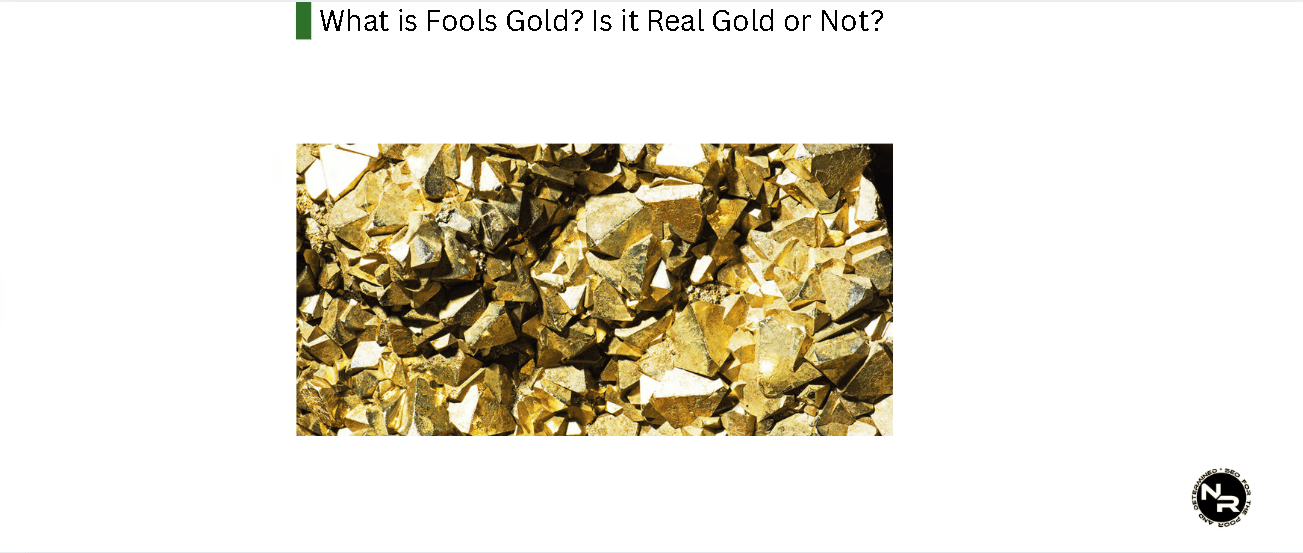
Table of Contents
How Much is Fools Gold Worth? Is it Worth Anything?
Fool’s gold isn’t worth much. Pyrite is abundant and lacks significant industrial use, making it relatively worthless compared to real gold which is rare, expensive and widely used in different industries.
For example, Amazon sells pyrite by the grams, with each gram valued at $11.99. Compare it to the price of gold where each gram costs $100+.

Hey, you’re interested in fools gold which means you probably like real, yellow gold as well, right? Check this out next if you answered yes!
Is Fools Gold Real Gold? What is it Made of?
No, fools gold isn’t real gold.
Fools gold is a mineral, specifically iron sulfide with the chemical formula FeS₂. It shares a similar brass-yellow color and metallic luster with gold, but it’s not the same as gold, nor is it as valuable.
Is Fools Gold Natural? Do Fools Gold Ores Exist? How is it Mined?
Yes, fools gold is natural. It’s a naturally occurring mineral, an iron sulfide with the chemical formula FeS2. Pyrite forms in various geological environments, including igneous, sedimentary, and metamorphic rocks, as well as in hydrothermal veins and coal deposits.
Fool’s gold’s name comes from its resemblance to gold, which has led prospectors to mistake it for the precious metal.

Hey, you’re interested in fools gold which means you probably like real, yellow gold as well, right? Check this out next if you answered yes!
Is Fools Gold Magnetic?
No, fools gold isn’t magnetic when it’s in its pure state with no impurities.
Fools gold becomes magnetic when it’s impure and the other present metals are magnetic.
However, the magnetic effect will still be miniscule because it takes a lot of other magnetic or ferromagnetic metals to cause a noticeable and persistent magnetism.
Note: real gold is also non-magnetic. It’s diamagnetic.
Fool's gold isn't magnetic just like pure gold isn't magnetic. #gold #foolsgold #preciousmetals Share on XIs Fools Gold Hypoallergenic?
Yes, fools gold is hypoallergenic. It isn’t possible to be allergic to pyrite just as it isn’t possible to be allergic to pure gold. However, it’s possible to be allergic to jewelry items that contain fools gold, but also some other (allergenic) metals and materials.
For example, many people are allergic to brass and brass mixed with pyrite (fool’s gold) will cause allergic attacks in sensitive individuals.
The same goes for other common metal allergens like nickel, copper and even sterling silver (it’s rare to be allergic to sterling silver).
Hey, you’re interested in fools gold which means you probably like real, yellow gold as well, right? Check this out next if you answered yes!
Do Fools Gold Coins and Bars Exist?
No, coins and bars made of fools gold don’t exist.
Fool’s gold has minuscule value compared to real gold and there’s no demand for coins and bars made of this mineral. No mint in the world is making fool’s gold coins and bars and I doubt you could even make a custom order anywhere.
It simply isn’t done.
Augusta Precious Metals are the best US gold investment firm and they can help you stock up on genuine gold coins and bars. You can even include some of these IRA-approved gold coins and bars in your gold IRA account.
Don’t invest in gold and other precious metals until you get your free gold investment guide here.
Augusta Precious Metals will even waive all fees for you for 10 years.

Does Fools Gold Jewelry Exist?
Yes, fools gold jewelry exists, though it’s quite rare.
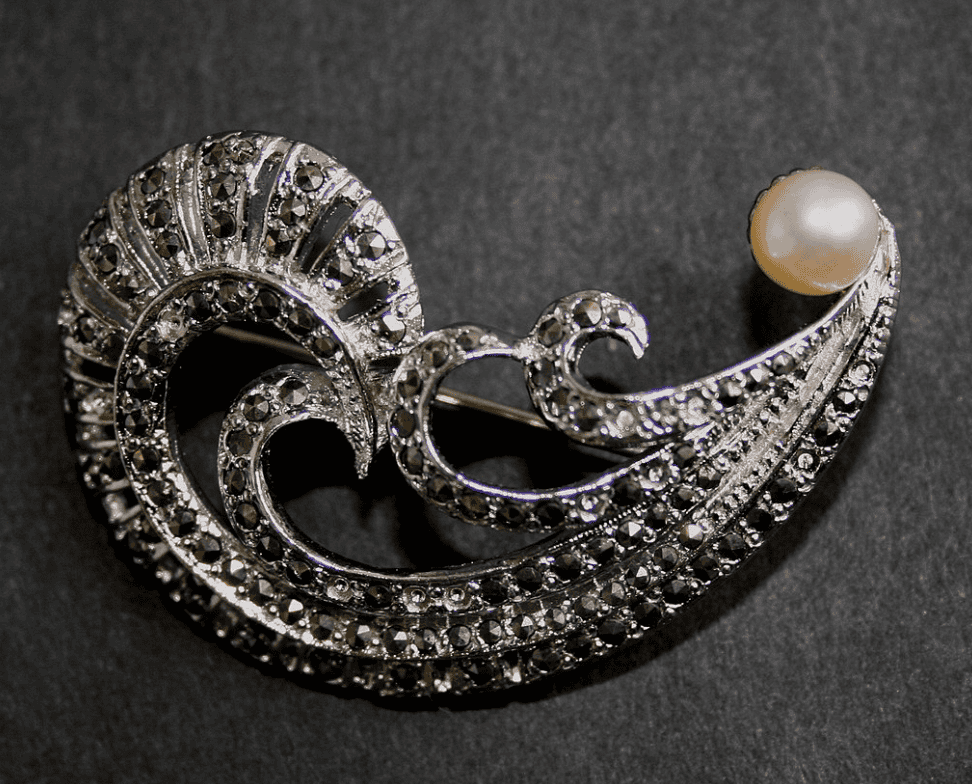
Marcasite jewelry is the most popular jewelry example made with pyrite.
Marcasite jewelry is jewelry made with cut and polished pyrite rather than the mineral marcasite itself. These small, faceted pyrite stones create intricate and sparkling designs, often set in silver.
Here’s an example of intricately designed marcasite brooch made from pyrite and silver.
Hey, you’re interested in fools gold which means you probably like real, yellow gold as well, right? Check this out next if you answered yes!
Fool’s Gold vs Real Gold- How to Tell them Apart?
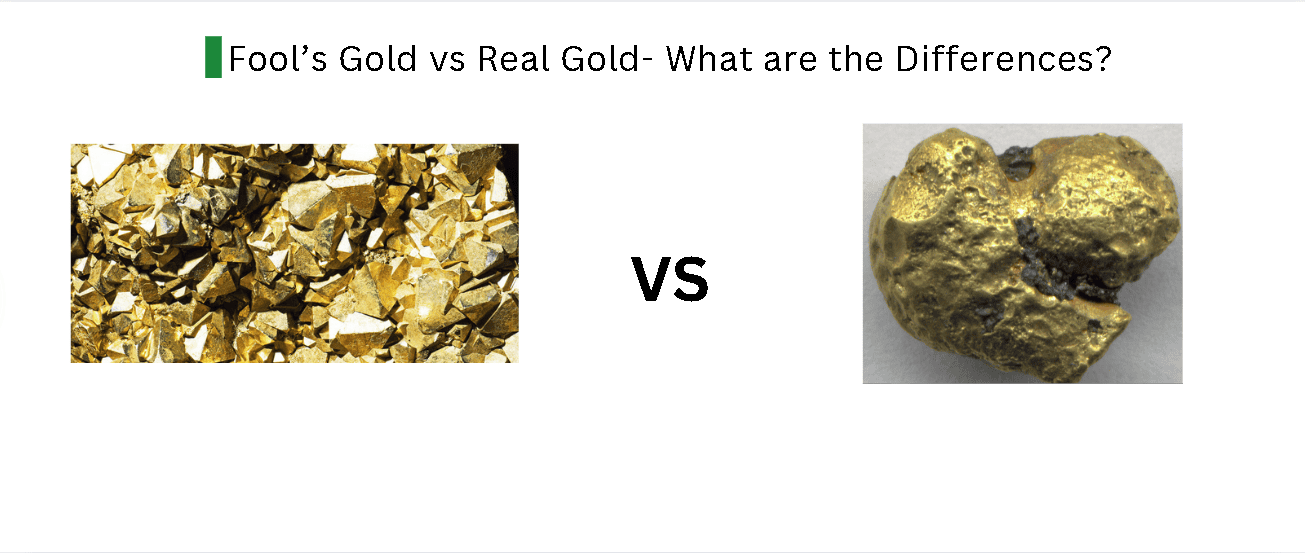
To differentiate between fool’s gold (pyrite) and real gold you should consider weight, streak, hardness, and shape.
Fool’s gold is heavier and leaves a dark streak when scratched, while real gold is lighter and leaves a golden streak.
Pyrite is brittle and shatters when struck, whereas gold is malleable and can be shaped even into tiny wires.
Fool’s gold often has a brassy color and cubic or geometric shapes. Real gold is a rich, bright yellow and typically forms irregular shapes or nuggets.
| Characteristic | Fool's gold | Gold |
|---|---|---|
| Malleability | Brittle and shatters when hammered. | Extremely malleable, meaning it can be hammered into a sheet thin enough to be semi-transparent. |
| Composition | An iron sulfide mineral with the formula FeS₂. | A pure element, Au, which is virtually unreactive. |
| Oxidation | Oxidizes easily when exposed to air and moisture, which can produce sulfuric acid. | Does not tarnish or corrode and maintains its luster over centuries. |
| Streak | Leaves a greenish-black or brownish-black streak when scraped on unglazed porcelain. | Leaves a yellow or golden streak when scraped. |
| Density | Has a specific gravity of around 5, which feels significantly lighter than gold. | Has a very high specific gravity of 19.3, making it feel very heavy for its size. |
| Crystal shape | Often forms distinctive, geometric crystals, such as cubes, pyritohedrons, or octahedrons. | Typically forms irregularly shaped nuggets or flakes with no specific crystalline structure. |
| Cost | Fool's gold is 8-10 cheaper than gold. | Gold is far more expensive than pyrite. |
Can Fool’s Gold Be Used as Golden Leaf?
No, fool’s gold can’t be used as gold leaf because it is brittle and will shatter when hammered thin.
And it’s possible to create golden leaves from real gold because real gold is extremely soft and malleable.
Note: gold leaves are created by hammering actual gold into incredibly thin, almost weightless sheets.
How Heavy is Fool’s Gold Compared to Real Gold?
Fool’s gold is less dense and thus much lighter than real gold.
Fool’s gold has a density of about 5 g/cm³ compared to real gold’s ~19.3 g/cm³ density.
This means a cubic centimeter of real gold weighs almost four times as much as the same volume of pyrite, making real gold feel substantially heavier for its size.
This also means fool’s gold doesn’t sink like real gold as real gold is significantly denser and sinks quicker.
Note: you can test real’s gold’s authenticity with water. It’s called gold float test and it gives conclusive results.
However, testing pyrite with water will give inconclusive results because of pyrite’s lower density (pyrite will float or stay suspended for longer due to its lower density).

Is Real Gold Found with Fool’s Gold?
Yes, real gold is often found with, or even incorporated within fool’s gold as both minerals form under similar geological conditions.
This trapped gold is sometimes called “invisible gold” because it’s not visible to the naked eye or standard microscopes, but instead occurs as microscopic particles or alloys within the pyrite’s crystal structure.
While pyrite itself is worthless, its presence indicates the potential for more valuable, real gold deposits in the area.
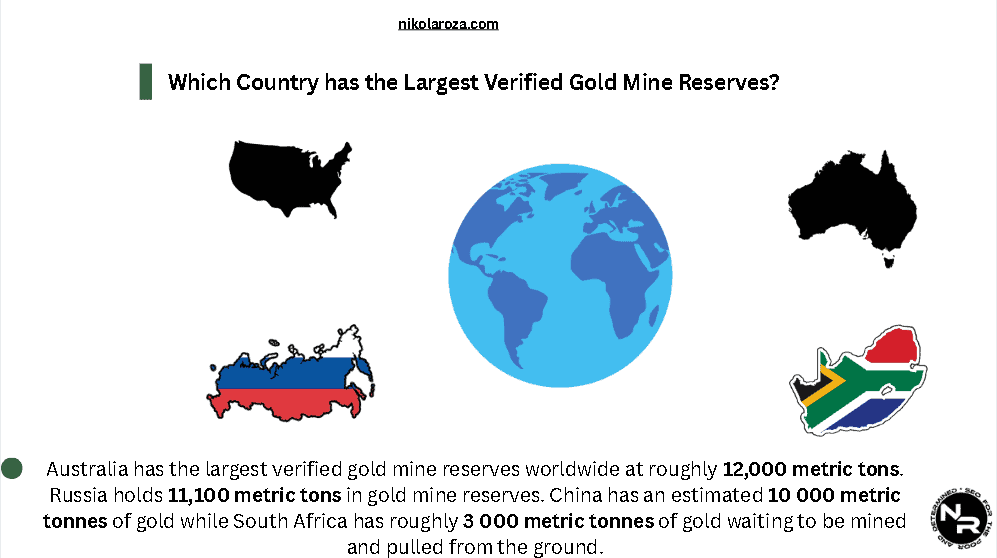
In fact, the biggest gold producing countries in the world also have the biggest pyrite deposits, even though no one’s mining fool’s gold.
Hey, you’re interested in fools gold which means you probably like real, yellow gold as well, right? Check this out next if you answered yes!
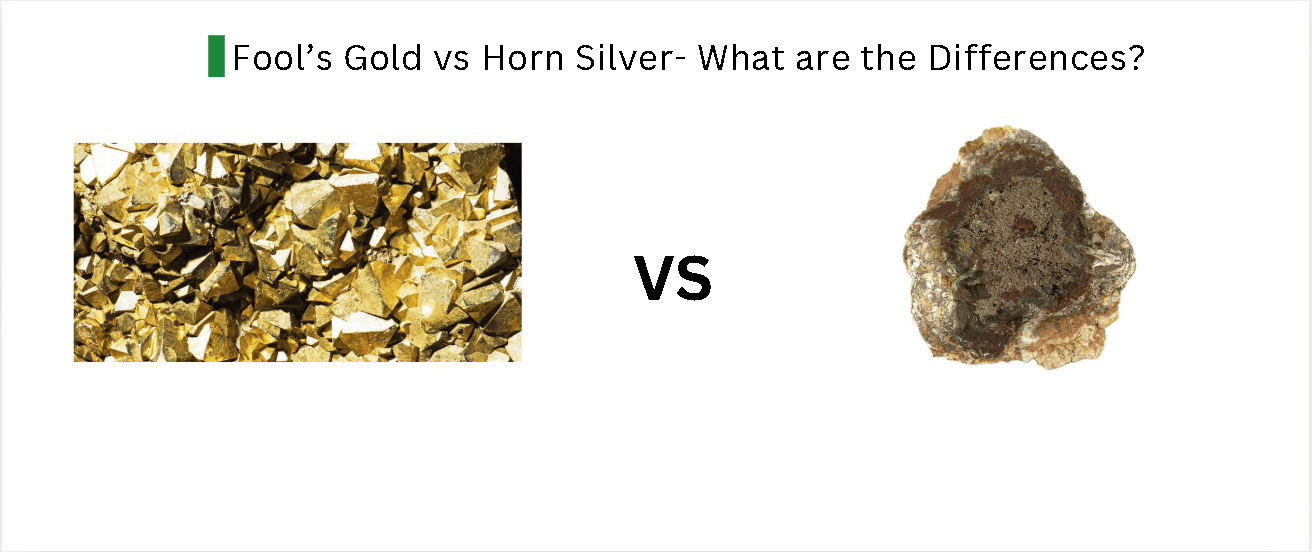
Is Fool’s Gold the Same as Horn Silver?
No, Fool’s gold and horn silver aren’t the same. They’re two different minerals. Fool’s fold is an iron sulfide, while horn silver is a silver chloride.
| Characteristic | Fool's gold | Horn silver |
|---|---|---|
| Composition | Iron sulfide (\(FeS_{2}\)). | Silver chloride (\(AgCl\)). |
| Appearance | Brassy yellow color and a metallic luster, which is why it is often mistaken for gold. It can tarnish to a darker color. | White, gray, or yellowish color. Its name comes from its resemblance to a waxy cow horn when polished by the wind. |
| Hardness | It is brittle and has a Mohs hardness of 6–6.5. Unlike real gold, it will break or shatter if struck with a tool. | It is very soft and can be easily scratched, even with a fingernail. |
| Streak | Leaves a greenish-black or brownish-black streak when scraped across an unglazed porcelain plate. | Leaves a shiny, colorless to pale yellow streak. |
| Value | It is a common and relatively worthless mineral, though it can sometimes contain trace amounts of "invisible gold". | It is a valuable silver ore and an important source for silver extraction. |
| Occurence | Found in a wide variety of rock types, including igneous, metamorphic, and sedimentary. | Formed in the oxidized upper sections of silver deposits, particularly in arid climates. |
What is Fools Gold? What Does it Mean? Is it Real? Is it Magnetic and Hypoallergenic? Does it Tarnish, Corrode and Rust?
Fool’s gold, scientifically known as pyrite (iron sulfide, FeS₂), is a naturally occurring mineral that resembles real gold but has minimal value. While real gold costs over $100 per gram, pyrite sells for around $12 per gram on the market.
Pyrite isn’t magnetic in pure form and is hypoallergenic, though jewelry containing other metals+ pyrite may cause allergic reactions depending on the metal.
Pyrite is abundant in various geological environments across the world. Unlike precious metals, fool’s gold coins and bars don’t exist due to lack of demand. Though rare marcasite jewelry made from polished pyrite does exist.
You can distinguish fool’s gold from real gold through several easy tests.
Pyrite is heavier, has a brassy color, leaves dark streaks when scratched, forms cubic shapes and is brittle and shatters when struck.
Real gold is lighter, leaves golden streaks, is malleable, has rich yellow color, and forms irregular gold nuggets.
Check out our jewelry shop for some realistic gold replicas. They’re not made of fool’s gold, but they’re awesome.
We ship worldwide!
References:
- Fool’s Gold: Meaning, Avoiding bad Investments- https://www.investopedia.com/terms/f/foolsgold.asp
- What is “Fool’s Gold?”- https://www.usgs.gov/faqs/what-fools-gold
- Pyrite: The Real Story Behind “Fool’s Gold”- https://www.thermofisher.com/blog/mining/pyrite-the-real-story-behind-fools-gold/
- Fool’s Gold vs Real Gold: How to tell the difference- https://www.gold-traders.co.uk/gold-information/how-to-tell-fools-gold-from-real-gold/
- Pyrite Vs. Gold: How to Identify Real Gold from Fool’s Gold- https://www.geologyin.com/2024/09/pyrite-vs-gold-identifying-methods.html
- Marcasite jewelry- https://en.wikipedia.org/wiki/Marcasite_jewellery
- Fool’s Gold vs. Gold – How to Tell Fools Gold from Real Gold? – https://somethingborrowedpdx.com/fools-gold-vs-gold/
- Chlorargyrite- https://en.wikipedia.org/wiki/Chlorargyrite

Nikola Roza
Nikola Roza is a blogger behind Nikola Roza- SEO for the Poor and Determined. He writes for bloggers who don't have huge marketing budget but still want to succeed. Nikola is passionate about precious metals IRAs and how to invest in gold and silver for a safer financial future. Learn about Nikola here.