
Disclosure: Some of the links you’ll encounter are unique links. Click and buy something and I’ll earn some money, at zero expense to you. Thank you!
Writing a fundraising strategy for your nonprofit takes on a whole new form on social media.
From personalizing your campaigns for an online audience to tailoring your content so it’s native to each platform, you have your work cut out for you.
The good news?
Launching your fundraising strategy on social media opens up endless donation opportunities for your nonprofit, especially as more donors engage with nonprofits through online platforms and mobile devices.
In fact, DataReportal reports that the total number of social media identities stands at 5.66 billion in 2026.
So, if you’re ready to use social media to launch your next fundraising campaign, you’ve come to the right place.
In today’s article, we’ll show you how to write a social media fundraising strategy for your nonprofit in eight simple steps.
1. Start by defining your fundraising goals and target audience
The first step to writing your social media fundraising strategy?
Define your fundraising goals and target audience.
This includes identifying donor segments, understanding donor prospects, and aligning your fundraising program with broader organizational priorities. Securing sponsorships from these corporate donor segments can also present a significant B2B opportunity to establish long-term financial partnerships.
So think about it:
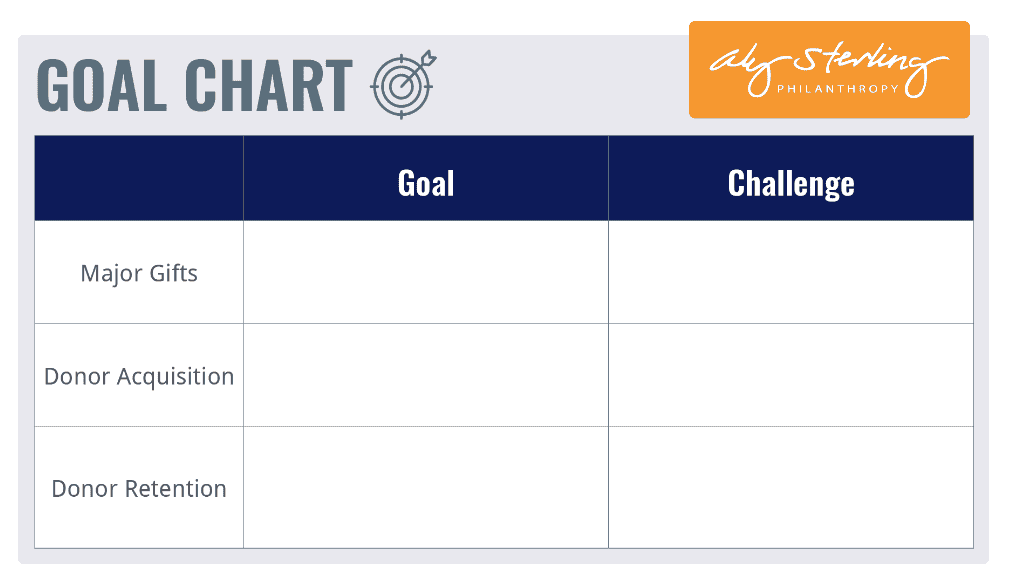
- What are your top three goals for your fundraiser?
- What major gifts would you like to receive?
- What are your donor acquisition and retention goals?
- What potential challenges might you face along the way, and how can you tackle them?
- Who do you expect will donate the most to your cause and why?
When defining your target audience, get laser-clear on who they are by creating donor personas.
For each donor persona, create a faux name and a complete list of their characteristics.
Then, consider what causes these donor personas to trigger the giving process (and how you can help encourage repeat donations).
Consider these donor personas anytime you:
- Create marketing copy and fundraising messaging
- Strategize and plan marketing campaigns
- Reach out to donors via email, in-app, social, or via text
- Set future campaign goals
2. Then, highlight your fundraiser’s purpose
Why should people care about your fundraiser? How are you making a major difference in the world? What separates your nonprofit from others?
The answer lies in your fundraiser’s core purpose.
That’s why it’s essential to understand the fundamental reason your fundraiser exists and why your target audience should get fired up about it, too.
Hint: If you’re targeting the right audience, your purpose will be that much simpler to highlight.
For instance, if you’re raising money for cancer research, you may have more success communicating your cause and earning donations from audience members who’ve come into contact with cancer in some way.
Whether they’re in remission themselves, they’ve lost a loved one to cancer, or they know someone currently battling the illness, you may find that empathetic donors are more generous givers.
So, how do you use your core purpose to increase donations on social media?
Create value statements and hooks to insert in your marketing copy. More on this in a bit!
3. Next, brainstorm and finalize campaign ideas
Once you’re clear on your goals and core purpose, brainstorm and finalize social media campaign ideas in line with your target audience’s behavior.
For instance, if your target audience loves to travel, consider partnering with travel agencies to give donors the chance to win an all-expense paid trip.
And speaking of contests, using giveaways and contests on social media is a great way to stir up momentum around a campaign and encourage virality. To really make the most of this tip, motivate givers to refer their friends in exchange for more contest entries.
Other campaign ideas that drum up momentum may include:
- Partnering with influencers to take over your social media accounts
- Asking influencers to highlight your cause on their pages
- Locking arms with affiliate marketers
- Introducing brand collabs
- Hosting virtual events
- Building an online community
- Offering freebies and other lead magnets in exchange for contact info
4. Create a dedicated hashtag and choose your CTAs
To help social media users spread the word about your fundraiser, create a dedicated hashtag that’s easy to remember.
For instance, if you’re raising money for stray dogs, your hashtag might be #donatestray or #straytodonate.
Or, if you’re raising money for a new community park, you might choose a hashtag like #newjonespark or #donateparknow.
Be sure to add your dedicated hashtag to each campaign in the comments section, along with other relevant, audience-specific hashtags. Use your call to action (CTA) to encourage users to spread the word about your campaign using your dedicated hashtag.
And speaking of CTAs …
Spend some time preparing CTAs for your future campaigns. To keep this simple, center each CTA around one of your specific goals.
Keep your CTAs organized by category to make it easier to craft your campaign copy.
5. Prepare your website for an influx of visitors
It’s essential to ensure that your website can handle a large influx of traffic and provide a smooth donation experience, especially if your fundraising campaign goes viral on social media.
One way to ensure your website remains available and accessible to potential donors?
Use a DDoS protection service to ensure that your website stays up and running in the event of a DDoS or other cybersecurity attack.
You should also check with your web developer or hosting provider about best practices for maintaining your site speed and supporting an influx of users before launching your campaigns.
6. Create, batch, and schedule your campaigns
Now that you’ve chosen your campaign ideas, created dedicated hashtags and CTAs, and secured your website, it’s time to create, batch, and schedule your campaigns!
To start, make sure each campaign targets at least one of your top goals. Then, in the marketing copy, add your accompanying:
- Hooks
- Value statements
- Hashtags
- CTAs
Remember, your value statements and hooks are meant to reflect your fundraiser’s core purpose so you can attract aligned donors.
And speaking of attracting the right donors, don’t forget to personalize your campaigns according to your audience. Personalization includes the messaging style, colors, giving tools, and even the donation options you accept.
You’ll also need to tailor the format of your content so it seems native to each platform you employ.
To help you streamline your efforts, get your hands on some trusted tools.
If you’re planning a light campaign rollout, you may be able to get away with using Google Tools like Google Calendar for timeline planning and the YouTube nonprofit program to engage with your supporters.
But for longer or more complex launches, you may need a suite of tools.
One tool you can use to create captivating campaign images?
A photo editing tool complete with poster templates! You can use these to create fun, custom flyers for your event. For instance, check out the following poster promoting Christchurch events for inspiration:

We love how creative, colorful, and attention-grabbing this poster looks.
Other social media marketing tools you might find useful include:
- A social media scheduling tool like Buffer or Planable
- A social media post design tool like Canva
- Done for you caption templates and professional still images from Social Curator (membership required)
- Free vector images to add personality and color to your marketing material
7. Implement a multi-channel marketing approach
To make the most of your social media fundraising campaigns, implement a multi-channel marketing approach.
When appropriate, tie each channel to your social media campaigns so they can feed into each other.
In addition to social media, we highly recommend including texting in your fundraising strategy, as it’s one of the most engaging ways to communicate with customers — or, in this case, donors.
Consider using a platform like TextUS to engage in real-time conversations with your donors and prospects.
8. Create a system to track, evaluate, and report success
And finally, create a system to help you watch and track your campaign results.
Use a tool to measure campaign KPIs and analyze side-by-side data comparisons. You might also want to consider creating a Gantt chart in Google Sheets to help you create efficient workflows for your fundraising and visualize all steps in one place.
If you prefer a simpler monitoring process, use a social listening tool like Brandwatch, which can help you spot comments related to your fundraiser and review customizable dashboards to measure campaign performance.
Wrap up
And that’s it, folks! You’ve officially created a social media fundraising strategy for your nonprofit.
Now it’s up to you to launch and track your strategy efforts — and course-correct as needed.
Social media can do a lot for a fundraising campaign, but reach matters as much as the content itself.
Getting your campaigns in front of the right people, consistently, comes down to how well you distribute your content and how visible you are in search.
Platforms like Nikolaroza.com work with organizations on exactly that: building an online presence, driving qualified traffic, and turning content into something that actually delivers results over time.
If long-term fundraising growth is the goal, visibility and content performance are worth the investment.
Author Bio:

Ioana Wilkinson
Ioana is a freelance content writer and SEO strategist for B2B and B2C brands specializing in Business, Digital Marketing, SaaS, Tech, and Mental Health. Born in Transylvania, raised in Texas, and transplanted to Barcelona and Mexico, Ioana’s most recent move has taken her to windy Oklahoma City.

Nikola Roza
Nikola Roza is the owner of Nikola Roza- Everything You Can Learn About Precious Metals. He writes for people who love precious metals and jewelry and who're interested in adding gold, silver platinum and palladium to their Gold IRAs and retirement portfolios.