Disclosure: Some of the links you’ll encounter are unique links. Click and buy something and I’ll earn some money, at zero expense to you. Thank you!
Ever noticed a tiny letter on your coins and wondered what it means? That’s a mint mark, and it holds a wealth of history and significance.
Coin mint marks have been used for thousands of years, dating back to the Ancient Greeks and Romans, who employed them to ensure accountability for coin quality. Mint marks are identifiers that tell you where a coin was produced, allowing collectors and investors to trace its origin and assess its value.
Read my guide below to learn everything you need to know about coin mint marks, including crucial info about the rarest coin mint marks in the world.
What is Mint Mark on a Coin (Definition and Meaning)?
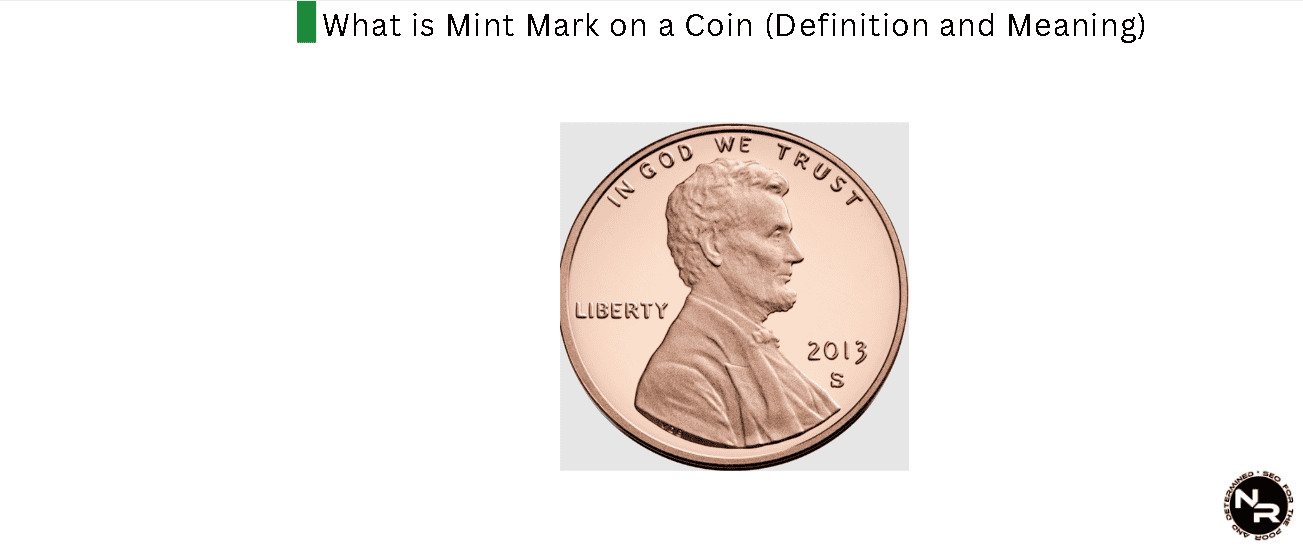
A mint mark is a small coin inscription that tells the specific mint where a coin was made.
This small letter or symbol serves as a critical identifier for collectors and historians. Mint marks originated thousands of years ago, starting with Ancient Greek and Roman coins around the 3rd century. These markings held mints accountable for their coins’ weight and quality.
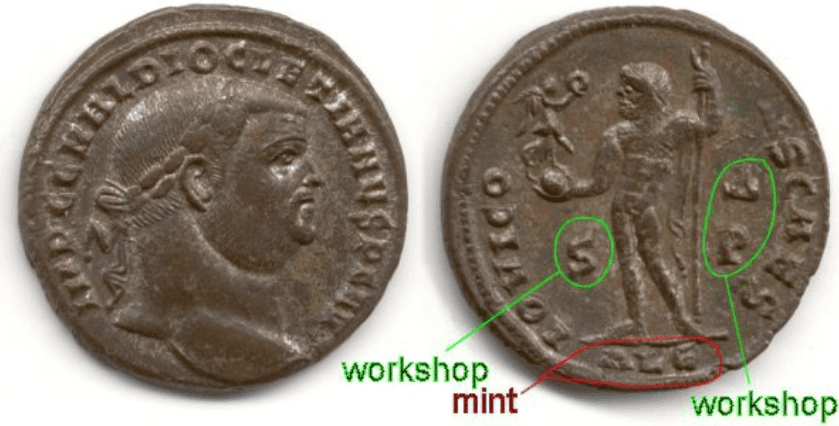
Roman coins mint.Mint marks usually appear on the coin’s field, which is the blank area not occupied by the design or inscriptions. In the United States the most common mint marks are “D” for Denver and “S” for San Francisco.
Other countries use different symbols and letters. For example, some European mints display varying letters or initials.
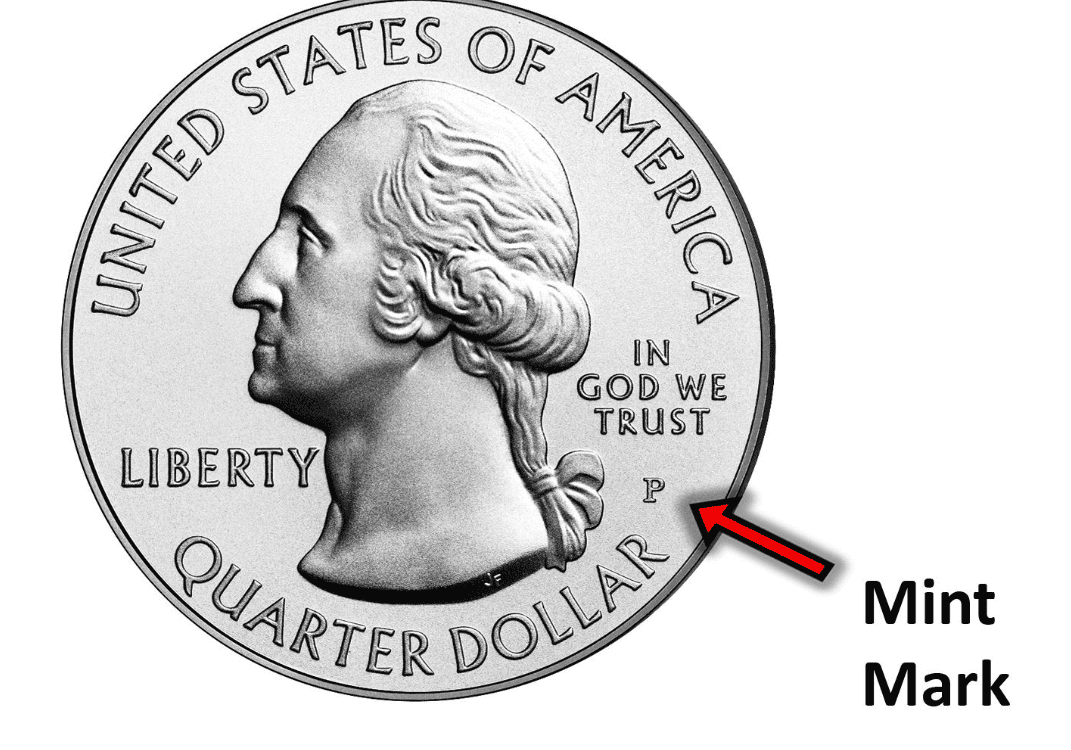
Mint mark plays a significant role when analyzing a coin’s value. Certain mint marks indicate rarity or historical significance and understanding a coin’s mint mark aids in determining its market worth.
This is especially important for rare coins that can fetch thousands of dollars per piece.
Check this out next once you’re done reading my coin mint marks guide. Especially important if you’re an American citizen with a worry about the economy and a keen interest in precious metals and investing.
What is the Rarest Mint Mark on a Coin?
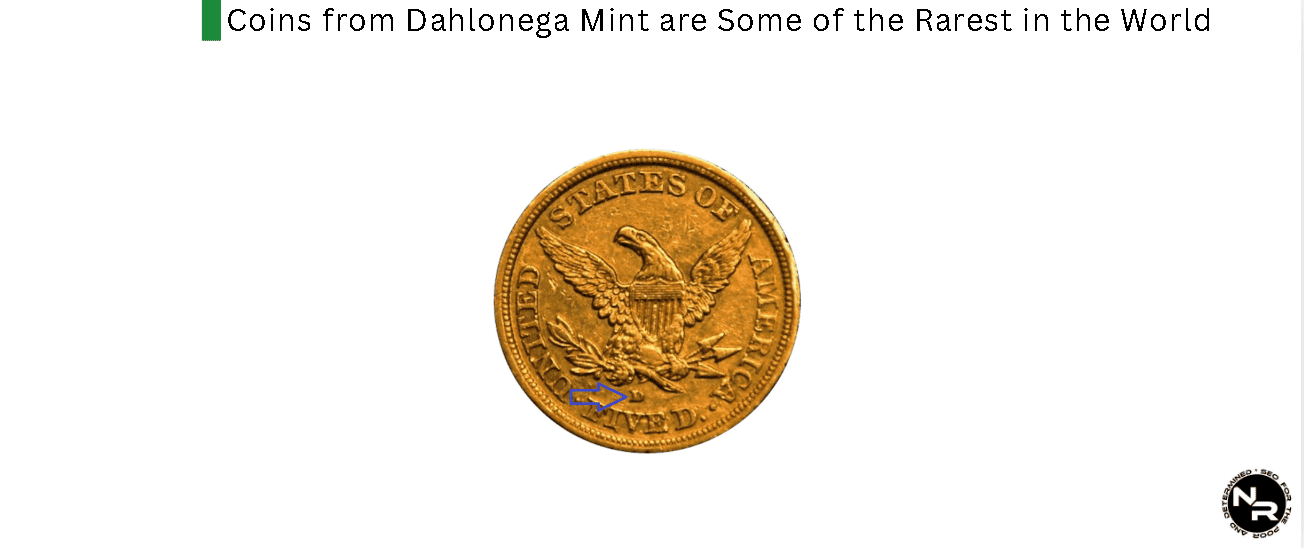
The rarest mint marks on U.S. coins include “C” for Charlotte and “D” for Dahlonega, as well as “CC” for Carson City.
Coin collectors search for specific coins from these mints because these mints are now long closed and the coins they once minted are the only ones left in the world. No more are being produced.
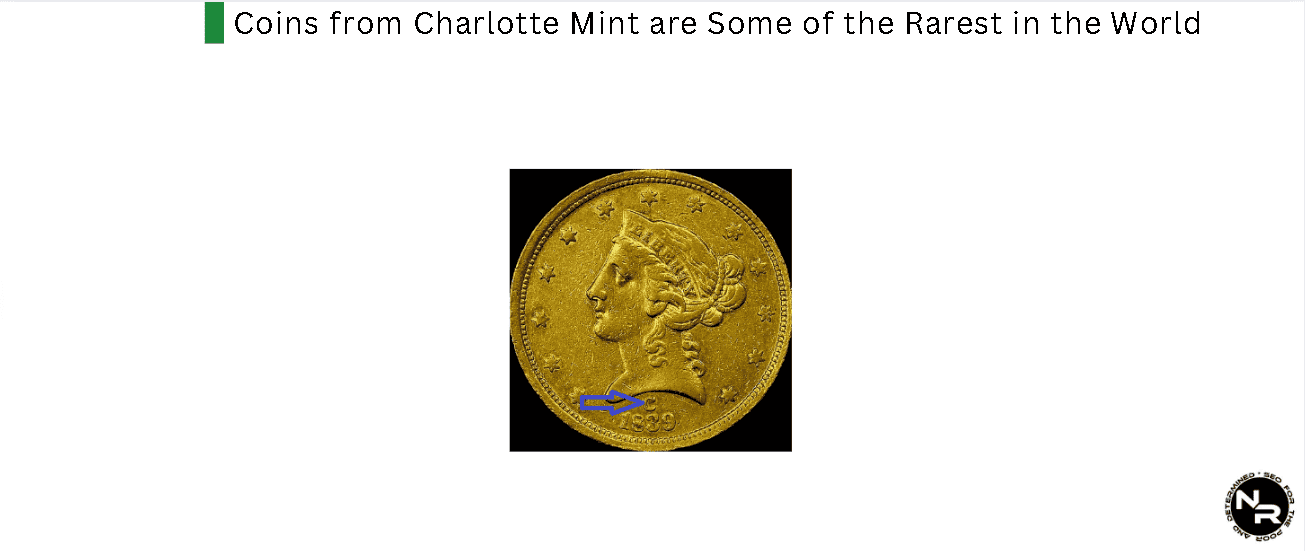
Charlotte (C) Mint
Coins minted in Charlotte, North Carolina, from 1838 to 1861 are extremely rare, especially their gold coins. Most of these coins had mintages in the low thousands, making them highly collectible regardless of the specific date or denomination.
Here’s an example of a rare gold coin minted by the Charlotte mint. The “C” under the bust is clearly visible, despite the coin being minted in 1839, a long time ago.
Dahlonega (D) Mint
The Dahlonega Mint produced gold coins from 1838 to 1861, with very few surviving today. The rarity of these coins is attributed to their limited production and the historical context of the mint.
Carson City (CC) Mint
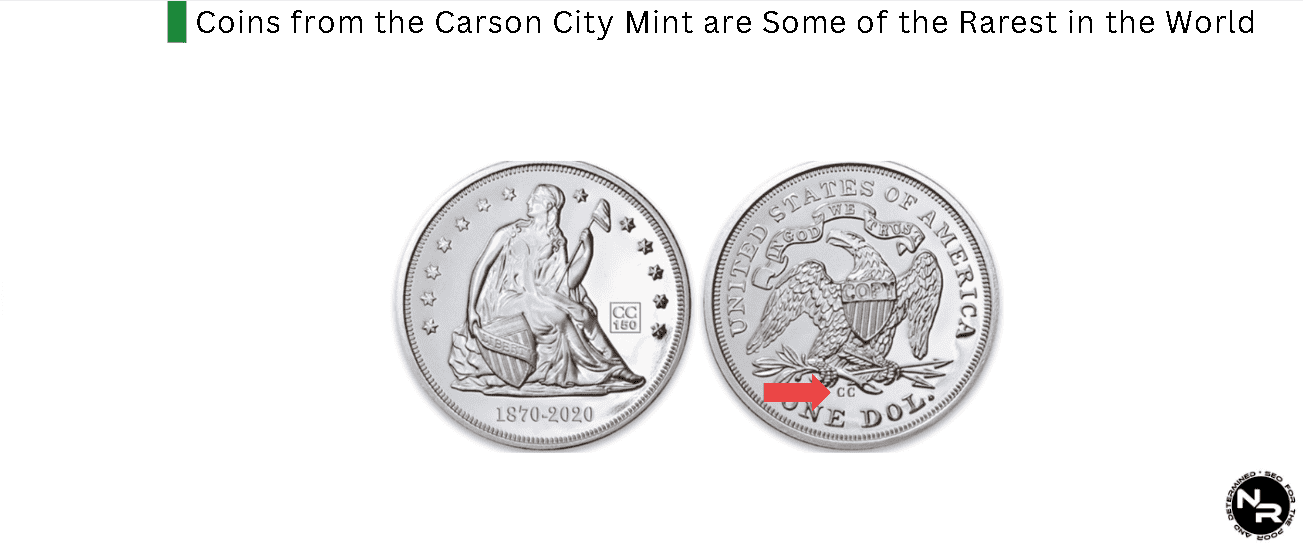
The Carson City Mint in Nevada operated from 1870 to 1893 and is known for its low mintage numbers. Notable rare coins from this mint are listed below.
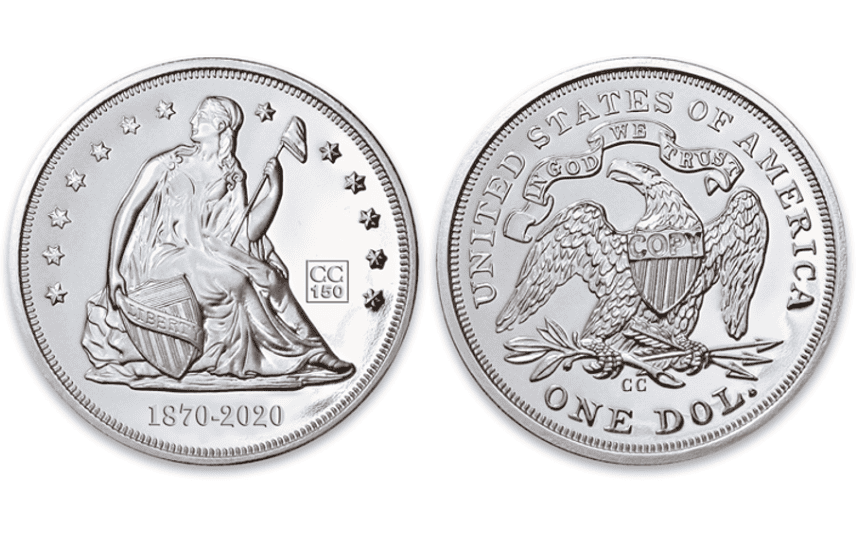
- 1870-CC Liberty Seated Dollar. Only 11,758 pieces were minted, making it one of the rarest coins from this mint.
- 1870-CC Double Eagle ($20 Gold Piece). This coin is exceptionally rare and highly valued by collectors with only 3,789 minted.
- 1870-CC Eagle ($10 Gold Piece). This coin had an even smaller mintage of 5,908, adding to its desirability.
Below are some more examples of rare-mint coins.
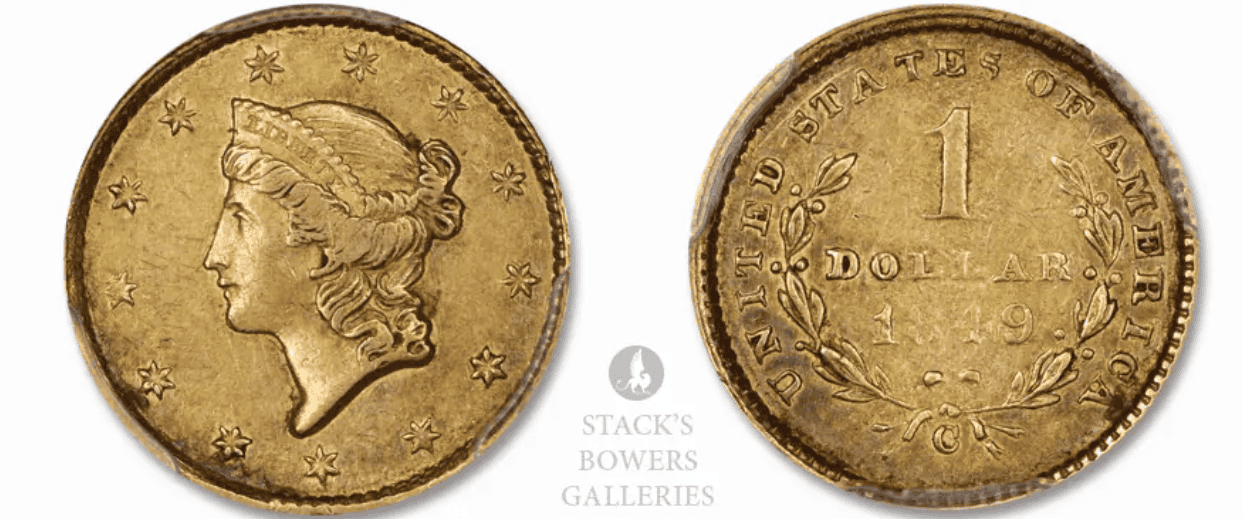
The 1849-C Open Wreath Gold Dollar, minted at the Charlotte Mint, stands out due to its extremely low survival rate. Only a handful of these coins remain, making them highly sought after.
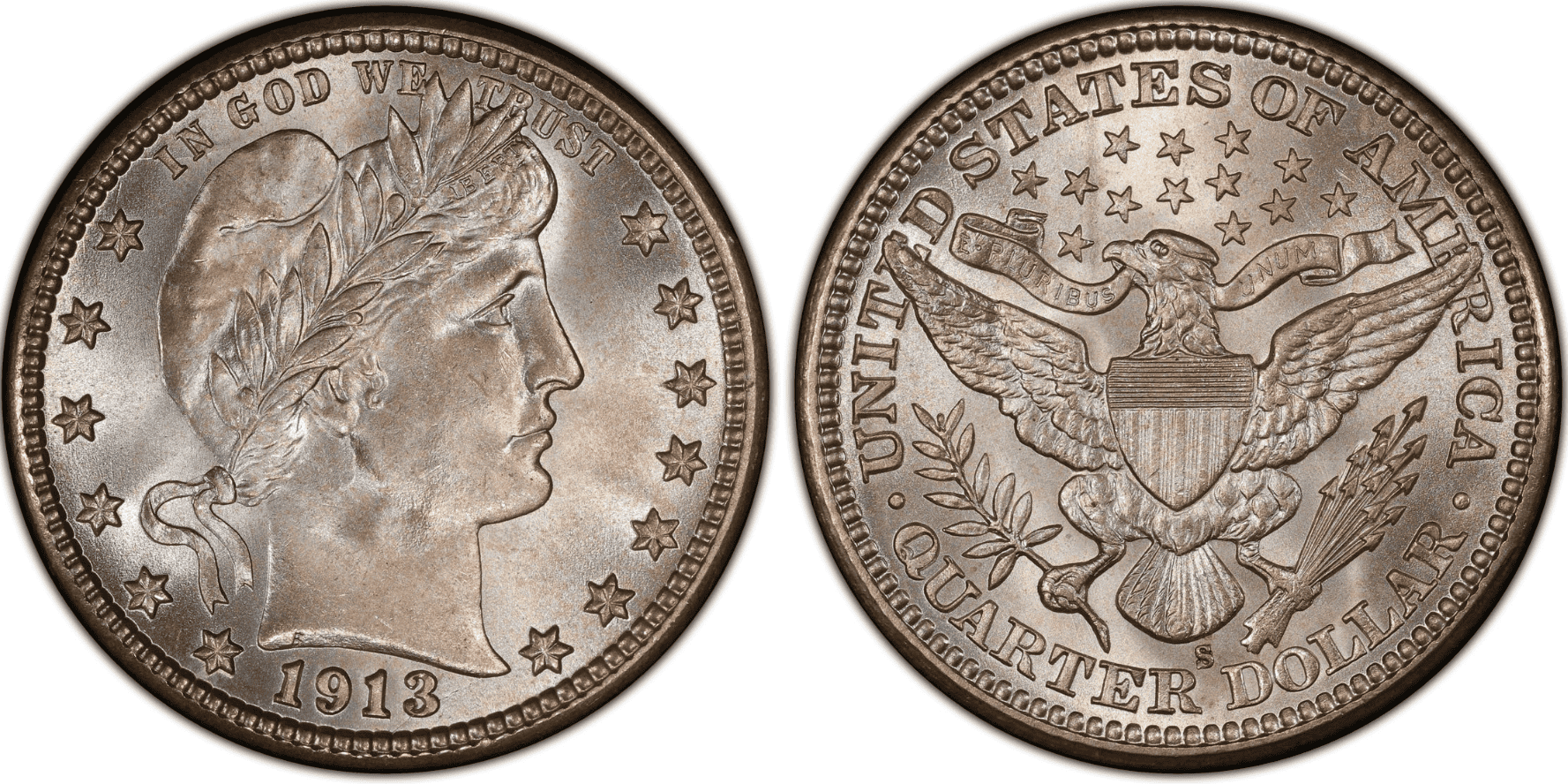
The 1913-S Barber Quarter ranks similarly, thanks to limited minting and demand from collectors.
Another notable example is the 1870-CC Seated Liberty Dollar, minted in Carson City, which remains rare because the facility operated from 1870 to 1893.
This list of coins with rare mint marks isn’t exhaustive.
What are the Most Common Mint Marks on US Coins?
The most common mint marks on U.S. coins currently in circulation are P (Philadelphia) and D (Denver).
The S (San Francisco) and W (West Point) mint marks are also used, primarily for proof, uncirculated, and commemorative coins, making them far less common in general circulation.
Check this out next once you’re done reading my coin mint marks guide. Especially important if you’re an American citizen with a worry about the economy and a keen interest in precious metals and investing.
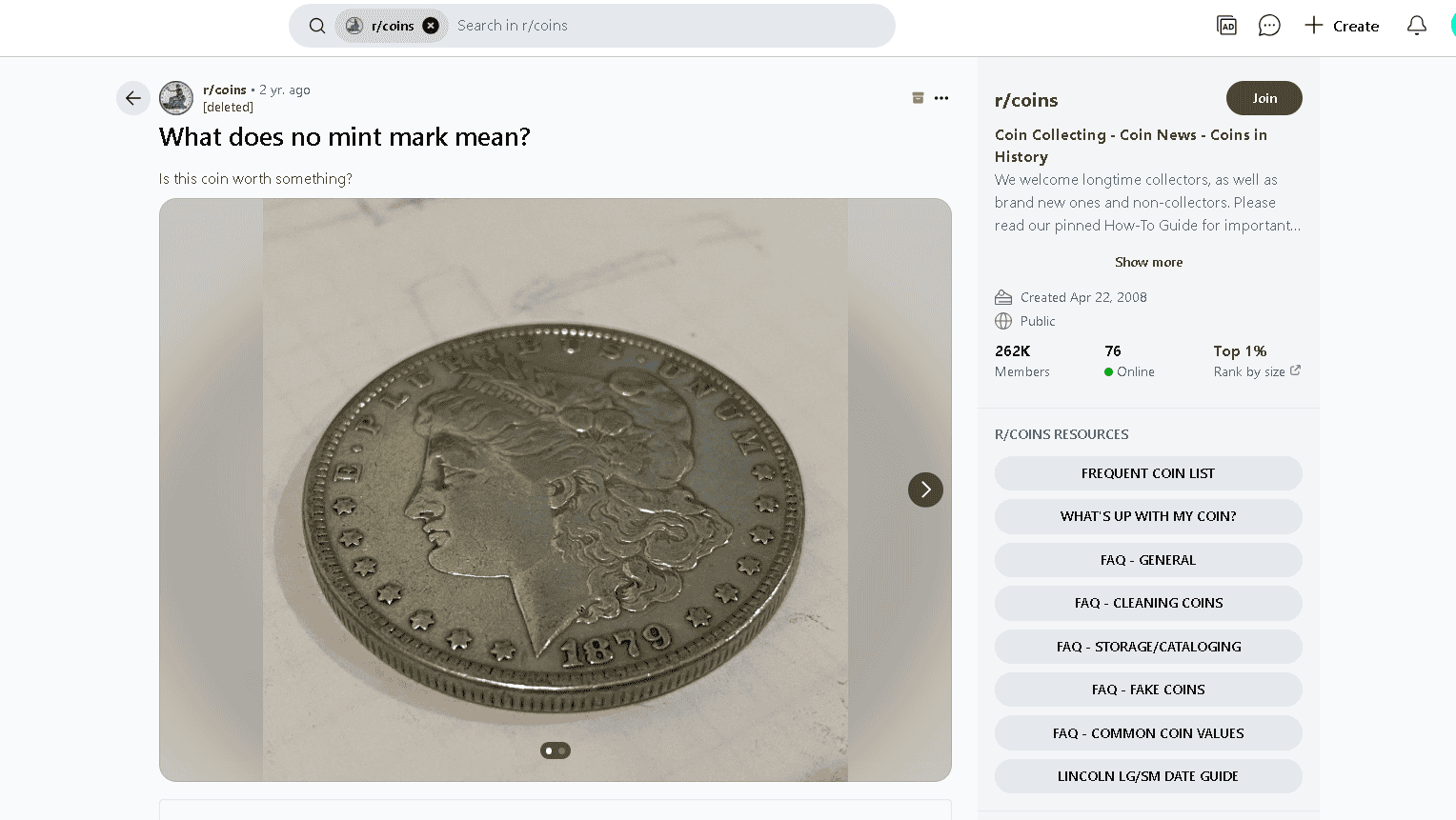
Do All Coins Have Mint Marks? What Does it Mean When There’s no Mint Mark on a Coin?
No, not all coins have mint marks and there’s plenty of example of coins without mint stamps.
A coin without a mint mark is typically one produced at the Philadelphia Mint. It’s because Philadelphia mint didn’t use a mint mark on its coins before 1942.
This “no mint mark” policy was temporarily changed during World War II for wartime nickels, and the “P” mint mark was permanently reintroduced in 1979 for dollar coins, and in 1980 for other denominations.
Examples of U.S. coins without mint marks include most circulating coins from 1965–1967, and many older Lincoln cents, Washington quarters, and Philadelphia-minted dollars.
Mint marks heavily influence a coin’s value, but not having mint marks makes certain coins extra valuable to coin collectors and numismatics.
Where is the Mint Mark on a Coin? How to Identify and Find it?
Mint mark on a coin is found either on the obverse (front), or the reverse (back) of the coin. Its location varies depending on the coin series and year of production.
Some of the coins with obverse mint mark locations are listed below.
- Lincoln Cents. The mint mark is located below the date, between Lincoln’s chest and the coin’s rim.
- Jefferson Nickels. After 1968, the mint mark is located on the obverse, lower right of the design near the date.
- Roosevelt dimes. Mint mark is above the date on the obverse.
- Washington Quarters. The mint mark is on the obverse, right of the design, near Washington’s ponytail.
- Standing Liberty Quarters. The mint mark is on the obverse, below the lower left part of Liberty’s design.
Some of the coins with reverse mint mark locations are listed below.
- Jefferson Nickels (1938-1964). The mint mark was to the right of Monticello, near the rim.
- Some Silver Dollars (Morgan, Peace). The mint mark is on the reverse, typically below the wreath or near the eagle’s tail.
- 1942-1945 Jefferson War Nickels- The mint mark was on the reverse, above Monticello.
Do Proof Coins Have Mint Marks?
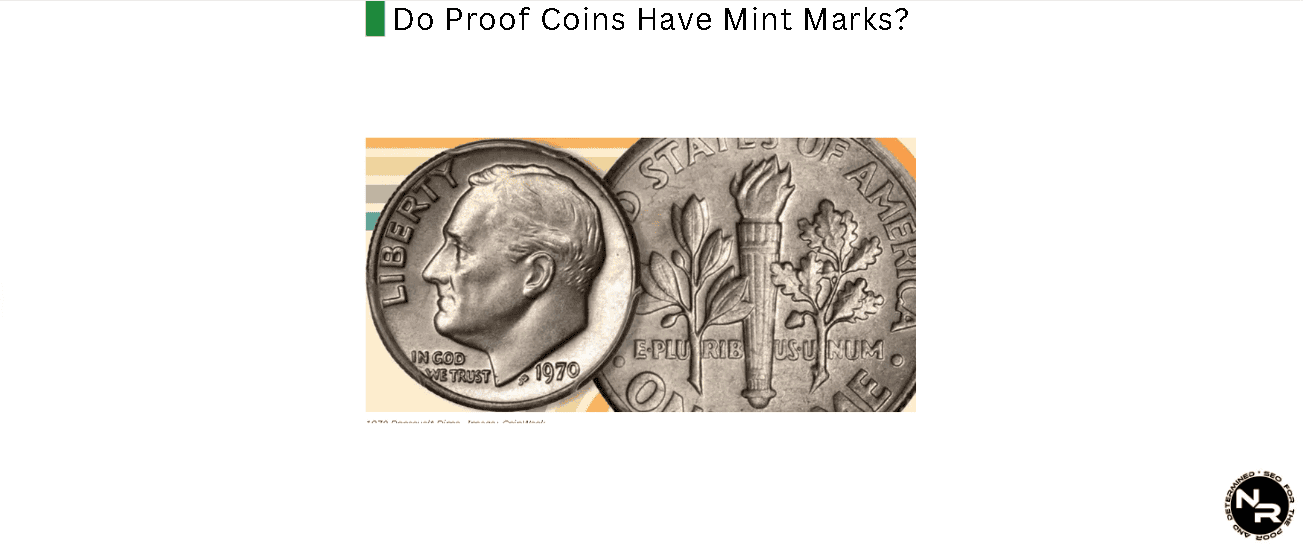
Yes, most U.S. proof coins have mint marks. Typically, it’s “S” for San Francisco, which produces the majority of proof coins, though “W” for West Point and “P” for Philadelphia also appear on special issues.
Proof coins without mint marks are usually made by accident. 1970 No-S Roosevelt dime and 1971 No-S Jefferson nickel are excellent examples of such no-mint proof coins.
Check this out next once you’re done reading my coin mint marks guide. Especially important if you’re an American citizen with a worry about the economy and a keen interest in precious metals and investing.
Do Bullion Coins Have Mint Marks?
No, bullion coins don’t have mint marks. Because bullion coins are valued because on their standardized precious metal content, and not for their point of origin or collectability.
For example, none of the bullion coins sold by Augusta Precious Metals (a premiere gold investment company) have mint marks on them.

Are Coins Without Mint Marks More Valuable than Regular Coins?
No, most coins without mint marks aren’t inherently more valuable than regular coins (that have mint stamps).
Most coins without mint marks, particularly those dated after 1980, were minted in Philadelphia, and Philadelphia Mint didn’t use a mint mark for many years.
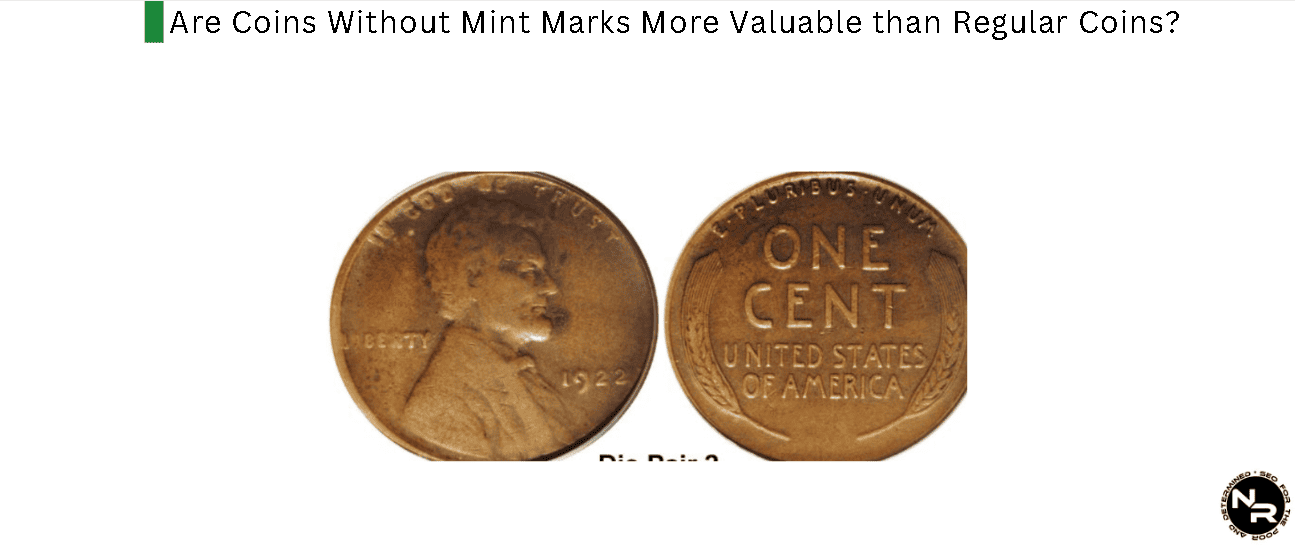
Rarely, a lack of a mint mark makes the coin super valuable to collectors, often fetching thousands of dollar in auctions. For example, all 1922 “No D” Lincoln Cent coins were struck in Denver mint and were supposed to carry a “D” stamp.
But, a very small percentage of them (<1%, or fewer than 250 as 25 000 of these coins were originally minted) were struck without a mint mark by accident.
Where is the Mint Mark on the 1979 Dollar Coin?
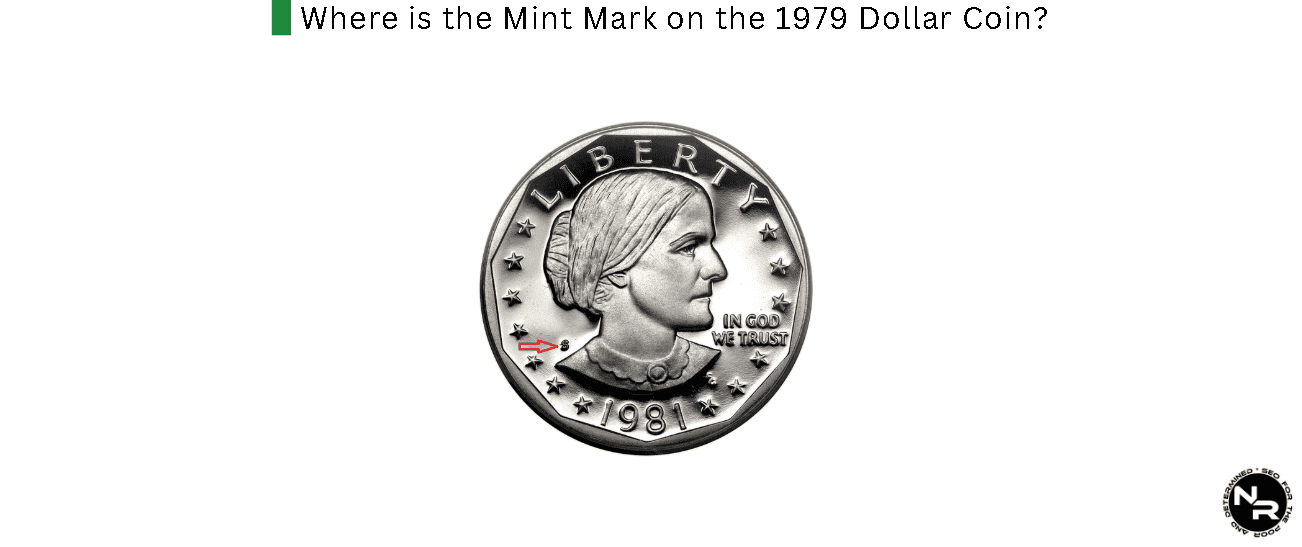
The mint mark on a 1979 dollar coin is located on the obverse (front) of the coin, just above the shoulder of Susan B. Anthony.
The mint mark for a 1979 Dollar is “P” for Philadelphia, “D” for Denver, or an “S” for San Francisco.
Here’s an example of a Susan B. Anthony 1979 dollar produced in San Francisco mint. You can clearly see the “S” mark above her right shoulder.
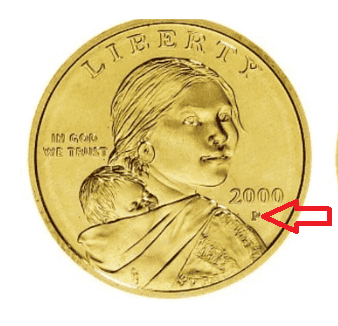
Sacagawea Dollar is the successor coin to Susan B. Anthony coin. The mint mark on Sacagawea coin is located on the obverse (front) of the coin, just below the date.
Where is the Mint Mark on the Presidential Dollar Coin?
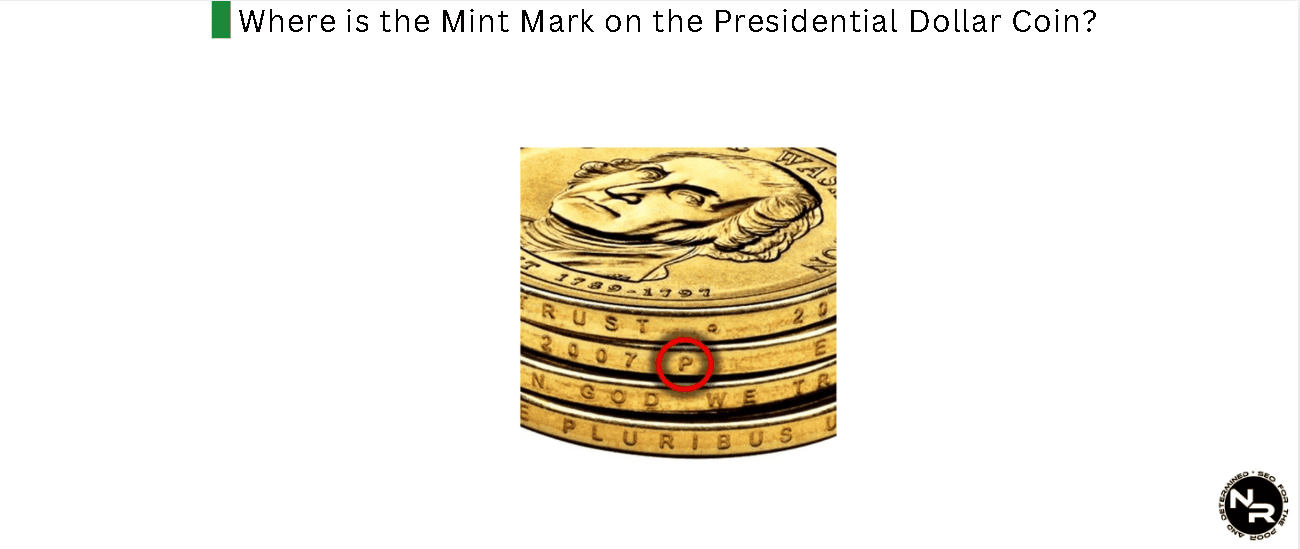
The mint mark on a Presidential Dollar coin is located on the edge of the coin. You can find it inscribed on the edge alongside the year of minting and the motto “E Pluribus Unum”.
Where is the Mint Mark on Silver Eagle Coins?
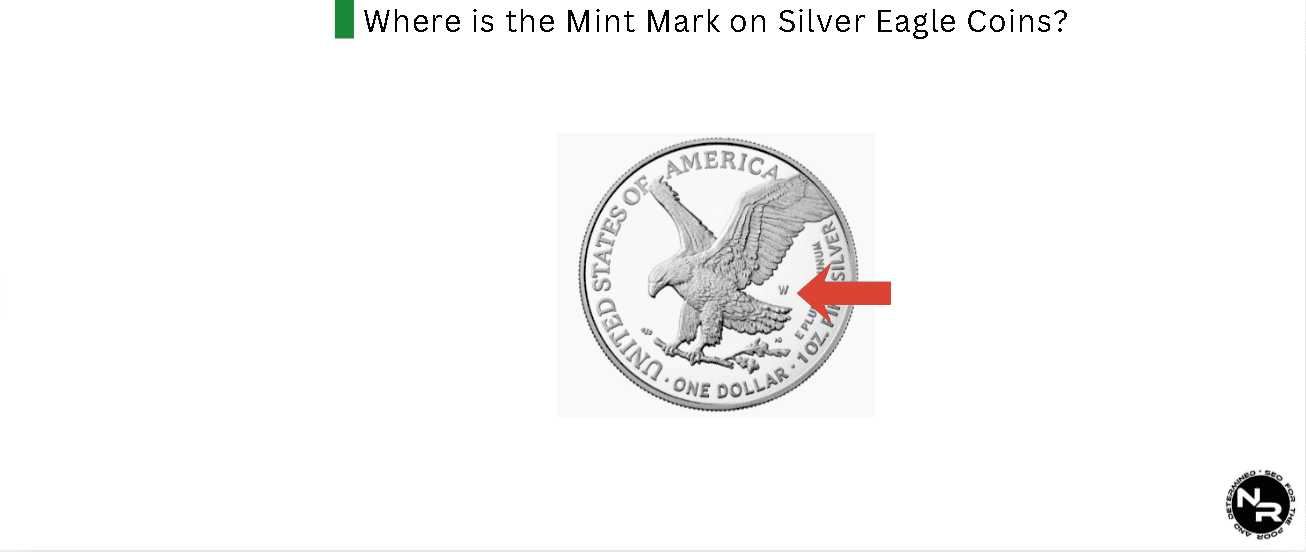
The mint mark on American Silver Eagle coins is on the reverse (tails) side, under the left talon of the eagle. However, mint marks only appear on special collector versions like Proof and Burnished coins.
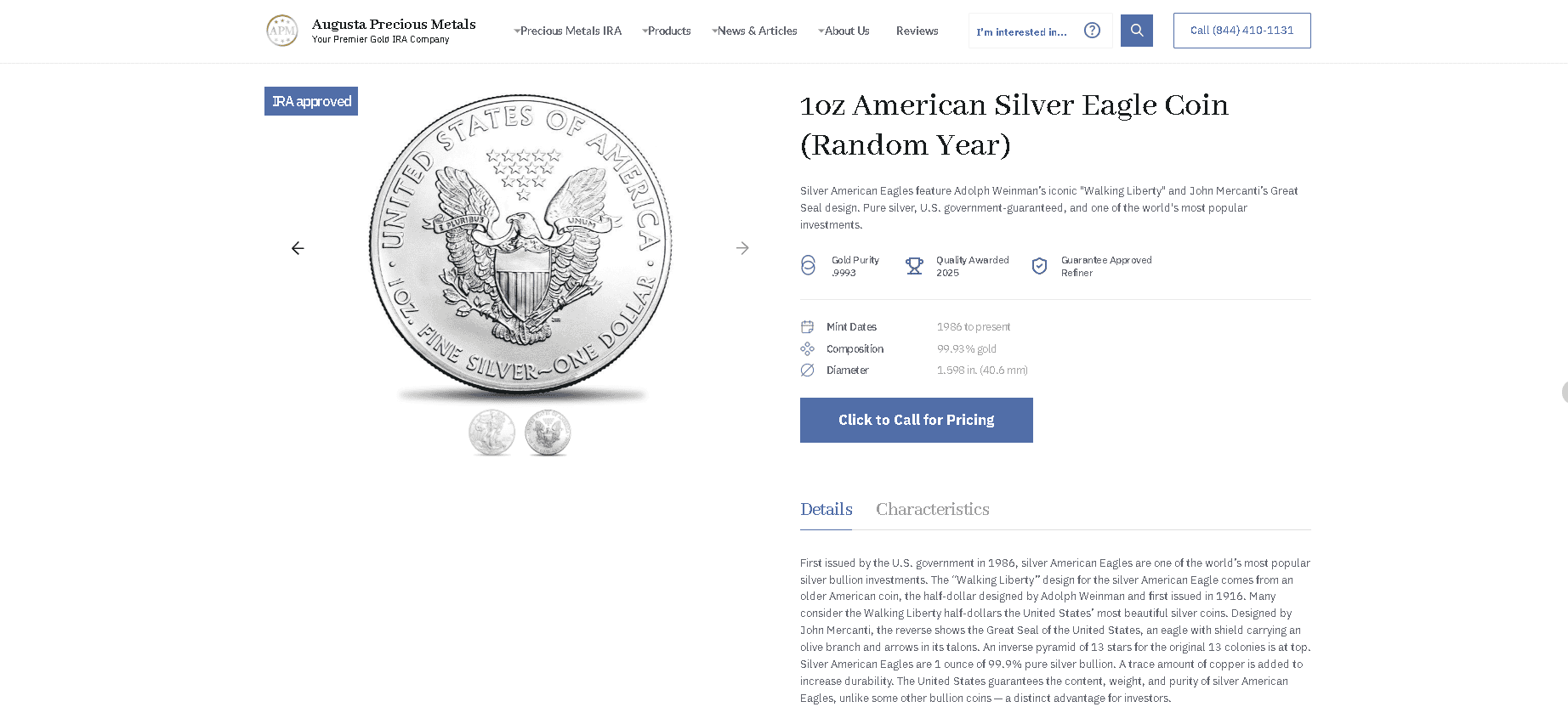
Bullion versions of Silver Eagle coins don’t have a mint mark (see example below).
Check this out next once you’re done reading my coin mint marks guide. Especially important if you’re an American citizen with a worry about the economy and a keen interest in precious metals and investing.
Where is the Mint Mark on Gold Eagle Coins?
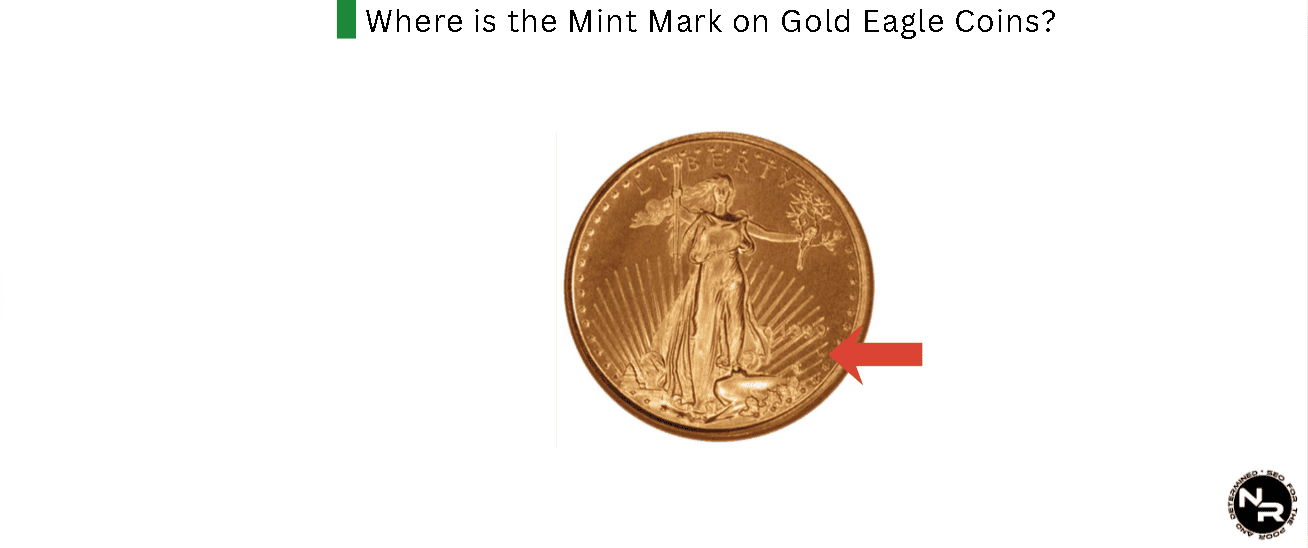
The “W” mint mark is located under the date on the reverse (tails) side of proof and non-circulated American Gold Eagle coins, signifying they were made at West Point Mint.
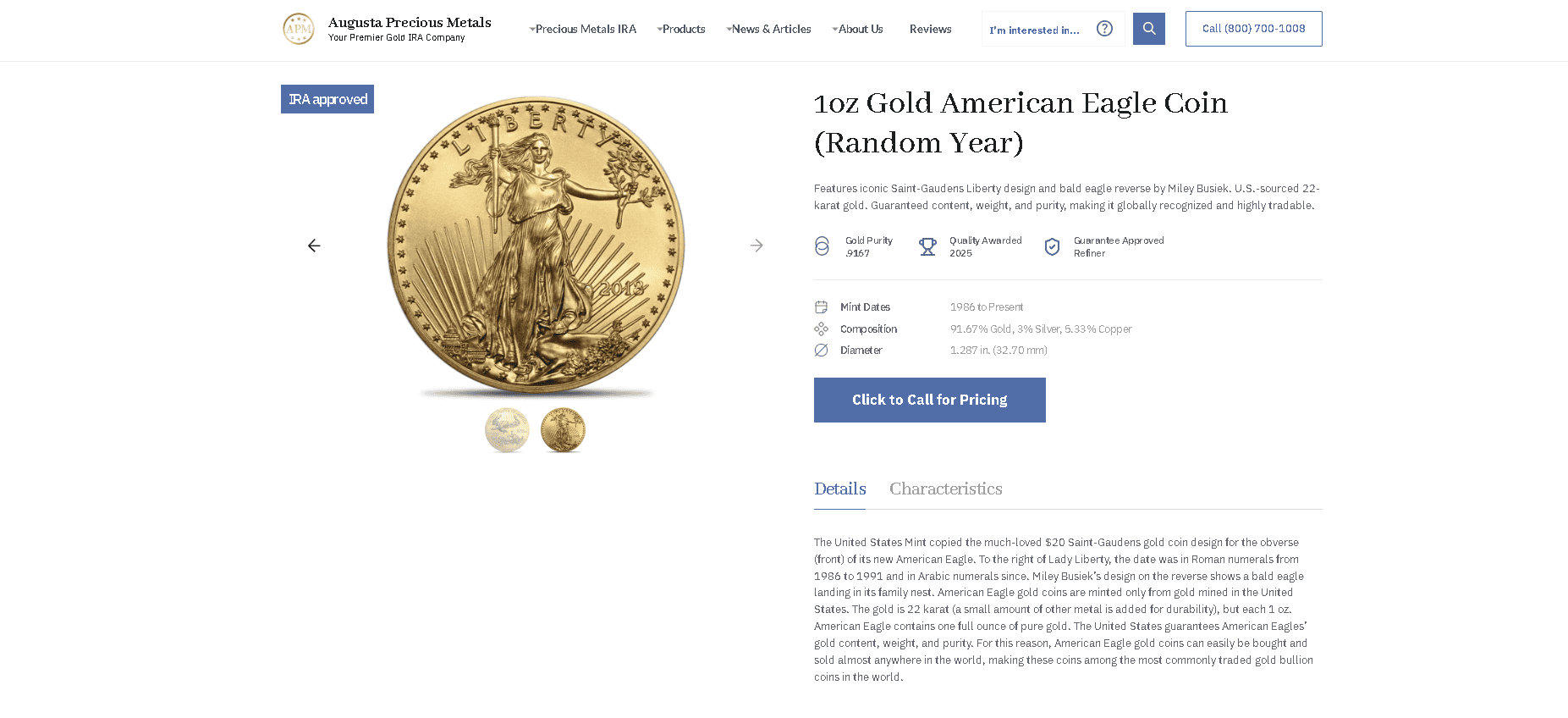
Standard bullion Gold Eagle coins often don’t have a mint mark.
Do Gold IRA Coins Have Different Coin Mint Marks than Regular Coins?
Yes, Gold IRA coins can have different mint marks than regular coins, depending on the specific mint and type of coin.
However, the mint mark itself doesn’t determine whether or not a coin is eligible for gold IRA account inclusion.
IRA-eligible coins must be produced by an accredited/certified refiner, assayer, manufacturer, or national government mint.
While specific mints and their marks are relevant, the most crucial factor for IRA eligibility is the coin’s composition, purity, and adherence to IRS rules.
Opening a gold IRA account is easy and fast if you go a with a legit US-based gold IRA company. I recommend this gold investment company for the task.
They waive all gold IRA fees for 10 years for their customers and no gold IRA scam will befall you if you work with them.

- What are the Mint Marks on Coins?- https://atkinsonsbullion.com/news/educational/what-is-a-mint-mark
- Coin Mint Marks- https://www.usmint.gov/learn/collecting-basics/mint-marks
- Coin Mint Marks Guide- https://en.wikipedia.org/wiki/Mint_mark
- Understanding Mint Marks on Coins: How They Affect Coin Value- https://shopglobalcoin.com/blogs/blog/understanding-mint-marks-on-coins-how-they-affect-coin-value
- MINT-MARKS- https://www.forumancientcoins.com/historia/mints/mints.htm
- Explaining Mint Marks – What Do They Mean and Why They Matter- https://thepatrioticmint.com/blog/explaining-mint-marks-what-do-they-mean-and-why-they-matter/
- 1849-C Open Wreath Gold Dollar Rarity Featured in November 2024 Showcase Auction- https://stacksbowers.com/1849-c-open-wreath-gold-dollar-rarity-featured-in-november-2024-showcase-auction/
- 1913-S 25C (Regular Strike)- https://www.pcgs.com/coinfacts/coin/1913-s-25c/5666
- https://ncmint.com/1870-cc-first-carson-city-dollar-tribute/
- Charlotte Mint- https://en.wikipedia.org/wiki/Charlotte_Mint
- Dahlonega Mint- https://en.wikipedia.org/wiki/Dahlonega_Mint
- Carson City Mint- https://en.wikipedia.org/wiki/Carson_City_Mint
- American Silver Eagle- https://en.wikipedia.org/wiki/American_Silver_Eagle
- Mint marks in error on American Eagle bullion coins- https://www.coinworld.com/news/precious-metals/mint-marks-in-error-on-bullion-coins.html
- 1970 Roosevelt Dime : A Collector’s Guide- https://coinweek.com/1970-roosevelt-dime-a-collectors-guide/
- 1922 Penny Value (Errors List, “D” & No Mint Mark Worth)- https://www.coinvaluechecker.com/how-much-is-a-1922-penny-worth/
- 1922 No D and Weak D Varieties- https://www.lincolncentresource.com/1922Ddievarieties.html
- Susan B. Anthony dollar- https://en.wikipedia.org/wiki/Susan_B._Anthony_dollar
- Presidential Dollar Values and Prices- https://www.thesprucecrafts.com/presidential-dollar-values-and-prices-4054277

Nikola Roza
Nikola Roza is the owner of Nikola Roza- Everything You Can Learn About Precious Metals. He writes for people who love precious metals and jewelry and who're interested in adding gold, silver platinum and palladium to their retirement portfolios. Nikola is passionate about gold IRAs and investing in multiple asset types for a safer financial future. He also runs a successful online jewelry store where you can buy precious metal jewelry and various replicas of famous coins and bars. Learn about Nikola here.